Common Data Migration Mistakes When Switching EHRs (and How to Avoid Them)

Common Data Migration Mistakes

Table of Contents

Introduction

Switching to a new Electronic Health Record (EHR) system is often a necessary step for healthcare organizations aiming to improve efficiency, compliance, and patient care. However, while the decision to upgrade or replace an EHR system may be strategic, the execution, especially data migration, is where things tend to go wrong.
EHR data migration is not just a technical task. It involves transferring sensitive patient data, preserving its accuracy, and ensuring compliance with strict US healthcare regulations. Even a small error during this process can lead to operational disruptions, financial losses, or compliance risks.
Understanding where organizations typically go wrong is the first step toward ensuring a successful transition.

Why EHR Data Migration Often Fails

EHR migration projects rarely fail because of one major mistake. Instead, they fail due to a combination of overlooked details and underestimated complexity.
Healthcare data is often stored in legacy systems that have evolved over years, sometimes decades. These systems may contain inconsistent formats, incomplete records, or redundant data. When this information is moved without proper evaluation, those issues are carried into the new system.
Additionally, migration efforts often suffer from a lack of coordination between teams. Clinical staff, administrators, and IT professionals may all have different expectations, and without alignment, the process becomes fragmented. When combined with tight timelines and limited expertise, the risk of failure increases significantly.
Common EHR Data Migration Mistakes

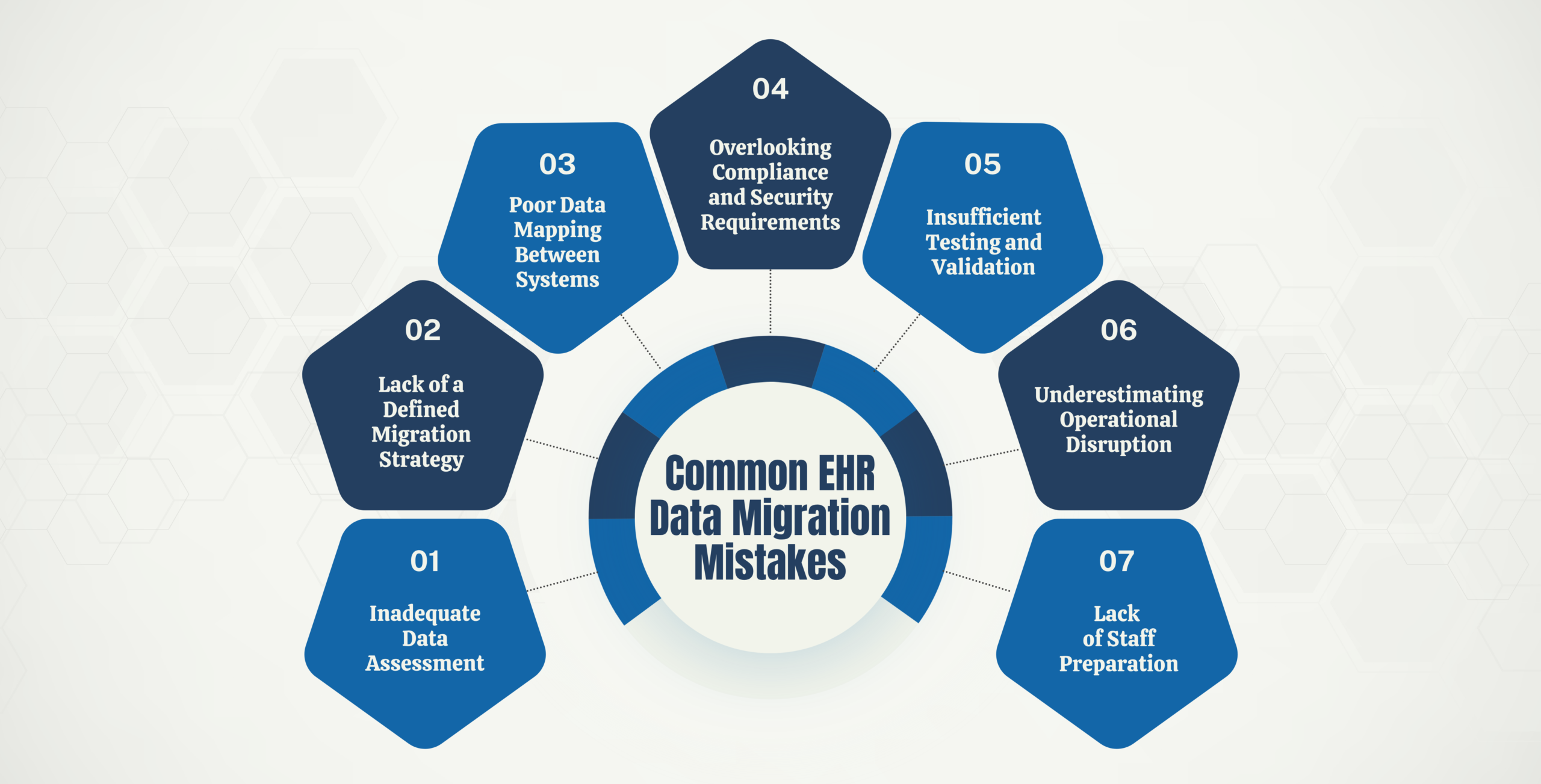
Common EHR Data Migration Mistakes

Inadequate Data Assessment

One of the most common issues is migrating data without first evaluating its quality. Over time, healthcare systems accumulate duplicate records, outdated information, and inconsistencies. Transferring this data without cleanup leads to inefficiencies in the new EHR and can negatively impact patient care.

Lack of a Defined Migration Strategy

Many organizations move forward without a structured plan, assuming the migration will be straightforward. However, without clearly defined steps, responsibilities, and timelines, the process quickly becomes disorganized. This lack of clarity often results in delays and avoidable errors.

Poor Data Mapping Between Systems

Different EHR systems structure data differently. If fields are not mapped accurately, critical information, such as medications or lab results, can be misplaced or misinterpreted. These errors may not be immediately obvious, but can create long-term risks.

Overlooking Compliance and Security Requirements

During migration, patient data must remain secure and compliant with regulations. When organizations prioritize speed over security, they may neglect essential safeguards. This can expose sensitive information and lead to serious legal consequences.

Insufficient Testing and Validation

Another frequent mistake is assuming that once the data is transferred, the job is complete. Without proper validation, errors can remain hidden within the system, affecting everything from clinical decisions to billing accuracy.

Underestimating Operational Disruption

Migration impacts daily workflows more than many organizations anticipate. When systems are unavailable or unfamiliar, productivity declines, and patient services may be delayed. Without proper planning, even short disruptions can have a ripple effect across the organization.

Lack of Staff Preparation

Technology alone does not guarantee success. If staff members are not properly trained, they may struggle to use the new system effectively. This can lead to frustration, inefficiencies, and increased chances of error.

How to Avoid These Mistakes

A successful EHR migration is built on preparation, precision, and continuous validation. Organizations that take a proactive approach are far more likely to achieve a smooth transition.
One of the most important steps is conducting a thorough data audit. By reviewing and cleaning existing data, organizations can ensure that only accurate and relevant information is transferred. This improves both system performance and usability.
Equally important is having a well-defined migration plan. This plan should outline every stage of the process, from data preparation to post-migration evaluation, ensuring that all stakeholders are aligned.
To further reduce risks, healthcare organizations should focus on the following:
When these elements are combined, the migration process becomes far more controlled and predictable.

EHR Migration Checklist

Phase Key Actions
Pre-Migration
Assess data quality, define migration goals, align stakeholders
Preparation
Clean and standardize data, finalize mapping structure
Execution
Transfer data securely, run pilot migration
Validation
Verify accuracy, test workflows, fix inconsistencies
Go-Live
Monitor system performance, support users
Post-Migration
Conduct audits, optimize system usage
Why the Right EHR Partner Matters

Why the Right EHR Partner Matters

Even with careful planning, EHR migration is a complex process that benefits greatly from expert support. The right EHR partner brings experience, technical knowledge, and proven methodologies that reduce risk and improve outcomes.
A strong partner can help organizations navigate challenges such as data mapping, compliance requirements, and system integration. More importantly, they provide structured guidance throughout the migration journey, ensuring that no critical step is overlooked.
When evaluating an EHR partner, healthcare organizations should look for:
  • Proven experience in EHR data migration and implementation.
  • Strong understanding of US healthcare compliance requirements.
  • End-to-end support, from planning to post-migration optimization.
  • Scalable solutions tailored to organizational needs.
Choosing the right partner is not just about technology; it’s about ensuring long-term success and stability.

Conclusion

EHR data migration is one of the most critical aspects of switching systems, and it comes with significant challenges. Mistakes such as poor planning, inadequate data assessment, and insufficient testing can have lasting consequences.

However, with a structured approach and the right expertise, these risks can be effectively managed. By focusing on data quality, validation, and team readiness, healthcare organizations can ensure a seamless transition that supports both operational efficiency and patient care.

Planning to Switch Your EHR System?

A smooth migration starts with the right strategy and the right partner. Maximus EHR helps healthcare providers transition with confidence, ensuring secure data migration, compliance, and minimal disruption – with ZERO migration fee.  Schedule a demo today and make your EHR transition simple, safe, and successful.

Switch Your EHR Without Risk or Disruption

Maximus EHR ensures secure, accurate data migration with zero downtime and full compliance. Book your free demo today.

FAQs

What are the biggest risks when switching EHR systems?
The biggest risks include data loss, inaccurate patient records, workflow disruptions, and compliance violations. These issues typically arise from poor planning, incorrect data mapping, or a lack of proper testing during migration. If not addressed, they can impact both patient care and operational efficiency.
How can healthcare providers ensure data accuracy during EHR migration?
Ensuring data accuracy starts with a thorough data audit before migration, followed by proper data mapping and multi-stage validation. Organizations should test the migrated data extensively and involve both technical teams and clinical staff to verify that all information is accurate, complete, and usable.
How long does an EHR data migration typically take?
The timeline for EHR migration varies depending on the size of the organization, the volume of data, and the complexity of the systems involved. Smaller practices may complete migration within a few weeks, while larger healthcare organizations can take several months to ensure proper planning, testing, and implementation.
Why is staff training important during an EHR transition?
Staff training is critical because even a perfectly executed migration can fail if users are not comfortable with the new system. Proper training helps healthcare professionals adapt quickly, reduces errors, and ensures that workflows remain efficient after the transition.
What should healthcare organizations look for in an EHR migration partner?
Healthcare organizations should look for a partner with proven experience in EHR migration, a strong understanding of compliance requirements, and the ability to provide end-to-end support. The right partner should not only handle the technical aspects but also guide strategy, minimize risks, and ensure a smooth transition.