Clinical Decision Support Systems (CDSS): How EHRs Assist Providers in Real Time

Clinical Decision Support Systems (CDSS) How EHRs Assist Providers in Real Time
In today’s fast-moving healthcare environment, providers are expected to process enormous volumes of patient data while making split-second decisions that directly impact lives. Clinical Decision Support Systems (CDSS) have emerged as one of the most powerful tools in modern medicine, working seamlessly within Electronic Health Records (EHRs) to deliver real-time, evidence-based guidance exactly when clinicians need it most.
Whether it’s flagging a dangerous drug interaction, reminding a physician of preventive care guidelines, or alerting a nurse to a critical lab value, CDSS quietly works in the background to make care safer, smarter, and more consistent.

What Is a Clinical Decision Support System (CDSS)?

A Clinical Decision Support System (CDSS) is a health information technology application that analyzes patient data to assist healthcare providers in making informed, evidence-based clinical decisions. Unlike static reference tools, a CDSS actively integrates with clinical workflows, pulling real-time data from the EHR and generating context-specific recommendations, alerts, and reminders.
According to ForeSee Medical, clinical decision support is defined as any health information system that delivers the right information to the right people, through the right channels, in the right formats, at the right points in the clinical workflow. In short, CDSS does not replace clinical judgment; it enhances it.

How CDSS Integrates With EHRs

The real power of CDSS is unlocked when it is tightly integrated with an EHR. Research published in the Journal of Medical Internet Research (2025) identifies three primary channels through which CDSS accesses and inputs data:
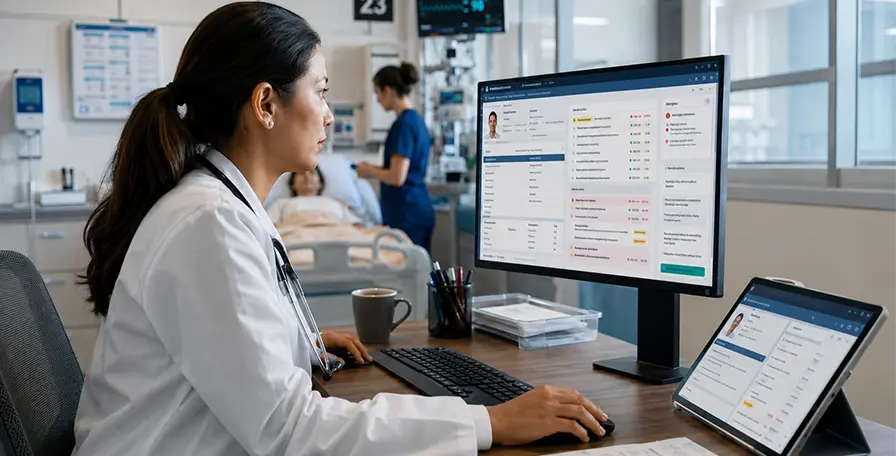
When CDSS is embedded within an EHR, as with Maximus EHR, providers do not need to switch between systems. Alerts, reminders, and recommendations appear naturally within the documentation and ordering workflow.
Core Functions of CDSS in Real-Time Care

Core Functions of CDSS in Real-Time Care

Modern CDSS platforms perform three broad categories of functions, all delivered in real time:

Information Delivery

Provides clinicians with immediate access to current clinical guidelines, drug databases, and evidence-based pathways, without leaving the patient encounter screen.

Patient-Specific Recommendations

Generates personalized alerts tailored to the individual patient’s data. For example, dosage adjustments for a patient with renal insufficiency, or reminders for overdue immunizations based on age and medical history.

Workflow Integration

Ensures that decision support is embedded directly into clinical tasks, ordering medications, documenting diagnoses, or reviewing lab results, so insights are actionable without disrupting care.

Types of Clinical Decision Support

CDSS solutions come in several forms, each designed to support different aspects of clinical decision-making:
v

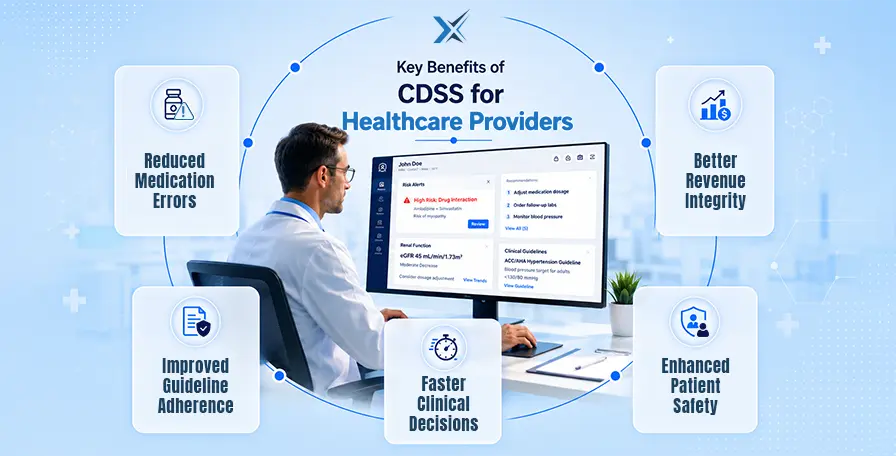
Key Benefits of CDSS for Healthcare Providers

The integration of CDSS into EHRs delivers measurable improvements across patient safety, clinical efficiency, and practice performance:CDSS solutions come in several forms, each designed to support different aspects of clinical decision-making:

CDSS Market Growth & Statistics

The global demand for clinical decision support is accelerating, reflecting healthcare’s growing reliance on intelligent, data-driven tools:
Metric Value / Source
Global CDSS market size (2024)
$5.79 billion Grand View Research
Projected market size (2030)
$10.71 billion Grand View Research
Annual growth rate (CAGR 2025–2030)
11.0%
North America market share (2024)
43.10%
Drug allergy alert market share (2024)
>26% Future Market Insights
Reduction in medication errors with CDSS
Up to 55% NCBI (2024)
Studies reporting quality assurance benefits
69% Interact J Med Res (2024)

Challenges and Considerations

While the benefits are well-established, healthcare organizations must also navigate real implementation challenges:

Alert Fatigue

One of the most cited risks of CDSS is alert fatigue, when providers receive so many notifications that they begin ignoring them, including critical ones. Effective platforms minimize this by making alerts contextual, prioritized, and customizable to the practice’s needs.

Interoperability

Standalone CDSS tools that do not connect to the EHR limit their own usefulness. True value is only realized when decision support is embedded within the clinical workflow using live patient data.

Data Completeness

Real-time CDSS depends on structured, timely data entry. If clinical data is incomplete or entered late, the system may not trigger relevant alerts, underscoring the importance of thorough EHR documentation practices.

How Maximus EHR Powers Clinical Decision Support

At Maximus EHR, clinical decision support is not an add-on; it is built into the fabric of the platform. Here is how Maximus EHR delivers smarter, safer care:

Maximus EHR Feature How It Supports Clinical Decisions
Smart AI Alerts
Real-time, AI-powered notifications embedded in the provider workflow, no extra clicks or screens.
Customizable Decision Rules
Practices tailor alert thresholds and recommendations to their patient population and specialty.
Medicare & Billing Integration
CDSS alerts aligned with documentation requirements reduce coding errors and revenue leakage.
HIPAA-Compliant Communication
Patient-specific decision support is delivered securely at every step.
Multi-Device Accessibility
Providers receive real-time guidance on phone, tablet, laptop, or desktop.
Priority-Based Task Management
Clinical alerts are surfaced by urgency so the most critical decisions are always front and center.
By combining intelligent decision support with an intuitive, customizable interface, Maximus EHR empowers providers to deliver consistent, evidence-based care without adding to their cognitive burden.

Conclusion

Clinical Decision Support Systems represent one of healthcare’s most significant advances in patient safety and clinical quality. When thoughtfully integrated into an EHR, CDSS functions as a silent, ever-present safety net, catching errors before they happen, surfacing evidence-based guidance, and helping providers deliver the right care to every patient, every time.
As the global CDSS market races toward $10.71 billion by 2030, the practices that invest in intelligent, EHR-integrated decision support today will be best positioned to meet tomorrow’s standards of care. With Maximus EHR, that future is already here.

See How Maximus Saves You Money

Explore an all-in-one EHR solution built to reduce software complexity, billing errors, and unexpected costs.

FAQs

What is a Clinical Decision Support System (CDSS) in healthcare?
A Clinical Decision Support System (CDSS) is a technology that analyzes patient data and provides healthcare providers with real-time, evidence-based recommendations, alerts, and reminders. It helps clinicians make informed decisions while improving patient safety and care quality.
How does CDSS work with an Electronic Health Record (EHR)?
CDSS integrates directly with an EHR to access patient information such as medical history, medications, allergies, lab results, and diagnoses. Using this data, it generates context-specific alerts and recommendations within the provider’s workflow, eliminating the need to switch between systems.
What are the main benefits of Clinical Decision Support Systems?
CDSS helps reduce medication errors, improve adherence to clinical guidelines, enhance patient safety, accelerate clinical decision-making, and support accurate documentation and billing. These benefits contribute to better patient outcomes and operational efficiency.
Can Clinical Decision Support Systems replace a healthcare provider's judgment?
No. CDSS is designed to support, not replace, clinical judgment. It provides evidence-based insights and alerts that help providers make more informed decisions, while the final treatment decisions always remain with the clinician.
How does Maximus EHR support Clinical Decision Support?
Maximus EHR includes built-in clinical decision support features such as AI-powered alerts, customizable decision rules, billing and documentation guidance, priority-based task management, and secure multi-device access. These tools help providers deliver safer, more consistent, and more efficient patient care in real time.

Table of Contents

Maximus | Electronic Health Record

Transform Your
Practice with
AI-Powered EHR

Reduce administrative burden, streamline workflows, accelerate revenue, and deliver exceptional patient care.