How Cloud EHRs Improve Disaster Recovery & Business Continuity

How Cloud EHRs Improve Disaster Recovery & Business Continuity

Why Disaster Recovery Matters in Healthcare

In healthcare, system downtime is never just an inconvenience; it can directly impact patient safety. When electronic health records (EHR) go offline, physicians lose access to patient histories, medication lists, lab results, and critical diagnostic data. The consequences can range from delayed treatments to life-threatening errors.
The financial impact is equally severe. Healthcare downtime can cost as much as $7,900 per minute, making it one of the most expensive disruptions any industry can face. Beyond financial loss, organizations risk HIPAA violations, reputational damage, and eroding patient trust.
That is why cloud EHR disaster recovery has become a non-negotiable priority for modern healthcare practices, from small clinics to large multi-specialty hospitals.

What Is Cloud EHR Disaster Recovery?

Cloud EHR disaster recovery (DR) refers to the policies, tools, and processes that enable a healthcare organization to rapidly restore full EHR access after a disruptive event, such as a cyberattack, natural disaster, server failure, or power outage.

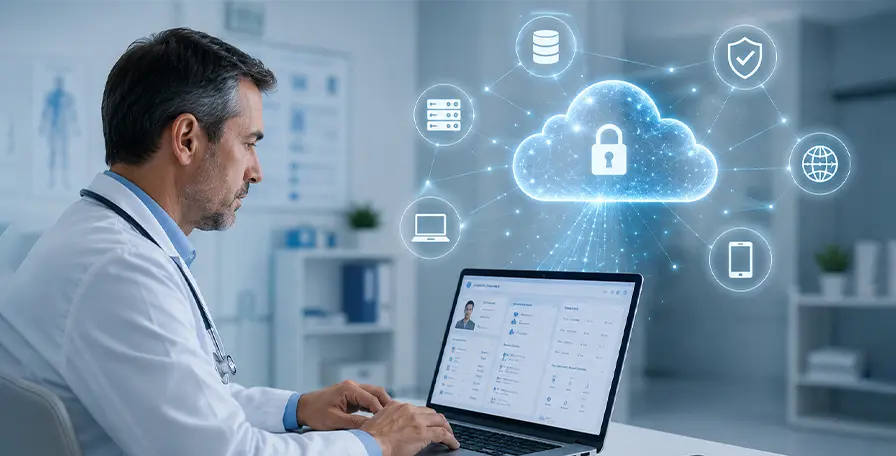
Unlike traditional disaster recovery, which relied on physical backups stored on-site or at off-site data centers, cloud-based DR keeps copies of your systems and data in secure, geographically distributed cloud environments. Recovery is driven by automation, prebuilt templates, and real-time replication, restoring services in minutes rather than days.

Business continuity, on the other hand, is the broader strategy that ensures healthcare operations keep running, or resume quickly, during and after any disruption. Disaster recovery is a core component of a strong business continuity plan.
Key Threats to EHR Uptime

Healthcare organizations face a wide range of threats that can disrupt EHR access:
How Cloud EHRs Improve Disaster Recovery

How Cloud EHRs Improve Disaster Recovery

Cloud-based EHR systems offer several powerful advantages over legacy on-premise solutions when it comes to disaster recovery and business continuity:

Automated Real-Time Data Replication

Cloud EHRs continuously replicate patient data to secondary servers in different geographic regions. If the primary server fails, the system automatically switches to a backup, often without any noticeable interruption.

Automated Failover

Manual recovery processes are slow and error-prone. Cloud EHR platforms use automated failover mechanisms that trigger instantly when a failure is detected, dramatically reducing downtime.

Geographically Distributed Backups

Unlike on-premise systems, where a single disaster (fire, flood) can wipe out all data, cloud systems store encrypted backups across multiple data centers in different locations.

Scalable Infrastructure

Cloud infrastructure can scale resources up or down based on demand, ensuring performance is not compromised during high-traffic recovery periods.

Remote Access During Downtime

Even if a clinic’s physical location is inaccessible, staff can access cloud-hosted EHRs from any internet-ready device, including phones, tablets, and laptops, from any location.

Continuous Testing and Monitoring

Cloud platforms support automated DR testing and 24/7 monitoring, allowing healthcare teams to verify their recovery processes regularly without disrupting live operations.

Understanding RTO and RPO in Healthcare

Two critical metrics define the effectiveness of any disaster recovery plan:
Metric Full Name Definition Healthcare Target
RTO
Recovery Time Objective
How quickly systems must be restored after a disruption
2–4 hours (ideal: under 1 hour)
RPO
Recovery Point Objective
Maximum acceptable amount of data loss, measured in time
Under 24 hours (ideal: near-zero)
  • RTO Example: If your RTO is 2 hours, your EHR must be fully restored and accessible within 2 hours of an outage.
  • RPO Example: If your RPO is 1 hour, your last backup must be no more than 1 hour old, meaning you can lose at most 1 hour of data.
Cloud EHR systems with real-time replication can achieve near-zero RPO, meaning virtually no data is ever lost. Automated failover drives RTO down to minutes, far beyond what any legacy on-premise system can deliver.

Cloud EHR vs. On-Premise EHR: A Comparison

Feature Cloud EHR On-Premise EHR
Disaster Recovery
Automated, multi-region
Manual, single location
Recovery Time (RTO)
Minutes
Hours to days
Data Loss Risk (RPO)
Near-zero (real-time sync)
High (daily backups)
Backup Storage
Geographically distributed
Single physical site
Remote Access
Any device, anywhere
Limited to local network
Scalability
On-demand
Fixed hardware
HIPAA Compliance
Built-in encryption & audit trails
Requires manual setup
Cost
Subscription-based, predictable
High upfront hardware cost
Maintenance
Vendor-managed
In-house IT required
Cyberattack Recovery
Automated rollback
Manual and slow
The contrast is clear: cloud EHR systems are built for resilience, while on-premise systems leave practices vulnerable to prolonged outages and irreversible data loss.

HIPAA Compliance and Cloud EHR Security

Disaster recovery and HIPAA compliance are deeply interconnected. Under the HIPAA Security Rule, healthcare organizations are required to:
  • Establish and test a contingency plan for EHR systems
  • Implement data backup procedures for all electronic Protected Health Information (ePHI)
  • Ensure emergency access procedures so authorized users can access ePHI during emergencies
  • Maintain disaster recovery plans that address how systems will be restored
Cloud EHR systems address all of these requirements through:
  • End-to-end encryption of data in transit and at rest
  • Role-based access controls that restrict ePHI access to authorized personnel
  • Audit trails that log all data access and modifications
  • Automated compliance documentation to simplify regulatory audits
  • Secure off-site backups aligned with HIPAA storage standards
Failing to maintain a proper disaster recovery plan is not just a technical risk; it is a compliance risk that can result in significant HIPAA penalties.
How Maximus EHR Protects Your Practice

How Maximus EHR Protects Your Practice

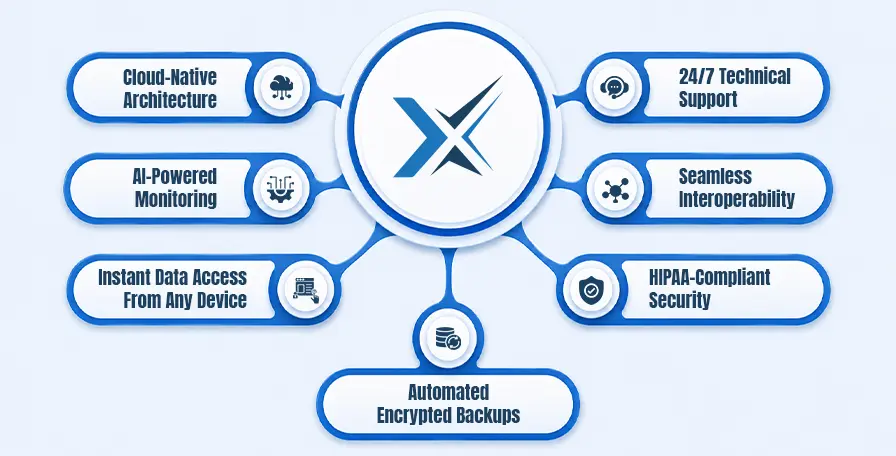
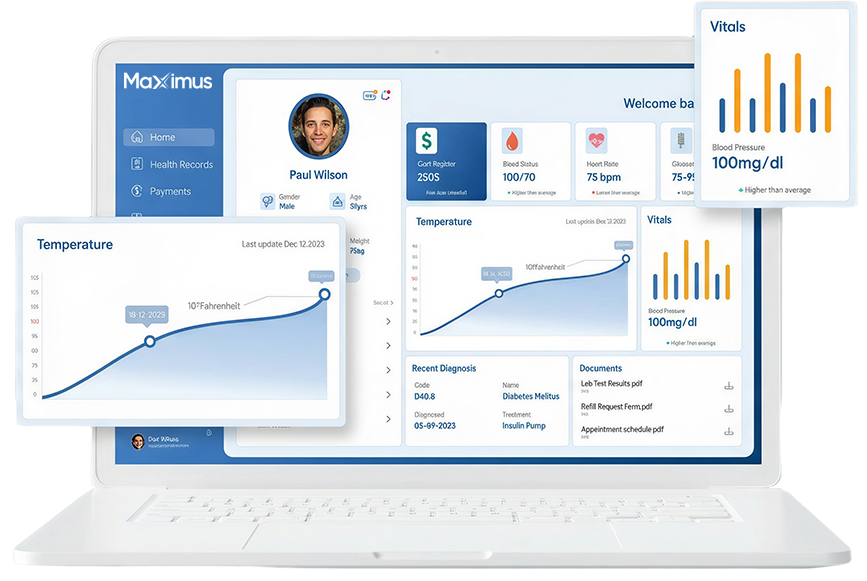
Maximus EHR is built with disaster recovery and business continuity at its core. As a fully cloud-based, AI-powered electronic health record system, Maximus EHR ensures that your practice never has to face the catastrophic consequences of prolonged downtime.

Here is how Maximus EHR strengthens your disaster recovery posture:
With Maximus EHR, practices benefit from enterprise-grade disaster recovery without the enterprise-level IT overhead, making it the ideal solution for independent clinics and specialty practices alike.

Best Practices for EHR Business Continuity

Even with a robust cloud EHR like Maximus, healthcare organizations should follow these best practices to strengthen their overall business continuity strategy:

Conclusion

The shift to cloud-based EHR systems represents one of the most important steps a healthcare practice can take to protect itself from disruption. With automated failover, real-time replication, geographic redundancy, and HIPAA-compliant security, cloud EHRs like Maximus EHR deliver the disaster recovery capabilities that modern healthcare demands.
In an era where cyberattacks are rising, natural disasters are unpredictable, and patient expectations are higher than ever, your practice cannot afford to rely on outdated, manual disaster recovery systems. The cost of unpreparedness in dollars, compliance penalties, and patient trust is simply too high.
Maximus EHR gives your practice the resilience, confidence, and continuity it needs to keep delivering exceptional care, no matter what disruptions come your way.

Protect Your Practice with Cloud EHR

Discover how Maximus EHR keeps patient data secure, accessible, and recoverable during emergencies.

FAQs

What is cloud EHR disaster recovery?
Cloud EHR disaster recovery refers to the systems and processes that help healthcare organizations quickly restore access to electronic health records after disruptions such as cyberattacks, server failures, natural disasters, or power outages. It uses cloud-based backups, real-time replication, and automated failover to minimize downtime and data loss.
How do cloud EHRs reduce downtime during emergencies?
Cloud EHRs reduce downtime through automated failover, geographically distributed backups, and real-time data replication. If one server or region fails, the system automatically switches to a backup environment, allowing providers to continue accessing patient records with minimal interruption.
What is the difference between RTO and RPO in healthcare disaster recovery?
RTO (Recovery Time Objective) measures how quickly systems must be restored after an outage, while RPO (Recovery Point Objective) measures how much data loss is acceptable. Cloud EHR systems typically achieve lower RTO and near-zero RPO compared to traditional on-premise systems.
Are cloud EHR systems HIPAA compliant?
Yes, most modern cloud EHR systems are designed to support HIPAA compliance through features like end-to-end encryption, audit trails, role-based access controls, secure off-site backups, and emergency access procedures for electronic protected health information (ePHI).
Why is business continuity important for healthcare practices?
Business continuity ensures that healthcare providers can continue delivering patient care during disruptions such as cyberattacks, natural disasters, or system failures. A strong continuity plan protects patient safety, reduces financial losses, maintains compliance, and preserves patient trust.

Table of Contents

Maximus | Electronic Health Record

Transform Your
Practice with
AI-Powered EHR

Reduce administrative burden, streamline workflows, accelerate revenue, and deliver exceptional patient care.