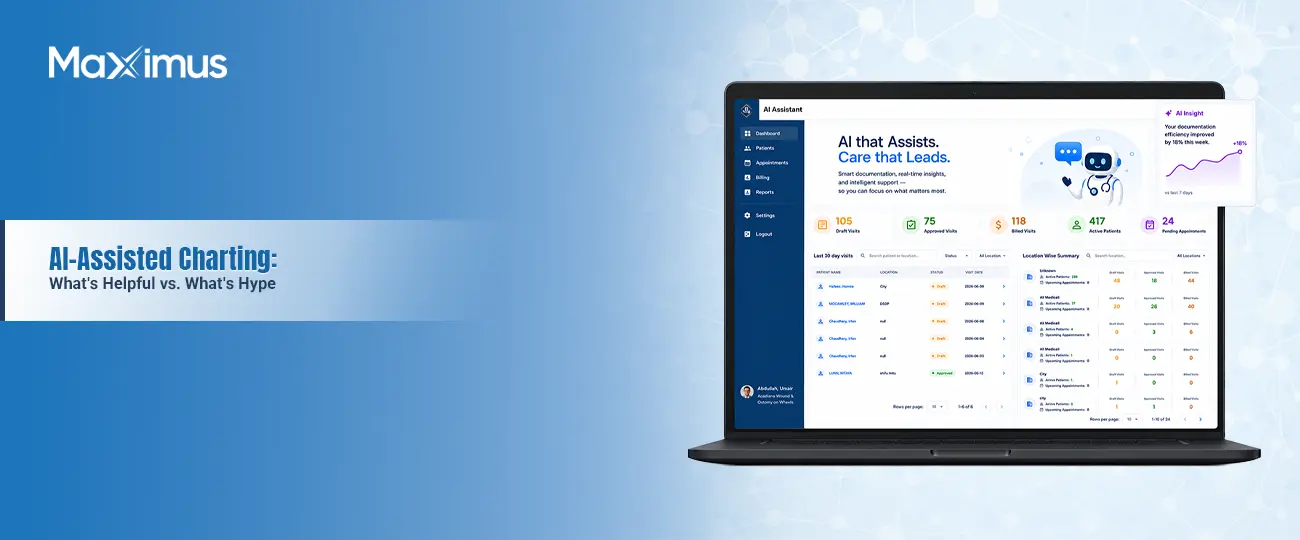
AI-Assisted Charting: What’s Helpful vs. What’s Hype

AI-Assisted Charting Helpful Tools vs Hype

Introduction

Every healthcare conference in 2026 features at least one vendor promising that AI will “eliminate documentation forever.” Physicians scrolling their social feeds see headlines about ambient scribes that never miss a word, AI systems that auto-code with perfect accuracy, and decision-support engines that diagnose better than doctors. Some of it is real. A lot of it isn’t. This guide cuts through the noise for clinicians, practice managers, and healthcare IT leaders. Get a clear-eyed view of where AI-assisted charting delivers, where it falls short, and how to choose technology that helps rather than hypes.

The Documentation Burden Problem

Before evaluating any AI solution, it helps to understand the scale of the problem it’s meant to solve. Clinical documentation has quietly become one of healthcare’s biggest crises, not because it’s unimportant, but because it consumes an unsustainable proportion of physician time.

Key Statistics:

  • For every 15 minutes spent with patients, physicians spend an average of 9 minutes charting. (Sources)
  • 42% of U.S. physicians report burnout symptoms (AMA, 2026)
  • 68% of physicians increased AI use for documentation in 2025 (Sources)
  • AI scribes can reduce charting time by up to 75%
Documentation is now the number-one driver of physician burnout, ranking above bureaucratic red tape and difficult patients alike. Physicians regularly spend two hours on paperwork for every hour of direct patient care, a pattern that erodes both clinical performance and personal well-being.

What Actually Works: Proven AI Charting Benefits

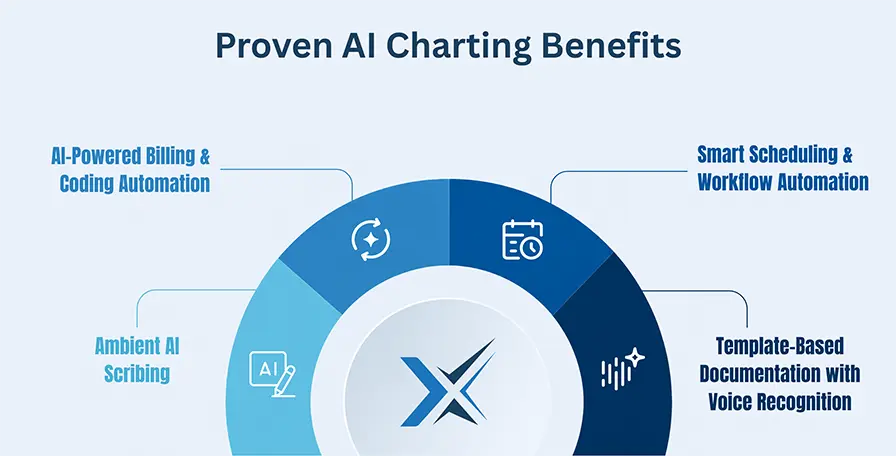
Amid the marketing noise, several AI charting capabilities have now accumulated enough real-world evidence to be considered genuinely useful.

Ambient AI Scribing:

Ambient AI scribes listen to patient-physician conversations and automatically generate draft clinical notes. A 2025 randomized trial published in NEJM AI (UCLA Health) found that AI scribes meaningfully reduced per-note documentation time and produced modest but real improvements in physician burnout scores and cognitive workload. The Permanente Medical Group saved over 15,000 physician hours after 2.5 million AI-scribed encounters in a single year.

AI-Powered Billing & Coding Automation:

Revenue cycle AI, which auto-suggests diagnosis codes, identifies billing errors before submission, and predicts claim denials, has demonstrated consistent ROI across practice sizes. Leading EHR platforms report up to 98% first-pass claim acceptance rates when AI coding tools are properly implemented.

Smart Scheduling & Workflow Automation:

AI scheduling tools that optimize appointment slots, send automated reminders, and flag no-show risks have reliably reduced administrative overhead, with practices reporting shorter wait times and improved patient throughput.

Template-Based Documentation with Voice Recognition:

AI-assisted voice-to-text and customizable specialty-specific templates have proven effective at accelerating note creation, especially for primary care, urgent care, and behavioral health.

Proven Benefits at a Glance:

  • Ambient scribing reduces per-note time and after-hours “pajama time” charting.
  • AI billing tools cut claim denials and catch coding errors pre-submission.
  • Voice recognition with smart templates speeds up specialty-specific documentation.
  • 69% of small-practice clinicians who use AI tools report a lower administrative burden (Freed, 2025).
Proven AI Charting Benefits

What's Still Hype: Overpromised AI Claims

Not every AI promise holds up under scrutiny. Several widely marketed capabilities either lack sufficient evidence or carry significant implementation risks.

AI Will Eliminate Charting:
No current AI tool eliminates documentation; it only reduces it. Physicians still review, edit, and sign every AI-generated note. Errors in ambient transcription can introduce clinical risk if left unchecked. AI augments the physician; it does not replace clinical judgment.

Fully Autonomous Clinical Decision Support:
AI that claims to “diagnose” patients independently remains overhyped for general clinical settings. Decision support tools are most valuable as suggestion engines, not autonomous diagnosticians. Overreliance on AI recommendations without physician verification has been flagged as a key risk in peer-reviewed literature.
Zero Implementation Effort:
Vendors who promise seamless, plug-and-play AI charting rarely account for the change management, staff training, workflow adjustments, and EHR integration required. Practices that rush deployment without adequate support often see lower adoption and reduced benefit.
Hype Warning Signs:
  • AI does not eliminate charting — physicians must still review and validate every note
  • Fully autonomous AI diagnosis is not clinically safe or validated for routine use
  • AI accuracy varies significantly across specialties and documentation styles
  • Rapid AI deployment without training increases errors, not reduces them
  • Not all AI “integrations” are true EHR integrations — some require duplicate data entry

Helpful vs. Hype: Side-by-Side Comparison

AI Feature Verdict Evidence Level Notes for Clinicians
Ambient AI Scribing
✓ Helpful
High (RCT-validated)
Review every note; accuracy varies by accent and specialty
AI Billing & Coding
✓ Helpful
High (real-world data)
Significant ROI; reduces claim denials and rework
Voice-to-Text Documentation
✓ Helpful
High (widely proven)
Best with specialty templates and structured workflows
AI Smart Scheduling
✓ Helpful
Moderate–High
Reduces no-shows and admin load consistently
AI Decision Support (suggestions)
⚡ Mixed
Moderate
Useful as guidance; not for autonomous clinical decisions
AI Predictive Health Risk
⚡ Mixed
Moderate
Promising but still evolving; specialist-dependent
Eliminate Charting” Claims
✗ Hype
No clinical evidence
AI reduces, not eliminates, documentation burden
Fully Autonomous AI Diagnosis
✗ Hype
Not validated
Carries patient safety risks without physician oversight
Instant, Zero-Effort AI Setup
✗ Hype
No evidence
All EHR AI requires training, workflow design, and support

How to Choose the Right AI Charting Tool

With dozens of vendors competing for attention, selecting the right AI charting solution requires more than comparing feature lists.

AI Charting Evaluation Checklist:

The most important question to ask any AI vendor is simple: Can you show me peer-reviewed evidence or real-world outcome data from practices similar to mine? Reliable vendors will answer with data. Hype-driven vendors will answer with demos.

How Maximus EHR Delivers Real AI Value

Maximus EHR was built on a simple premise: AI should reduce physician burden, not add to it. Every AI feature in the Maximus platform is designed around clinical workflow — not technology for technology’s sake.

Maximus EHR Feature What It Does Real Benefit
AI-Powered Voice Documentation
Converts spoken notes into structured clinical text in real time
Faster charting; less after-hours documentation
Smart Billing Automation
Auto-suggests ICD/CPT codes and catches claim errors pre-submission
Higher first-pass acceptance rates; reduced revenue leakage
75+ Specialty Templates
Customizable charting workflows for 75+ medical specialties
Documentation fits clinical reality, not generic forms
AI Decision Assistance
Surfaces relevant clinical insights and treatment suggestions
Supports physician judgment without replacing it
One-Click Record Sharing
Securely transmits patient records across providers instantly
Eliminates manual coordination; improves care continuity
24/7 Technical Support
Round-the-clock EHR, billing, and AI support
Ensures uptime and smooth adoption for every practice size
Maximus EHR doesn’t promise to replace clinical judgment. Instead, it places AI exactly where it belongs, handling the administrative work so physicians can focus entirely on the patient in front of them.

Conclusion

AI-assisted charting has crossed a meaningful threshold: it is no longer just a promise on a product roadmap. Ambient scribing, intelligent billing automation, voice-to-text documentation, and smart scheduling have all demonstrated real-world value for practices willing to implement them thoughtfully. The gap between “helpful” and “hype” comes down to one thing: whether an AI tool is built around the actual constraints of clinical practice or built around a marketing pitch.
As you evaluate AI charting solutions, demand evidence, not just demos. Ask hard questions about accuracy, integration depth, HIPAA compliance, and specialty fit. Look for vendors who acknowledge what AI cannot do, not just what it can. And make sure every tool you adopt keeps the physician firmly in control.
The best AI charting technology doesn’t try to be a doctor. It tries to give doctors their time back.

Ready to see AI charting that actually works?

Discover how Maximus EHR uses practical AI tools to reduce admin burden, support clinical workflows, and give providers more time for patient care.

FAQs

What is AI-assisted charting in healthcare?
AI-assisted charting uses artificial intelligence to help healthcare providers create clinical documentation faster and more efficiently. It can transcribe conversations, suggest codes, populate templates, and streamline administrative tasks while keeping clinicians in control of the final note.
Can AI completely replace physician documentation?
No. Current AI tools can significantly reduce documentation time, but physicians must still review, edit, and approve all clinical notes. AI is designed to support clinicians, not replace their judgment or responsibility.
How accurate are AI-powered medical scribes?
AI scribes can be highly effective, but accuracy varies based on factors such as specialty, terminology, audio quality, and speaker accents. Providers should always review AI-generated notes before finalizing patient records.
What are the biggest benefits of AI charting software?
The most proven benefits include reduced documentation time, lower physician burnout, improved coding accuracy, fewer billing errors, faster workflows, and more time for patient care.
What should practices look for when choosing an AI charting solution?
Healthcare organizations should evaluate EHR integration, HIPAA compliance, specialty-specific support, physician review controls, interoperability, training resources, and real-world performance data before selecting an AI charting platform.

Table of Contents

Maximus | Electronic Health Record

Transform Your
Practice with
AI-Powered EHR

Reduce administrative burden, streamline workflows, accelerate revenue, and deliver exceptional patient care.