Preparing Your Practice for AI-Driven Healthcare – Starting With Your EHR

Preparing Your Practice for AI-Driven Healthcare – Starting With Your EHR

Introduction: AI Is Already in the Exam Room

Artificial intelligence in healthcare has moved past pilot programs and press releases. It’s now writing clinical notes, flagging at-risk patients before a crisis hits, and filling appointment slots that used to sit empty. The shift isn’t coming. It’s here.
For private practices and clinical groups, the question is no longer whether to adopt AI. It’s whether your current infrastructure can support it.
That’s where the EHR comes in. Every AI tool a practice adopts, from ambient scribes to predictive risk models, depends on clean, structured, accessible patient data. The EHR is the launchpad. A rigid, outdated system doesn’t just slow you down. It blocks AI adoption entirely, no matter how promising the tool.

Legacy EHR vs. AI-Driven EHR: A Side-by-Side Comparison

See exactly what separates yesterday’s software from tomorrow’s standard of care.
Metric Legacy EHR Capabilities AI-Driven EHR Capabilities
Data Entry Method
Manual typing, click-heavy templates
Ambient voice-to-charting auto-generated notes
Clinical Decision Support
Static alerts, generic rule sets
Context-aware, real-time predictive insights
Patient Engagement
Portal messaging, manual follow-ups
Automated outreach, personalized care reminders
Predictive Analysis
Retrospective reporting only
Forward-looking risk scoring and trend detection
Interoperability
Rigid, proprietary data silos
Open APIs, seamless cross-platform data exchange
Scheduling
Static calendars, manual overbooking fixes
Smart scheduling that predicts no-shows and optimizes slots

The Core AI Features Transforming the EHR

AI isn’t a single feature bolted onto your software. It’s a set of capabilities reshaping how clinicians work, hour by hour.

Ambient AI Medical Scribing

Voice-to-charting technology listens during the patient encounter and generates structured clinical documentation in real time. Physicians talk to their patients, not their keyboards.

Predictive Clinical Analytics

AI models scan patient histories, lab trends, and population data to flag risk before symptoms escalate. This turns the EHR from a passive record into an active clinical partner.

Smart Scheduling

AI-driven scheduling engines learn from historical no-show patterns, seasonal trends, and provider availability to optimize the calendar automatically.
The Risks of Inaction

The Risks of Inaction

Practices that delay modernization aren’t standing still. They’re falling behind, and the gap compounds every quarter.
None of these risks are hypothetical. They’re already showing up in staffing reports, patient satisfaction scores, and margin pressure across the industry.

Practical Roadmap: Preparing Your Practice for AI

Modernization doesn’t require ripping out your entire workflow overnight. It requires a clear, sequenced plan.
The Maximus EHR Advantage

The Maximus EHR Advantage

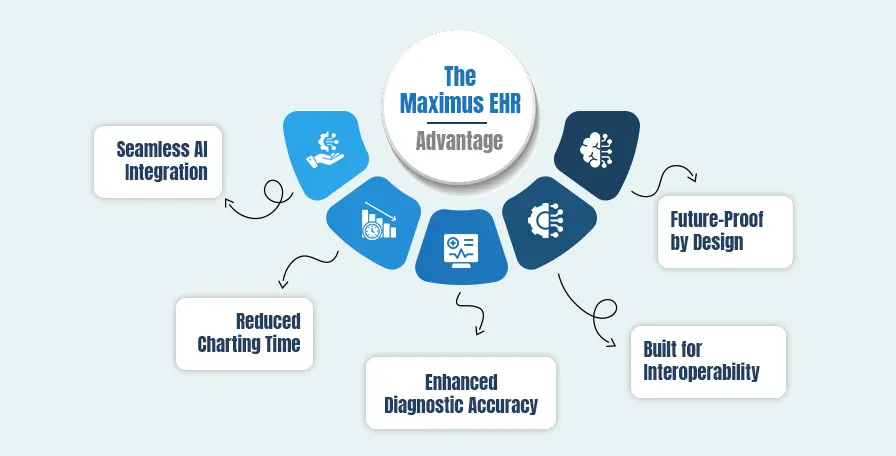
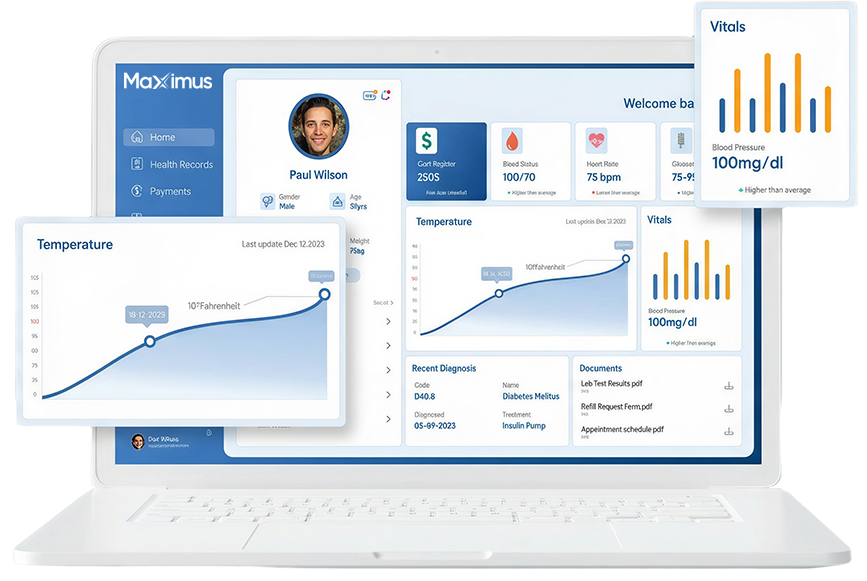
Maximus EHR was engineered for exactly this moment. While many legacy platforms are patching AI features onto outdated architecture, Maximus was built with AI-native infrastructure from day one.

Maximus EHR isn’t just keeping pace with AI-driven healthcare. It’s built to lead it, giving your practice a foundation that scales as the technology matures.

Book Your Personalized Demo

AI-driven healthcare is no longer a future trend. It’s the new standard, and the practices that prepare now will define the next decade of patient care.

Your EHR is the foundation everything else is built on. Make sure it’s ready.

Book a personalized demo of Maximus EHR today and see exactly how AI-ready charting, predictive analytics, and smart scheduling can transform your practice, without disrupting the workflows your team already trusts.

Future-proof your practice. Start with Maximus EHR.

Explore how AI-powered charting, predictive insights, and smart scheduling can transform your practice without disrupting your existing workflow.

FAQs

What is an AI-driven EHR?
An AI-driven Electronic Health Record (EHR) uses artificial intelligence to automate routine tasks, provide predictive clinical insights, improve documentation, optimize scheduling, and support better decision-making. Unlike traditional EHRs, AI-powered systems help clinicians save time while enhancing patient care.
How does AI improve clinical documentation?
AI-powered ambient medical scribing can listen to patient-provider conversations and generate structured clinical notes in real time. This reduces manual data entry, minimizes after-hours charting, improves documentation accuracy, and allows providers to focus more on patients than screens.
Can small and mid-sized medical practices benefit from AI-powered EHRs?
Yes. AI is no longer limited to large healthcare organizations. Small and mid-sized practices can use AI-driven EHRs to reduce administrative workload, improve scheduling efficiency, identify high-risk patients earlier, and streamline daily operations without significantly changing existing workflows.
Is an AI-powered EHR HIPAA compliant?
An AI-powered EHR can be HIPAA compliant if it includes strong security measures such as data encryption, role-based access controls, audit logs, and secure data handling practices. Healthcare organizations should always choose vendors that prioritize regulatory compliance and patient data security.
How can a practice prepare for AI adoption in healthcare?
The best way to prepare is by ensuring your EHR is AI-ready. Practices should improve data quality, evaluate current workflow bottlenecks, train staff on new technologies, strengthen cybersecurity measures, and choose an EHR platform that supports seamless AI integration and future scalability.

Table of Contents

Maximus | Electronic Health Record

Transform Your
Practice with
AI-Powered EHR

Reduce administrative burden, streamline workflows, accelerate revenue, and deliver exceptional patient care.