How Maximus EHR Supports Growth Without System Overhauls

How Maximus EHR Supports Growth Without System Overhauls

Growth should be a milestone rather than an added hassle. Yet for most practices, adding a provider, opening a second location, or launching a new specialty line triggers the same dreaded question: “Can our EHR even handle this?” Maximus EHR was built so the answer is always yes – no rip-and-replace, no six-figure re-implementation, no downtime.

Introduction: The High Stakes of Practice Expansion

Expansion is supposed to be a growth story. For too many practices, it becomes a cautionary tale instead.
A new provider joins. A second location opens. A specialty line launches. And suddenly, the EHR that once felt reliable reveals its ceiling. Legacy systems weren’t built to flex; they were built to run one practice, at one size, indefinitely.
That rigidity has a price tag. Rip-and-replace overhauls routinely cost practices tens of thousands of dollars in licensing, migration, retraining, and lost productivity, before a single new patient is seen. Worse, the operational disruption during the transition often erodes the very revenue growth it was supposed to generate.

Maximus EHR eliminates that trade-off. Built as a modular, cloud-native platform from the ground up, it treats growth as a configuration change, not a construction project. Add a provider. Open a clinic. Launch a specialty. The infrastructure was already built to absorb it.
The Nightmare of Legacy EHR Overhauls

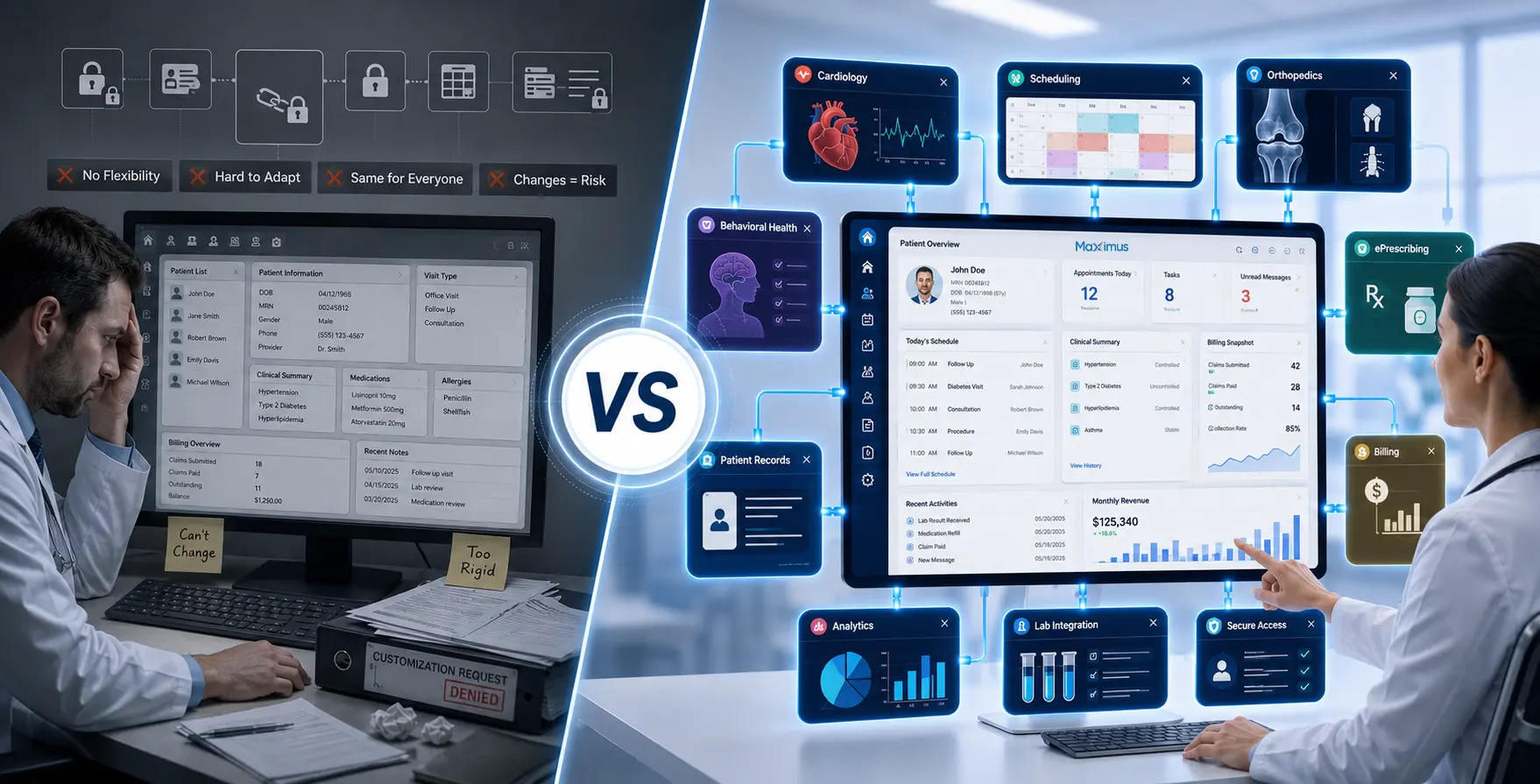
Legacy, server-bound EHR systems weren’t designed with scale in mind, and the bottlenecks show up exactly when a practice can least afford them.
Each of these bottlenecks compounds. A practice that wants to double in size within 18 months can find its EHR infrastructure costs tripling, while its staff drowns in workaround processes.
Modular Customization vs One Size Fits All

Modular Customization vs. One-Size-Fits-All

Maximus EHR is built around modularity, not a monolith. The core platform – scheduling, charting, billing, patient records stays intact and stable no matter how the practice evolves. Growth is handled by activating new components on top of that stable core.
This is the practical difference between a system that bends to fit new specialties and one that must be rebuilt to accommodate them.

Cloud-Native Infrastructure: Growing Without Hardware Friction

Maximus EHR runs on true cloud-native infrastructure, not a legacy system with a web login bolted on. That distinction has real financial and operational weight.
Traditional, server-bound systems ask a practice to predict its future capacity needs years in advance and build for them. Cloud-native infrastructure removes that guesswork entirely.

Scalability Showdown: Legacy EHR Overhauls vs. Maximus Scalability

Growth Metric Legacy EHR Overhaul Maximus EHR Scalability
Adding New Providers/Users
Manual license procurement, per-seat contract renegotiation, IT provisioning delays
Instant seat activation in the cloud dashboard, no hardware provisioning
Opening Multi-Site Locations
New server stack or VPN tunnel per site; siloed local databases
Single unified cloud instance, new locations sync instantly, zero duplication
Incorporating New Specialties
Custom development request, months-long vendor backlog, added licensing tier
Pre-built specialty modules and templates activated on demand
Data Server Maintenance
On-site server hardware, IT staff, scheduled downtime for patches
Fully managed cloud infrastructure, maintenance is invisible to staff
System Downtime During Upgrades
Planned outages, appointment rescheduling, lost billing hours
Rolling cloud updates with zero patient-facing downtime
Data Migration Between Systems
Costly third-party migration vendors, data-loss risk
Not applicable, no migration needed, ever

Unified Interoperability for Multi-Site Expansion

Opening a second or third location is where most legacy EHRs fail practices hardest. Maximus EHR was built specifically to make multi-site growth operationally seamless.

The result: a practice can open a new location and have it fully operational, clinically and financially integrated with the rest of the organization, from day one.
The Financial Logic of Future Proofing

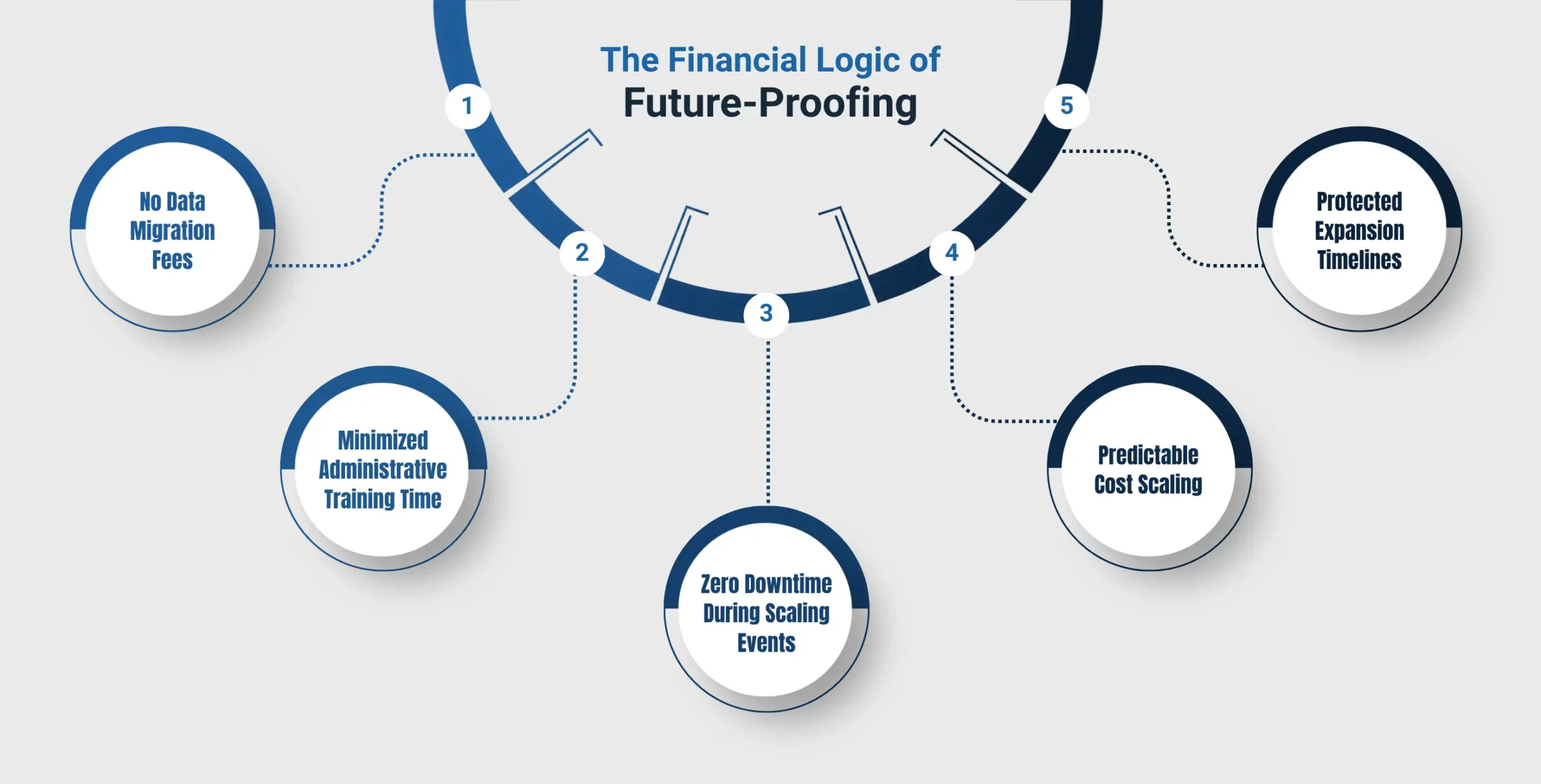
The Financial Logic of Future-Proofing

Choosing a scalable EHR isn’t just an operational decision; it’s a margin-protection strategy.
Every dollar not spent on emergency infrastructure work is a dollar available for clinical staff, equipment, or marketing – the things that actually drive growth.

Call to Action: Build Your Growth Launchpad

Expansion shouldn’t come with an asterisk. Every new provider, every new location, every new specialty should move your practice forward, not force a system overhaul that eats the very revenue you’re chasing. Maximus EHR is built to be the operational launchpad for that growth: modular, cloud-native, and ready to scale the moment you are.

Book a personalized, scalability-focused demo today and see exactly how Maximus EHR can support your next phase of expansion, without the tech headaches, the hidden costs, or the downtime.

Build Your Growth Launchpad

See how Maximus EHR can support your next phase of growth with scalable cloud infrastructure, modular workflows, multi-site support, and no costly system overhauls.

FAQs

Can Maximus EHR support practice growth without requiring a complete system replacement?
Yes. Maximus EHR is designed with a modular, cloud-native architecture that allows practices to add providers, locations, and specialties without replacing the existing system. Growth is managed through configuration rather than costly system overhauls.
How does Maximus EHR simplify multi-location practice management?
Maximus EHR provides a unified platform where all locations share the same patient records, scheduling system, billing data, and reporting tools. This eliminates duplicate databases, improves collaboration, and ensures consistent workflows across every site.
What makes a cloud-native EHR better for growing healthcare practices?
A cloud-native EHR removes the need for on-site servers, manual software updates, and expensive hardware upgrades. It enables practices to scale quickly, reduce IT costs, improve accessibility, and keep operations running with minimal disruption.
Can Maximus EHR be customized for different medical specialties?
Yes. Maximus EHR offers specialty-specific templates and configurable workflows that can be activated as needed. Practices can expand into new specialties without rebuilding their existing system or disrupting current operations.
How does Maximus EHR help reduce the cost of practice expansion?
By eliminating hardware investments, avoiding data migration projects, minimizing downtime, and allowing practices to activate only the features they need, Maximus EHR helps control costs while supporting long-term, scalable growth.

Table of Contents

Maximus | Electronic Health Record

Transform Your
Practice with
AI-Powered EHR

Reduce administrative burden, streamline workflows, accelerate revenue, and deliver exceptional patient care.