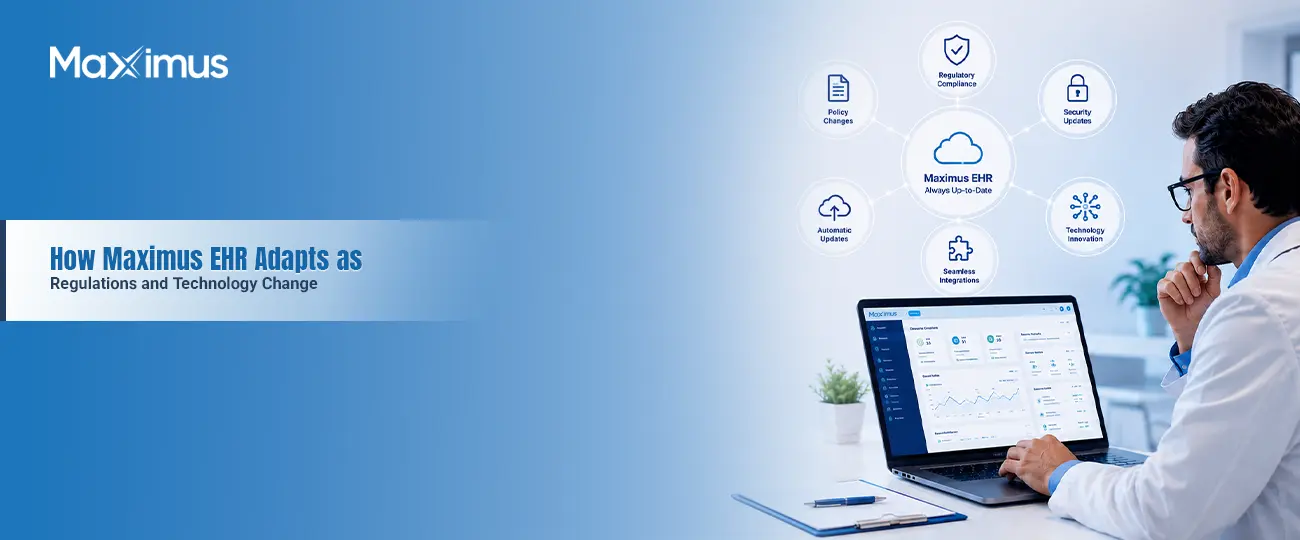
How Maximus EHR Adapts as Regulations and Technology Change

How Maximus EHR Adapts to Regulations and Technology

Introduction: The Compliance Pressure Cooker

Healthcare regulation doesn’t stand still. CMS quality reporting requirements shift annually. HIPAA privacy safeguards evolve in response to new cybersecurity threats. State-level telehealth and prescribing mandates change with little warning. For practice owners running on a legacy EHR, every one of these updates becomes an unplanned IT project; complete with vendor tickets, consultant invoices, and weeks of exposure to non-compliance penalties.
At the same time, clinical technology is accelerating. AI-assisted charting, ambient scribes, and remote patient monitoring devices are no longer novelties; they’re competitive necessities. A rigid, server-bound EHR wasn’t built to absorb this pace of change. It was built for a static regulatory environment that no longer exists.
Maximus was engineered differently. As a billing-native, cloud-native EHR, it treats regulatory and technological change as a core design requirement, not an afterthought. Updates happen in the background. Compliance parameters adjust automatically. New integrations plug in without custom development. The result: clinics stay current without lifting a finger.

Navigating the Regulatory Landscape Automatically

Federal and state healthcare regulations don’t wait for convenient upgrade cycles, and neither should your compliance posture.

How Maximus keeps clinics ahead of shifting mandates:
This means your front desk and clinical staff never have to interpret a federal register update or coordinate an emergency IT sprint. The compliance logic lives in the platform, not in a binder of manual procedures.
Seamless Tech Integration via Open APIs

Seamless Tech Integration via Open APIs

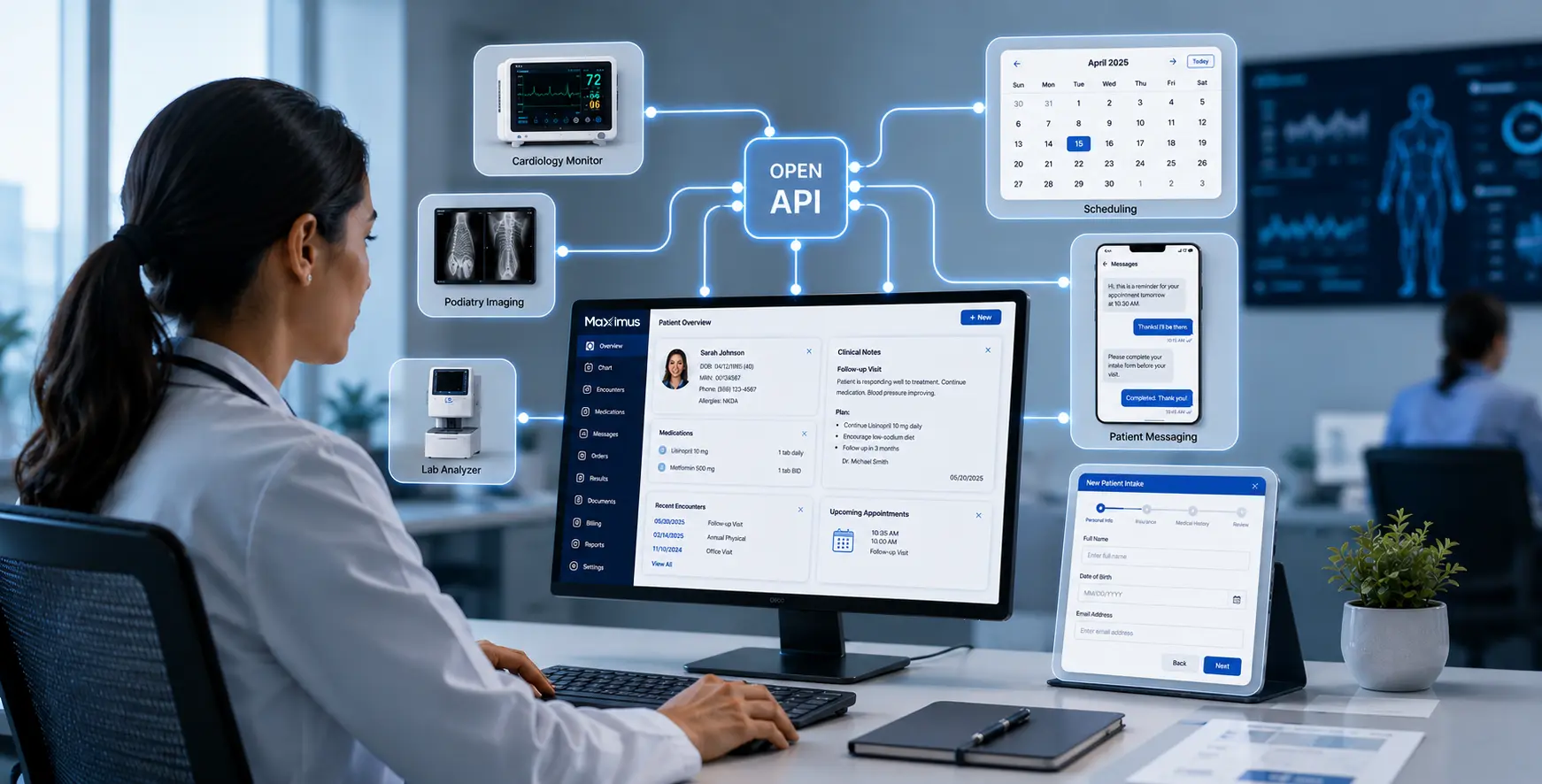
Modern clinical technology moves fast. Diagnostic devices, patient engagement tools, and specialty platforms are constantly improving, but only if your EHR can talk to them.

Maximus is built on an open API architecture, which means:

Closed, proprietary systems force practices to choose between staying with outdated tools or paying steep integration fees. Open APIs remove that trade-off entirely. Your practice adopts the best available technology on its own timeline, not the vendor’s.

True Interoperability and Modern Data Standards

Interoperability isn’t a feature; it’s the backbone of coordinated care. Maximus is built on HL7 and FHIR (Fast Healthcare Interoperability Resources) standards, the frameworks that define how modern health data actually moves.

What this enables in practice:

Because FHIR is the standard federal regulators are actively steering the industry toward, building on it today means Maximus is positioned for whatever interoperability mandates come next, rather than needing an architectural overhaul to catch up.

The Cloud-Native Evolution: Zero Upgrades, Zero Downtime

Legacy, server-bound EHRs require scheduled downtime for every patch, meaning clinical staff loses access precisely when they need it most.

Maximus eliminates that trade-off through true cloud-native architecture:

This isn’t just convenience. It’s risk reduction. Every hour a legacy system runs on outdated code is an hour of unpatched vulnerability exposure. Cloud-native delivery closes that gap continuously, not periodically.

The Adaptation Scale: Rigid Legacy Systems vs. Dynamic Maximus EHR

Core Metric Legacy On-Premise EHR Maximus EHR
Compliance Update Deployment
Manual patches, often 3–6 months behind mandate deadlines
Automatic, background updates aligned to CMS/HIPAA effective dates
Interoperability Architecture
Closed, proprietary data formats requiring custom interfaces
Native HL7 & FHIR support for direct, standards-based exchange
AI & Tech Tool Integration
Expensive custom development per device or platform
Open API architecture enables plug-and-play integration
System Downtime During Patches
Scheduled outages, after-hours maintenance windows
Zero-downtime cloud deployment; updates apply invisibly
Hardware/Infrastructural Costs
On-site servers, IT staff, periodic hardware refreshes
Zero on-premise hardware; infrastructure managed in the cloud
Regulatory Penalty Exposure
High — depends on IT team’s patch speed
Low — compliance logic updates centrally, applies instantly
The pattern is consistent: legacy systems push the burden of change onto the clinic. Maximus absorbs it at the platform level.
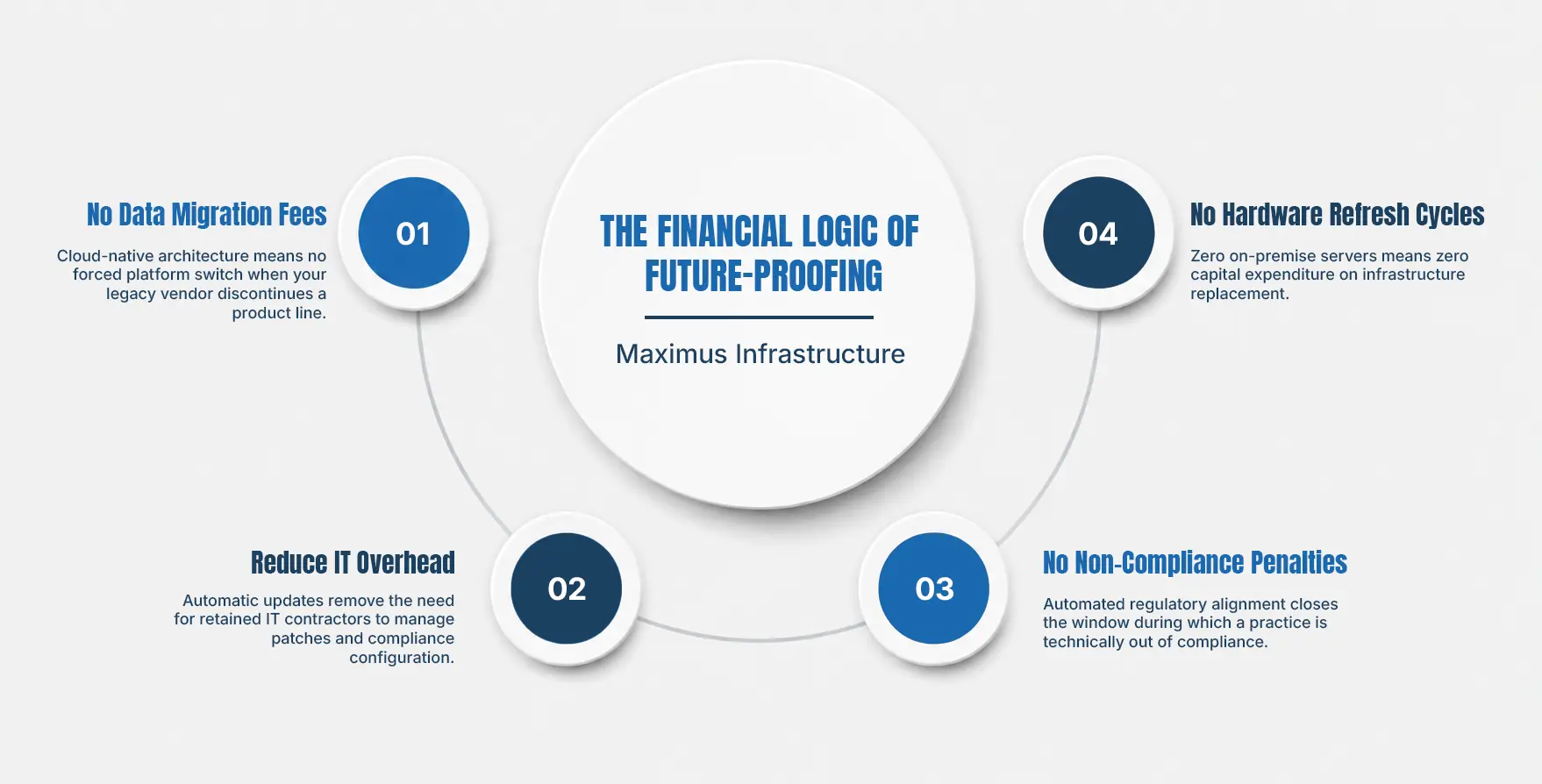
The Financial Logic of Future-Proofing

The Financial Logic of Future-Proofing

Compliance failures and technical obsolescence aren’t just operational headaches; they’re direct financial threats. Future-proofing isn’t a luxury line item; it’s a cost-avoidance strategy.

Where adaptable infrastructure protects your bottom line:

Practices running on Maximus’ connected ecosystem have seen this translate into measurable outcomes, which include up to a 30% improvement in revenue performance and a 20% gain in operational efficiency, built on more than 10 years of healthcare IT experience across 45+ states.

Future-Proof Your Practice Today

Regulations will keep shifting. Technology will keep accelerating. The only real choice is whether your EHR absorbs that change for you, or passes it straight to your staff and your budget.

Maximus is built to be the operational anchor that turns regulatory complexity into a competitive advantage. Automatic compliance updates, open API integrations, standards-based interoperability, and zero-downtime cloud delivery all work quietly in the background, so your team can focus on patient care.

Don’t wait for the next mandate to expose a gap in your current system.

Book a personalized, compliance-focused demo of Maximus today and see exactly how your practice can operate without the fear of software obsolescence or compliance penalties.

Book a Compliance-Focused Demo

See how Maximus EHR helps your practice stay current with changing regulations, modern integrations, cloud-based updates, and standards-based interoperability without downtime or costly system overhauls.

FAQs

How often does Maximus EHR update for new regulations?
Maximus EHR applies compliance updates as soon as new CMS, HIPAA, or state-level mandates take effect, not on a fixed quarterly or annual schedule. Because updates deploy centrally in the cloud, changes reach every practice simultaneously, closing the compliance gap that manual patching leaves open.
Will I need to hire an IT consultant to manage integrations or updates?
No. Maximus EHR’s cloud-native architecture and open API framework are designed to remove that dependency. Software updates roll out automatically in the background, and new third-party tools connect through standardized endpoints; no custom development contracts or retained IT staff required.
What happens to my patient data if I need to connect with a hospital, lab, or HIE?
Maximus EHR is built on HL7 and FHIR standards, the same frameworks hospitals, laboratories, and Health Information Exchanges use for secure data sharing. This means records move directly and accurately across systems, without manual re-entry or third-party conversion tools.
Does upgrading to a new version of Maximus EHR require downtime?
No. Maximus EHR deploys updates server-side through its cloud infrastructure, so there’s no local installation, scheduled outage, or “system unavailable” window. Every login automatically runs the most current, most secure version of the platform.
How does Maximus EHR protect my practice from compliance penalties?
Because regulatory logic, CMS reporting parameters, HIPAA safeguards, and state-specific mandates are updated centrally within the platform, practices aren’t left running outdated compliance rules while waiting on a manual patch. This significantly narrows the window of non-compliance exposure that triggers penalties.

Table of Contents

Maximus | Electronic Health Record

Transform Your
Practice with
AI-Powered EHR

Reduce administrative burden, streamline workflows, accelerate revenue, and deliver exceptional patient care.