Voice-to-Text and AI Documentation: Shifting the Focus Towards Better Healthcare

Voice-to-Text and AI Documentation

Table of Contents

The Growing Documentation Burden in US Healthcare

Physicians across the United States are spending more time documenting care than delivering it. Clinical documentation has become one of the leading contributors to physician burnout, with providers often working late nights to complete notes, charts, and patient records inside their EHR systems.

While Electronic Health Records were introduced to improve efficiency and care coordination, many practices still struggle with time-consuming manual data entry. This challenge has created a growing demand for smarter documentation solutions that reduce administrative workload without compromising accuracy or compliance.

Voice-to-text and AI-powered documentation have emerged as powerful solutions to this problem. When integrated directly into an EHR, these tools allow physicians to document patient encounters faster, more naturally, and with less friction. Maximus EHR addresses this challenge by offering built-in voice-to-text capabilities designed specifically for modern healthcare workflows.

What Is Voice-to-Text and AI-Driven Clinical Documentation?

Voice-to-text documentation allows physicians to dictate clinical notes verbally while the system converts speech into structured text in real time. AI-driven documentation takes this a step further by understanding medical terminology, clinical context, and specialty-specific language.
Instead of typing lengthy notes or navigating complex templates, providers can speak naturally during or after a patient encounter. The EHR then captures, organizes, and stores the information directly within the patient record.
In platforms like Maximus EHR, voice-to-text functionality is designed to work seamlessly within clinical workflows, ensuring that documentation remains accurate, searchable, and compliant with US healthcare regulations.

Why Traditional EHR Documentation Slows Physicians Down

Despite advancements in healthcare technology, many EHR systems still rely heavily on manual input. This creates several challenges for physicians and staff:
For healthcare administrators and practice owners, inefficient documentation also impacts productivity, patient throughput, and revenue cycle performance. Delays in chart completion can affect coding accuracy, billing timelines, and compliance audits.
Voice-to-text documentation directly addresses these inefficiencies by allowing providers to document faster while maintaining clinical accuracy.

How Voice-to-Text Technology Works Inside an EHR

When voice-to-text is embedded within an EHR system, the documentation process becomes significantly more streamlined. Physicians dictate notes using a microphone or mobile device, and AI-powered speech recognition converts spoken words into structured clinical text.
Advanced systems like Maximus EHR are designed to recognize medical terminology, abbreviations, and specialty-specific language. This ensures that dictated notes are accurate and aligned with clinical documentation standards.
The result is a smoother workflow where documentation happens naturally during patient care instead of becoming a separate administrative task.

Key Benefits of Voice-to-Text and AI Documentation for Physicians

Voice-to-text technology delivers measurable benefits for physicians across specialties. These benefits extend beyond convenience and directly impact productivity, care quality, and job satisfaction.

Time Savings and Efficiency

Physicians can complete documentation significantly faster through voice dictation compared to manual typing. This allows providers to see more patients without having to extend their work hours.

Reduced Burnout

By minimizing after-hours charting and repetitive data entry, voice-to-text helps reduce mental fatigue and burnout, a growing concern in US healthcare.

Improved Patient Interaction

When physicians are not focused on screens and keyboards, they can engage more meaningfully with patients, improving trust and satisfaction.

Consistent and Complete Documentation

AI-driven systems help capture complete clinical narratives, reducing the risk of missing key details that can impact care or billing.
Impact on Healthcare Administrators and Practice Leaders

Impact on Healthcare Administrators and Practice Leaders

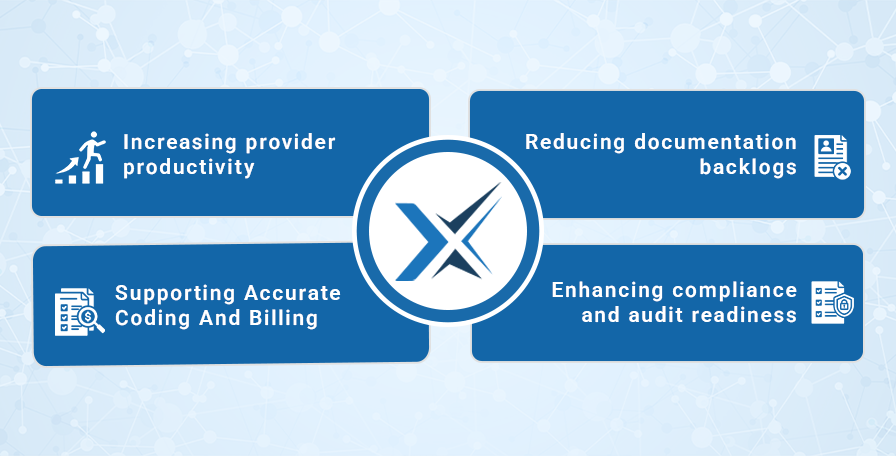
Voice-to-text and AI documentation are not only beneficial for clinicians but also for administrators and decision-makers responsible for operational efficiency.

For healthcare leaders, these tools help improve overall practice performance by:

When documentation is completed more quickly and accurately, practices experience smoother revenue cycles and better utilization of staff resources.

Voice-to-Text vs Traditional Clinical Documentation

The difference between voice-enabled documentation and traditional EHR workflows becomes clear when comparing efficiency, accuracy, and provider experience.
Feature Traditional EHR Documentation Voice-to-Text with AI
Documentation Speed
Slow, manual typing
Faster, real-time dictation
Provider Focus
Divided between the screen and the patient
Patient-centric interaction
Burnout Risk
High
Significantly reduced
Accuracy
Dependent on manual entry
AI-assisted clinical accuracy
Workflow Integration
Disruptive
Seamless within EHR
This comparison highlights why many US practices are shifting toward voice-enabled EHR solutions.

How Maximus EHR Simplifies Documentation with Voice-to-Text

Maximus EHR is designed with efficiency, usability, and provider experience in mind. Its built-in voice-to-text feature allows clinicians to document encounters quickly without leaving the EHR environment.
Key Advantages of Maximus EHR Voice-to-Text
Capability How It Helps Providers
Real-Time Dictation
Capture notes during or after visits
Medical Terminology Recognition
Ensures clinical accuracy
Seamless EHR Integration
No switching between tools
Specialty-Friendly Design
Supports diverse clinical workflows
Faster Note Completion
Reduces charting delays
By embedding voice-to-text directly into the EHR, Maximus eliminates the need for third-party dictation tools and fragmented workflows. This creates a more cohesive documentation experience for both physicians and staff.

Security, Accuracy, and HIPAA Compliance Considerations

Security and compliance remain top priorities for healthcare organizations in the US. Any documentation technology must meet strict HIPAA requirements and protect patient data.
Maximus EHR’s voice-to-text capabilities are built with security in mind. Dictated data is processed and stored securely within the EHR system, ensuring patient information remains protected at all times.
In addition, AI-assisted documentation helps improve accuracy by reducing manual entry errors, supporting cleaner records for clinical decision-making and billing.
The Future of AI Documentation in Healthcare

The Future of AI Documentation in Healthcare

AI-powered documentation is rapidly becoming a standard expectation in modern EHR systems. As technology continues to evolve, voice-to-text solutions will become even more intelligent, context-aware, and integrated into clinical workflows.
Future advancements will likely include deeper automation, smarter clinical insights, and enhanced interoperability across healthcare systems. Practices that adopt these technologies early position themselves for long-term efficiency, provider satisfaction, and better patient outcomes.
Maximus EHR continues to invest in innovation to ensure its platform supports the future needs of healthcare providers and administrators alike.

Conclusion: Saving Time, Reducing Burnout, and Improving Care with Maximus EHR

Voice-to-text and AI-driven documentation are transforming how physicians interact with EHR systems. By reducing administrative burden, improving efficiency, and supporting accurate clinical records, these technologies help restore focus to what matters most—patient care.
For US-based healthcare providers, administrators, and decision-makers, adopting an EHR with built-in voice-to-text functionality is no longer a luxury but a strategic advantage.
Maximus EHR empowers practices with intelligent documentation tools designed to save time, reduce burnout, and improve operational performance. If your organization is looking to streamline clinical workflows and enhance provider efficiency, now is the time to experience what Maximus EHR can deliver.
Request a free demo of Maximus EHR today and see how voice-to-text documentation can transform your practice.

Let AI Handle Documentation—So You Can Focus on Care

Schedule a free Maximus EHR demo and see how voice-to-text documentation speeds up charting and reduces burnout.

FAQs

What is voice-to-text documentation in healthcare?
Voice-to-text documentation allows physicians to dictate patient notes verbally, which are then automatically converted into text and stored within the EHR. AI-driven systems, like Maximus EHR, also understand medical terminology and clinical context, ensuring accurate, structured documentation without manual typing.
How does AI documentation save time for physicians?
AI documentation reduces the time physicians spend on manual data entry by converting spoken notes into accurate, organized patient records in real-time. This allows providers to focus more on patient care, decrease after-hours charting, and improve overall workflow efficiency.
Is voice-to-text documentation HIPAA compliant?
Yes. Modern EHRs with built-in voice-to-text features, like Maximus EHR, are designed to meet HIPAA and US healthcare compliance standards. Patient data is securely processed and stored within the system, ensuring privacy and regulatory adherence.
Can voice-to-text technology improve clinical accuracy?
Absolutely. AI-powered voice-to-text tools recognize medical terminology, abbreviations, and specialty-specific language, reducing errors from manual entry. This helps maintain complete and accurate clinical records, which support better patient care and billing processes.
How does Maximus EHR integrate voice-to-text into clinical workflows?
Maximus EHR’s voice-to-text feature is fully embedded into the platform, allowing physicians to document encounters directly within the EHR without switching tools. It supports real-time dictation, specialty-specific workflows, and faster note completion, improving efficiency for both providers and administrators.