Secure Patient Communication: How Maximus EHR Protects Sensitive Data

Secure Patient Communication. How Maximus EHR Protects Sensitive Data Banner

Table of Contents

Introduction

Digital transformation has reshaped nearly every touchpoint between healthcare providers and their patients. Instead of relying exclusively on phone calls and paper letters, patients today expect notifications, updates, and answers accessible from a laptop or a mobile device. Practices depend on digital systems just as heavily, using them to streamline operations, reduce administrative burden, and deliver care more efficiently.
However, this convenience places intense pressure on healthcare organizations to safeguard every piece of information shared electronically. Messages may appear simple. A vaccination reminder, a lab clarification, or a billing question each carries protected health information. Maximus EHR is built to handle that responsibility. It enables practices to adopt efficient, modern communication while ensuring patient privacy is maintained and regulatory compliance is fully upheld.

Why Secure Patient Communication Matters

Communication between a provider and a patient goes beyond a simple transaction; it forms the foundation of trust, quality care, and meaningful patient engagement. When patients ask questions or request information, they expect privacy automatically, even if they never explicitly mention it.
A secure communication system supports three critical areas:
Practices that prioritize secure communication are not just protecting data; they are strengthening the patient relationship.
The Risks of Insecure Channels

The Risks of Insecure Channels

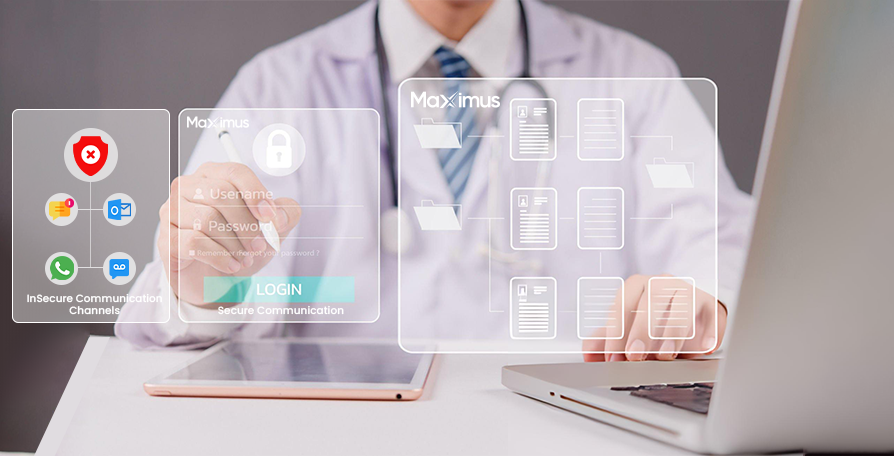
Despite the importance of privacy, many healthcare teams still rely on tools never meant for handling medical information. These risk-prone systems become doors that privacy breaches can walk through unnoticed.
Common risky tools include:
These channels share several vulnerabilities. Messages may be unencrypted, stored insecurely, forwarded unintentionally, or left accessible on lost devices. Most importantly, practices cannot verify who ultimately sees the information once it leaves their system.
Even harmless interactions, such as a prescription instruction or a lab update, can result in HIPAA non-compliance if sent incorrectly. This is why secure systems like Maximus EHR eliminate the need for risky shortcuts.

How Maximus EHR Enables Safe Messaging

Maximus EHR consolidates all communication into a single secure environment where conversations are safely stored, fully encrypted, and accessible only to authorized users. Instead of scattering patient messages across personal phones or email accounts, everything stays inside a platform specifically designed for healthcare.
Here’s how the process flows:
This establishes a fully closed communication loop, ensuring that no message leaves the EHR unless it is intentionally shared in accordance with policy. As a result, staff no longer need to monitor communication manually, because security is built in by default.

Security Features Built into the Platform

What distinguishes Maximus EHR is that privacy is not a feature bolted on after development—it is engineered into every layer of the system.
Key protections include:

Role-Based Access Control

Employees only view what is relevant to their responsibilities, reducing risk and oversight load.

Multi-Factor Authentication

Even if a password is compromised, unauthorized access remains blocked.

Usage Logs and Audit Trails

Every action leaves a trace, making privacy oversight easy and transparent.

Identity Verification for Patients

The portal ensures information is accessed only by the correct patient.

Together, these protections create a system where secure communication is seamless and automatic for users.

Encryption, Compliance & PHI Protection

To comply with both HIPAA and HITECH requirements, patient data must be protected at every step. Maximus EHR uses encryption to ensure that messages remain unreadable to anyone outside the system, even if the data is intercepted.
Encryption safeguards:
Instead of depending on staff discipline to maintain compliance, Maximus ensures the technology itself enforces it. Compliance becomes a by-product of normal workflow rather than extra work.

Secure Messaging vs Traditional Tools

A brief comparison highlights why EHR messaging is not only preferable but essential.
Communication Method HIPAA Compliant Security Level Suitable for PHI?
Regular Texting
No
High Risk
Never
Personal/Unencrypted Email
No
High Risk
No
Phone + Voicemail
Partially
Medium
Limited
Consumer Apps
No
High Risk
Prohibited
Maximus EHR Secure Portal
Yes
Protected
Always
Traditional tools may feel faster in the moment, but they create ongoing risk—something no modern practice can afford.

Benefits for Practices and Patients

Secure communication is often misunderstood as a compliance obligation, but clinics quickly discover operational advantages once they transition into portal-based messaging.
Maximus EHR improves the experience for both sides. Patients gain direct access to clinicians, receive faster answers, and stay more informed about their care. Providers benefit from clearer instructions, fewer communication errors, and automatically stored conversations that strengthen documentation.
The advantages extend to administrative staff, who experience noticeable improvements in workflow. Phone lines become less congested, follow-up calls decrease, and employees no longer need to juggle loose notes or voicemail transcriptions. Communication becomes trackable, centralized, and reliably documented.
Real-Life Communication Use Cases

Real-Life Communication Use Cases

Secure messaging inside Maximus EHR quickly becomes the backbone of interaction between patients and their care teams. Practices rely on the portal for daily tasks, including appointment confirmations, discussing lab results, addressing medication questions, and providing pre-visit instructions.
Consider a patient waiting for routine test results. Instead of calling repeatedly, the provider sends an update through the portal with the next steps attached. A patient who starts a new medication can ask questions about dosage timing without scheduling an appointment. Prescription renewal requests can be routed, approved, and documented without interrupting the provider’s day.
In every case, Maximus reduces manual work while elevating care delivery.

Conclusion

Healthcare communication is evolving. The days of depending on unsecured systems are behind us, and practices moving forward understand that privacy and communication must coexist. Maximus EHR makes secure communication effortless by keeping all patient interactions within a protected system designed to comply with regulations and safeguard sensitive data. It also helps create clearer, more reliable connections between patients and providers.

Secure communication is not simply safer; it is smarter. It strengthens relationships, improves outcomes, and frees practices to focus on care rather than worrying about technological gaps.
Maximus EHR equips healthcare providers with the tools to communicate securely, safeguard patient data, and minimize compliance risks. If your clinic is ready to modernize communication, enhance efficiency, and safeguard every message, take a step towards success now.

Modernize Your Practice With Maximus EHR

Discover the benefits of HIPAA-compliant messaging for patients, providers, and staff.

FAQs

Why is secure patient communication important in healthcare?
Secure communication protects sensitive health information, ensures compliance with HIPAA and HITECH regulations, and strengthens trust between patients and providers. Without it, even simple messages like lab results or appointment reminders can become privacy risks.
How does Maximus EHR keep patient messages secure?
Maximus EHR uses end-to-end encryption for messages in transit and at rest, role-based access controls, multi-factor authentication, identity verification for patients, and audit logs to ensure that only authorized users can access sensitive information.
Can I use regular texting or email instead of Maximus EHR for patient communication?
Regular texting, personal email, and consumer apps like WhatsApp or Facebook Messenger are high-risk and not HIPAA-compliant. Maximus EHR provides a secure, compliant alternative designed specifically for healthcare communication.
What types of communication can Maximus EHR handle?
Practices can use Maximus EHR for appointment confirmations, lab result discussions, medication instructions, prescription renewals, pre-visit instructions, and any other patient interactions – all stored securely within the EHR.
How does secure messaging benefit both patients and healthcare staff?
Patients receive faster responses and better access to care information, while providers and staff experience reduced errors, centralized communication, improved documentation, and decreased administrative burden. Secure messaging improves efficiency without compromising privacy.