Electronic Health Records (EHRs) were introduced to improve efficiency, patient safety, and care coordination. But as healthcare technology evolves, many practices find themselves stuck with systems that no longer support their needs. What once felt like a reliable solution can quietly become a barrier to growth, compliance, and provider satisfaction.
The challenge for most practices isn’t whether EHRs matter – it’s knowing when an EHR has become outdated enough to justify replacement. This decision impacts clinical workflows, revenue cycles, regulatory compliance, and even staff retention. Ignoring the warning signs can cost far more than making a timely switch.
Many practices delay replacing their EHR because the system is “still working.” However, functionality alone doesn’t equal effectiveness. An outdated EHR often introduces hidden inefficiencies that accumulate over time – longer documentation hours, billing delays, reporting limitations, and increased compliance risk.
In the US healthcare landscape, where regulations, reimbursement models, and patient expectations constantly evolve, outdated systems struggle to keep up. Practices that cling to legacy EHRs often pay the price through lost revenue, staff frustration, and reduced quality of care, even if those costs aren’t immediately visible.
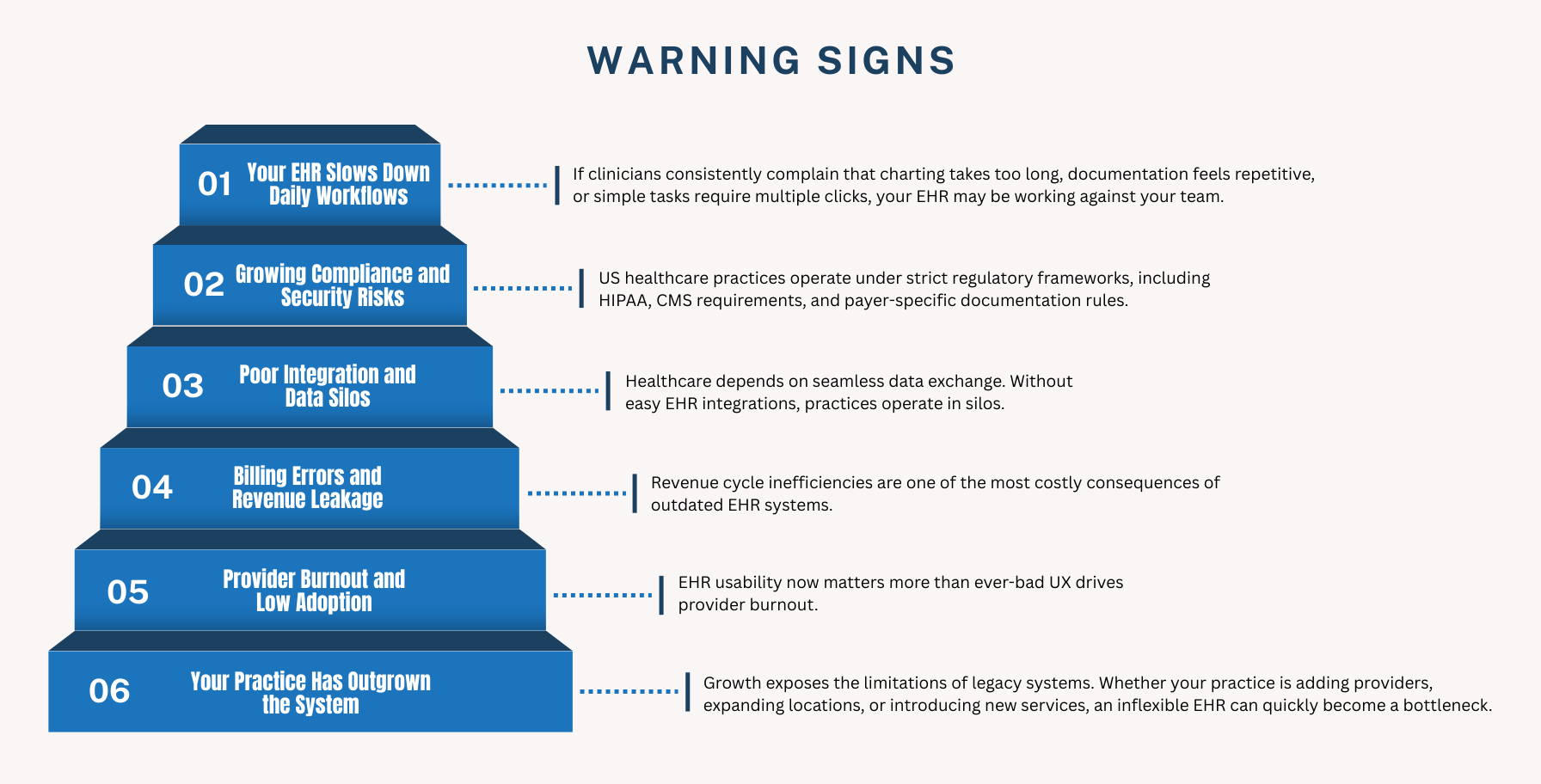
If clinicians consistently complain that charting takes too long, documentation feels repetitive, or simple tasks require multiple clicks, your EHR may be working against your team.
Modern healthcare demands speed and accuracy. When an EHR lacks intuitive workflows, automation, or specialty-specific customization, it increases administrative burden. Providers end up spending more time navigating screens than engaging with patients, leading to reduced productivity and longer workdays.
Over time, workflow inefficiencies don’t just affect staff morale; they directly impact patient throughput and revenue.
US healthcare practices operate under strict regulatory frameworks, including HIPAA, CMS requirements, and payer-specific documentation rules. An EHR that struggles to stay compliant with updates or lacks advanced security protocols puts your practice at serious risk.
Older systems may not support modern audit trails, role-based access, or updated reporting standards. Manual compliance workarounds increase the likelihood of errors, audits, and potential penalties.
If your EHR vendor is slow to release compliance updates or requires extensive manual adjustments, that’s a clear signal it may no longer be suitable for today’s regulatory environment.
Modern EHR systems are designed to support interoperability as a core function, not an add-on. If integrations feel like constant workarounds, replacement should be seriously considered.
Lack of interoperability results in duplicate data entry, delayed access to information, and incomplete patient records. This not only frustrates staff but also affects care coordination and decision-making.
Healthcare depends on seamless data exchange. Without easy EHR integrations, practices operate in silos.
Revenue cycle inefficiencies are one of the most costly consequences of outdated EHR systems. When documentation doesn’t align properly with coding, or when billing workflows aren’t automated, practices face increased claim denials and delayed reimbursements.
Small errors add up quickly. Missed charges, incorrect modifiers, and incomplete documentation can significantly impact cash flow. Practices often don’t realize how much revenue they’re losing until they transition to a system that aligns clinical documentation with billing in real time.
An EHR should support accurate, compliant billing, not create additional financial risk.
EHR usability is no longer “nice to have.” Poor user experience is one of the leading contributors to provider burnout.
If clinicians avoid certain features, rely on manual notes, or resist system updates, it often points to deeper usability problems. Low adoption rates indicate that the system doesn’t align with real-world clinical workflows.
When an EHR becomes a source of stress instead of support, it negatively impacts retention, satisfaction, and the overall practice culture.
Growth exposes the limitations of legacy systems. Whether your practice is adding providers, expanding locations, or introducing new services, an inflexible EHR can quickly become a bottleneck.
Older systems often struggle with scalability, advanced reporting, and customization. What worked for a small practice may no longer support complex scheduling, analytics, or multi-provider workflows.
An EHR should grow with your practice, not limit its potential.
Replacing an EHR isn’t just about fixing problems – it’s about positioning your practice for long-term success. A modern EHR should improve efficiency, reduce risk, and enhance patient care from day one.
Key considerations include workflow automation, cloud-based access, strong customer support, real-time reporting, and scalable architecture. Equally important is choosing a vendor that understands the operational realities of US-based healthcare practices and actively evolves with industry changes.
Maximus EHR is designed specifically for practices that have outgrown outdated systems and need a smarter, more adaptable solution.
With intuitive workflows, seamless integrations, and built-in compliance support, Maximus EHR helps practices reduce administrative burden while improving clinical and financial performance. Its scalable, cloud-based architecture ensures that growing practices never have to compromise on efficiency or security.
For healthcare administrators and decision-makers, Maximus EHR offers clarity, control, and confidence, without the complexity that often comes with EHR transitions.
If the warning signs discussed above sound familiar, it may be time to move forward with an EHR that actually supports your goals.
Replacing an EHR is a strategic decision, not just a technical one. When inefficiencies, compliance risks, and staff frustration begin to outweigh the comfort of familiarity, staying put becomes the riskier option.
Recognizing the warning signs early allows practices to transition thoughtfully, minimizing disruption while maximizing long-term benefits. With the right partner and a modern platform like Maximus EHR, replacing your EHR can be a turning point toward better workflows, healthier revenue cycles, and improved patient care.
If you’re experiencing slow workflows, billing errors, or compliance challenges, it might be time to switch. Schedule a demo of Maximus EHR today and discover smarter solutions!