EHR Downtime in Healthcare: How Modern Systems Minimize Disruptions to Patient Care

EHR Downtime in Healthcare How Modern Systems Minimize Disruptions to Patient Care

Table of Contents

Introduction: When Minutes Matter

In today’s healthcare environment, uninterrupted access to clinical data is not a luxury; it is essential. Providers rely on electronic health records for everything from reviewing patient histories and prescribing medications to documenting encounters and submitting claims. When those systems become unavailable, even briefly, the impact is immediate and widespread.
EHR downtime disrupts workflows, slows decision-making, and introduces risk into patient care. For healthcare administrators and executive leaders across the United States, system reliability has evolved into a strategic priority. What was once considered an occasional technical inconvenience is now recognized as a serious operational vulnerability.
Modern healthcare organizations cannot afford prolonged outages. They need infrastructure designed not just to function, but to remain resilient under pressure.

Understanding EHR Downtime in Modern Healthcare

EHR downtime refers to any period during which providers and staff are unable to access or fully use their electronic health record system. This may occur due to planned maintenance, but more concerning are unplanned outages resulting from server failures, cyberattacks, connectivity issues, or software malfunctions.
The consequences extend far beyond the IT department. When clinicians cannot retrieve patient histories, medication lists, lab results, or diagnostic data, clinical decision-making becomes more complex. Staff may revert to manual documentation processes, which increases the likelihood of errors and creates additional administrative burden once systems are restored.
Downtime is rarely isolated. A single outage can lead to documentation backlogs, delayed claims, appointment slowdowns, and operational bottlenecks that persist for days.
The Financial and Operational Consequences

The Financial and Operational Consequences

The financial impact of EHR downtime is often underestimated until it occurs. Healthcare organizations operate on tightly managed revenue cycles. When documentation is delayed, billing processes slow. When claims are not submitted on time, reimbursements are postponed. Even a short disruption can interfere with cash flow and strain operational stability.
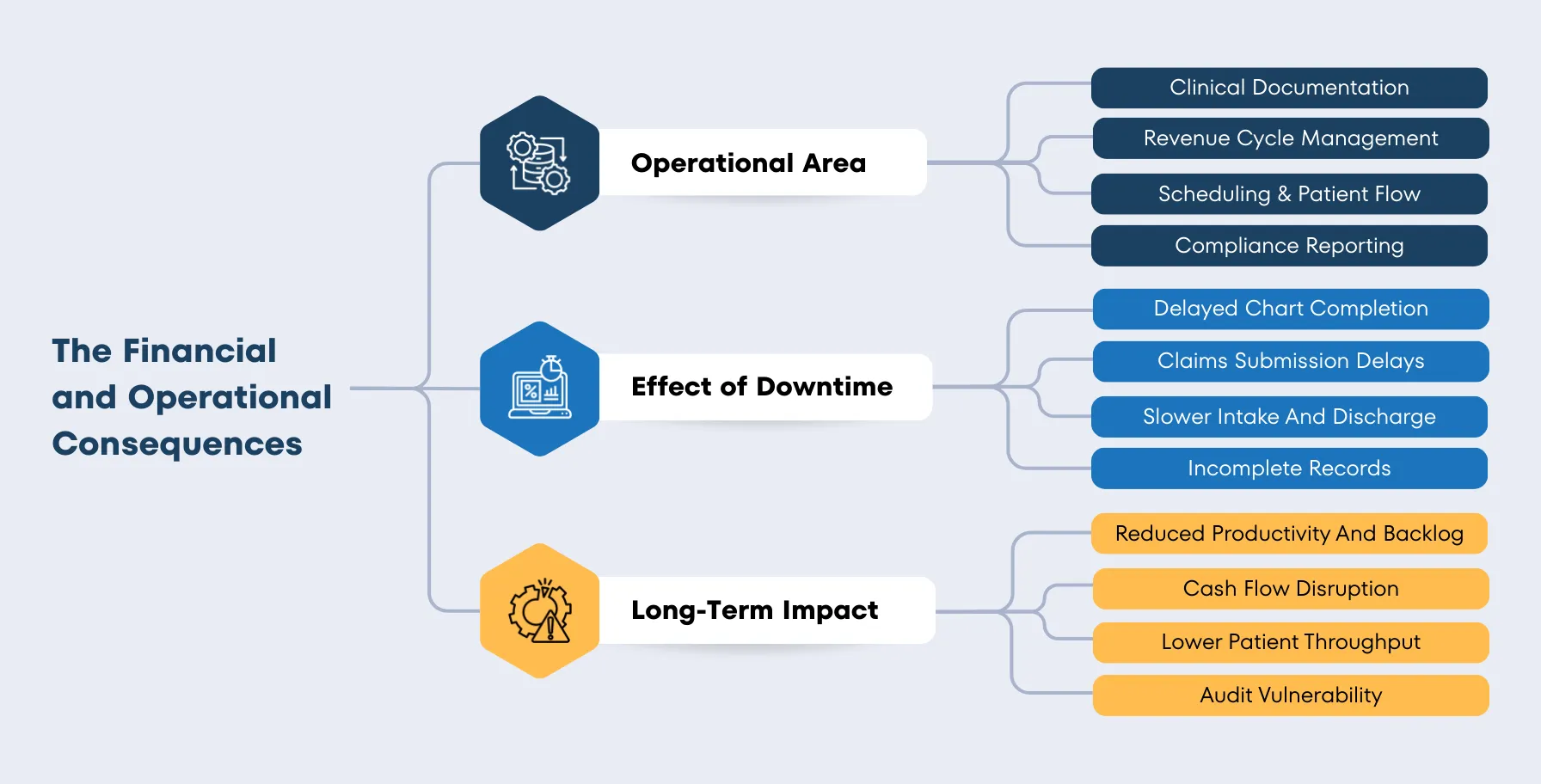
Consider how downtime affects core operational areas:
Operational Area Effect of Downtime Long-Term Impact
Clinical Documentation
Delayed chart completion
Reduced productivity and backlog
Revenue Cycle Management
Claims submission delays
Cash flow disruption
Scheduling & Patient Flow
Slower intake and discharge
Lower patient throughput
Compliance Reporting
Incomplete records
Audit vulnerability
Beyond measurable financial loss, downtime erodes staff confidence. Teams working under pressure to “catch up” often experience burnout, which affects morale and long-term performance. For healthcare leaders, protecting uptime is also about protecting workforce stability.

Patient Safety, Compliance, and Regulatory Exposure

At its core, healthcare is about patient safety. When EHR systems are inaccessible, clinicians may lack visibility into critical information such as allergies, medication interactions, or prior diagnoses. This increases the potential for medical errors and fragmented care.

From a compliance perspective, organizations are obligated to maintain secure and accessible patient records under federal regulations enforced by the U.S. Department of Health and Human Services. Requirements under the Health Insurance Portability and Accountability Act mandate safeguards that include secure backups, disaster recovery plans, and protections against data breaches.

Downtime that exposes data vulnerabilities or results in lost documentation can lead to penalties, legal risk, and reputational damage. In a highly regulated environment, resilience is not optional; it is expected.

Why Traditional Systems Struggle With Reliability

Historically, many healthcare organizations relied on on-premise EHR systems hosted on local servers. While this model offered a sense of control, it also introduced single points of failure. Hardware malfunctions, local power outages, and limited redundancy meant that if the central server failed, the entire system became unavailable.
Traditional infrastructure often lacks geographic data replication. This means that a regional disruption, such as severe weather or localized power grid failure, can halt operations entirely. Recovery may require manual intervention, increasing downtime duration.
As healthcare organizations grow, these legacy systems struggle to scale efficiently. Increased data loads and higher user volumes can strain infrastructure not designed for modern demand.

Cloud-Based Infrastructure and the Shift Toward Resilience

The healthcare industry has increasingly shifted toward cloud-based EHR systems because they address many of the limitations associated with on-premise models. Cloud architecture distributes data across multiple secure servers and geographic locations, significantly reducing the risk of complete system failure.

Instead of relying on a single server room, modern platforms utilize redundant data centers. If one location experiences disruption, another can immediately assume operational control. This process, known as failover, often occurs seamlessly without noticeable interruption to users. Cloud systems also allow for continuous monitoring and automated updates. Rather than requiring large, disruptive upgrades, improvements are deployed incrementally, reducing the risk of system-wide outages.
For decision-makers evaluating infrastructure reliability, the difference between traditional and modern systems is significant.

Core Technologies That Minimize Disruptions

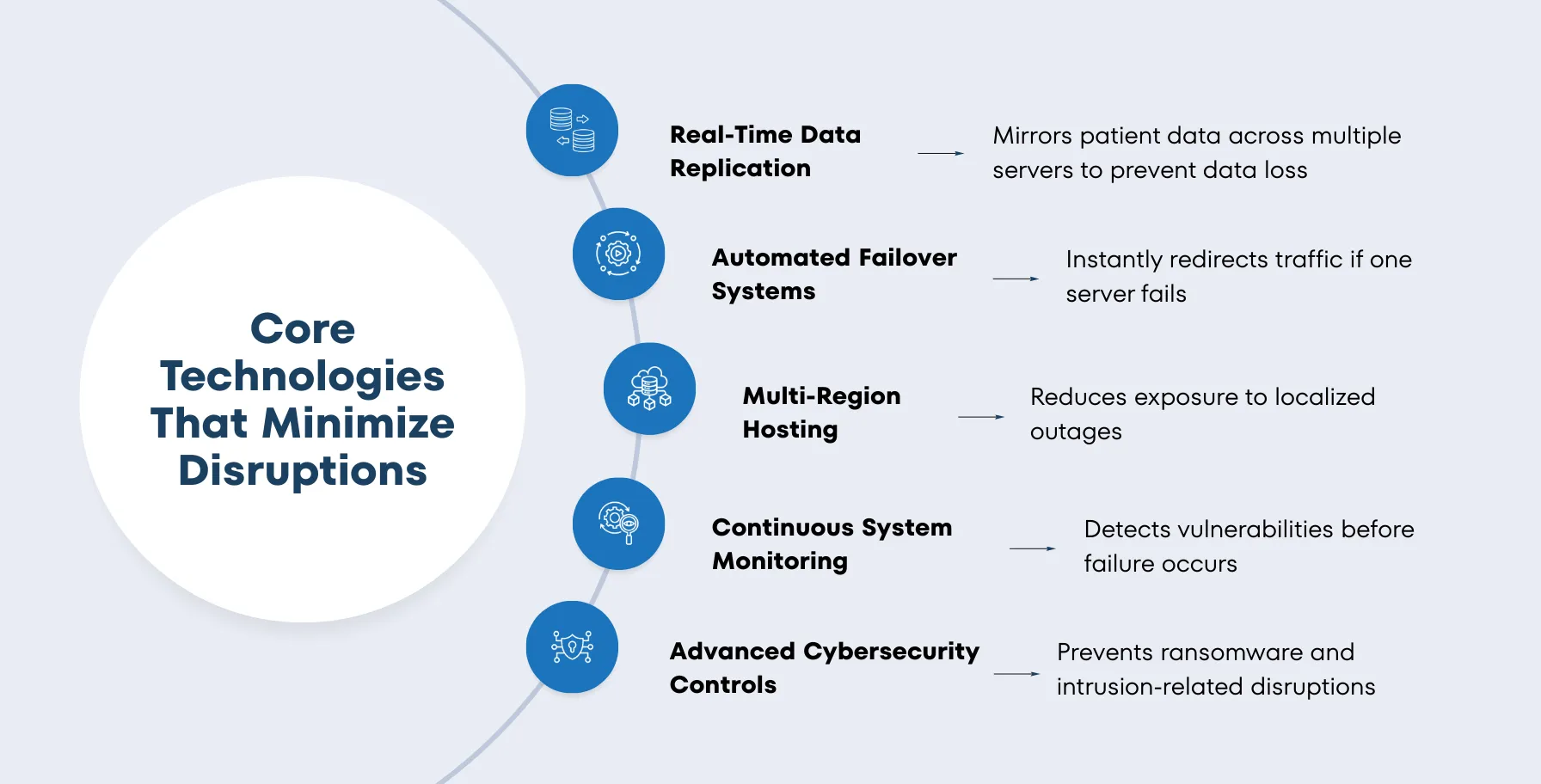
Modern EHR resilience is built upon several foundational technologies working together to prevent downtime or reduce its duration.
Technology How It Protects Continuity
Real-Time Data Replication
Mirrors patient data across multiple servers to prevent data loss
Automated Failover Systems
Instantly redirects traffic if one server fails
Multi-Region Hosting
Reduces exposure to localized outages
Continuous System Monitoring
Detects vulnerabilities before failure occurs
Advanced Cybersecurity Controls
Prevents ransomware and intrusion-related disruptions
These capabilities transform downtime management from a reactive process to a proactive strategy. Instead of responding to failures after they occur, modern systems are designed to anticipate and neutralize threats before they escalate.

Strategic Questions for Healthcare Decision-Makers

Healthcare administrators and executive leaders must evaluate EHR systems not only for features and usability but also for resilience. Uptime guarantees, recovery time objectives (RTOs), and data redundancy practices are now key evaluation criteria.

Decision-makers should seek clarity on infrastructure architecture, disaster recovery protocols, and cybersecurity safeguards. Understanding how quickly a system can recover from disruption is just as important as understanding how it functions under normal conditions.

When reliability becomes a competitive advantage, organizations that invest in resilient systems position themselves for sustainable growth and operational stability.

How Maximus EHR Is Built for Continuity

Maximus EHR is designed with continuity of care at the forefront. Recognizing that downtime threatens both patient outcomes and financial performance, the system leverages secure cloud-based infrastructure, automated backup processes, and real-time data replication.

Its architecture supports scalability for multi-provider practices and growing healthcare organizations, reducing overload-related instability. Continuous monitoring protocols identify vulnerabilities early, allowing proactive resolution before disruption occurs.
For healthcare providers and administrators, this translates into operational confidence. Workflows remain stable. Revenue cycles continue uninterrupted. Compliance safeguards remain intact.
In an era where digital infrastructure underpins every clinical and administrative function, Maximus EHR delivers the reliability healthcare organizations require to operate without compromise.
If your organization is evaluating ways to strengthen resilience and protect patient care from costly system disruptions, Maximus EHR offers infrastructure built for modern healthcare realities.

Conclusion: Downtime Is Preventable

EHR downtime is not inevitable. While no system is entirely immune to disruption, modern cloud-based architecture significantly reduces both frequency and duration of outages. By prioritizing redundancy, cybersecurity, and automated failover capabilities, healthcare organizations can safeguard patient care and financial stability.
For U.S.-based providers, administrators, and healthcare decision-makers, the question is no longer whether downtime will have consequences; it is whether your system is equipped to prevent them.

Maximus EHR is engineered to minimize disruptions, protect compliance, and ensure that patient care remains uninterrupted. Schedule a personalized demo today and discover how modern infrastructure can safeguard your organization’s future.

Protect Your Practice From EHR Downtime

Maximus EHR ensures uninterrupted access to patient records with cloud-based resilience, automated failover, and real-time data replication. Start a 3-month free trial today.

FAQs

What is EHR downtime, and why does it matter in healthcare?
EHR downtime refers to any period when clinicians and staff cannot access or fully use their electronic health record system. It matters because even short outages can disrupt clinical workflows, delay billing, slow patient throughput, and increase the risk of medical errors. For healthcare organizations, downtime directly impacts patient safety, compliance, and revenue cycle performance.
What are the most common causes of EHR system outages?
The most common causes of EHR downtime include hardware failure, cybersecurity attacks such as ransomware, software update errors, internet connectivity issues, and power outages. Legacy on-premise systems are particularly vulnerable due to limited redundancy and reliance on local infrastructure.
How does EHR downtime affect revenue cycle management?
When EHR systems go down, clinical documentation is delayed, which in turn delays coding and claim submission. This can slow reimbursements, disrupt cash flow, and create billing backlogs. Extended downtime may also increase claim errors due to manual data entry during outage periods.
Are cloud-based EHR systems more reliable than on-premise systems?
In most cases, yes. Cloud-based EHR systems use distributed infrastructure, real-time data replication, and automated failover capabilities to reduce downtime risk. Unlike on-premise systems that rely on a single physical server location, cloud systems operate across multiple secure data centers, improving uptime and disaster recovery capabilities.
How can healthcare organizations reduce the risk of EHR downtime?
Healthcare organizations can reduce downtime risk by choosing a cloud-based EHR with strong uptime guarantees, implementing disaster recovery plans, conducting regular cybersecurity assessments, and training staff on downtime protocols. Evaluating vendors based on infrastructure resilience plays a critical role in minimizing operational disruptions.