What to Look for in an EHR for Primary Care Practices

EHR for Primary Care Practices

Table of Contents

Primary care practices are the foundation of the U.S. healthcare system. From preventive care and chronic disease management to care coordination and patient education, primary care providers handle a wide range of responsibilities every single day. Choosing the right Electronic Health Record (EHR) system is no longer just a technology decision; it is a strategic investment that directly impacts efficiency, compliance, revenue, and patient outcomes.
If you’re evaluating options and wondering what to look for in an EHR for primary care practices, this guide will walk you through the essential features, performance indicators, and strategic considerations that matter most to U.S.-based healthcare providers, administrators, and decision-makers.

Understanding the Unique Needs of Primary Care

Primary care practices differ significantly from specialty clinics. They manage high patient volumes, address diverse health concerns, and often coordinate care across multiple providers and facilities. Because of this complexity, a generic EHR system may not be sufficient.
The best EHR for primary care should support preventive screenings, chronic disease management, immunization tracking, medication management, and seamless documentation, all within a streamlined workflow. An EHR built with primary care in mind reduces friction in daily operations rather than adding to the administrative burden.
For small and independent practices in the U.S., affordability and usability are just as important as advanced features. A system that is overly complex can slow providers down and increase burnout.

Clinical Workflow Optimization

One of the most critical factors when choosing a primary care EHR is workflow efficiency. Physicians already spend significant time on documentation. An effective EHR should reduce charting time, not extend it.

Look for features such as:

An optimized EHR minimizes clicks, eliminates redundant data entry, and supports faster clinical decision-making. For administrators, improved workflow translates into more patient visits per day without sacrificing quality of care.
When evaluating systems, ask: Does this EHR adapt to our workflow, or will we need to adapt to it?

Integrated Billing and Revenue Cycle Management

Revenue is the backbone of any healthcare practice. A primary care EHR should seamlessly integrate with billing and revenue cycle management tools.
In the U.S., reimbursement models are complex and constantly evolving. An EHR with built-in coding assistance and claim scrubbing capabilities can significantly improve clean claim rates and reduce denials.
Key considerations include:
When documentation aligns directly with billing, practices can reduce revenue leakage and accelerate cash flow. For decision-makers, this means better financial predictability and stronger ROI.
Compliance Security and Regulatory Readiness

Compliance, Security, and Regulatory Readiness

U.S.-based practices must ensure their EHR is compliant with federal regulations. This is non-negotiable.
The system should be:
Data security is equally important. The EHR should provide role-based access controls, encryption, audit trails, and secure patient portals. Regulatory compliance is not just about avoiding penalties. It also protects patient trust and enhances your practice’s credibility.

Interoperability and Care Coordination

Modern healthcare depends on collaboration. Primary care providers often coordinate with specialists, labs, imaging centers, and hospitals.
An ideal EHR must support interoperability, the ability to securely exchange data across systems. Look for compatibility with:
Efficient data sharing improves care coordination and reduces duplication of tests. For patients managing chronic conditions, seamless communication between providers can significantly improve outcomes.

Patient Engagement and Communication Tools

Today’s patients expect digital convenience. A strong primary care EHR should include tools that enhance engagement and accessibility.

Essential features include:

When patients can access their records, communicate easily, and participate actively in their care, satisfaction improves. Higher engagement also supports better adherence to treatment plans and preventive care measures.

Customization and Scalability

No two primary care practices operate the same way. A solo physician’s office has very different needs compared to a multi-location clinic.
The right EHR should offer flexibility. Customizable templates, configurable dashboards, and adaptable reporting tools allow practices to tailor the system to their specific workflows.
Scalability is equally important. As your practice grows, your EHR should grow with you. Whether expanding services, hiring additional providers, or opening new locations, the system must support long-term development without requiring a costly migration.

Data Analytics and Reporting Capabilities

Data-driven decision-making is becoming increasingly important in U.S. healthcare. A strong EHR should provide actionable insights through comprehensive reporting and analytics tools. These reports can help practices monitor:
For administrators and owners, data visibility allows proactive strategy adjustments. Instead of reacting to revenue issues or compliance gaps, you can identify risks early and act confidently.

Vendor Support and Implementation

Even the most advanced EHR system can fail without proper onboarding and support. Implementation should be structured, guided, and minimally disruptive.

When evaluating vendors, consider:

Reliable support ensures your practice can quickly resolve issues and adapt to evolving healthcare requirements.
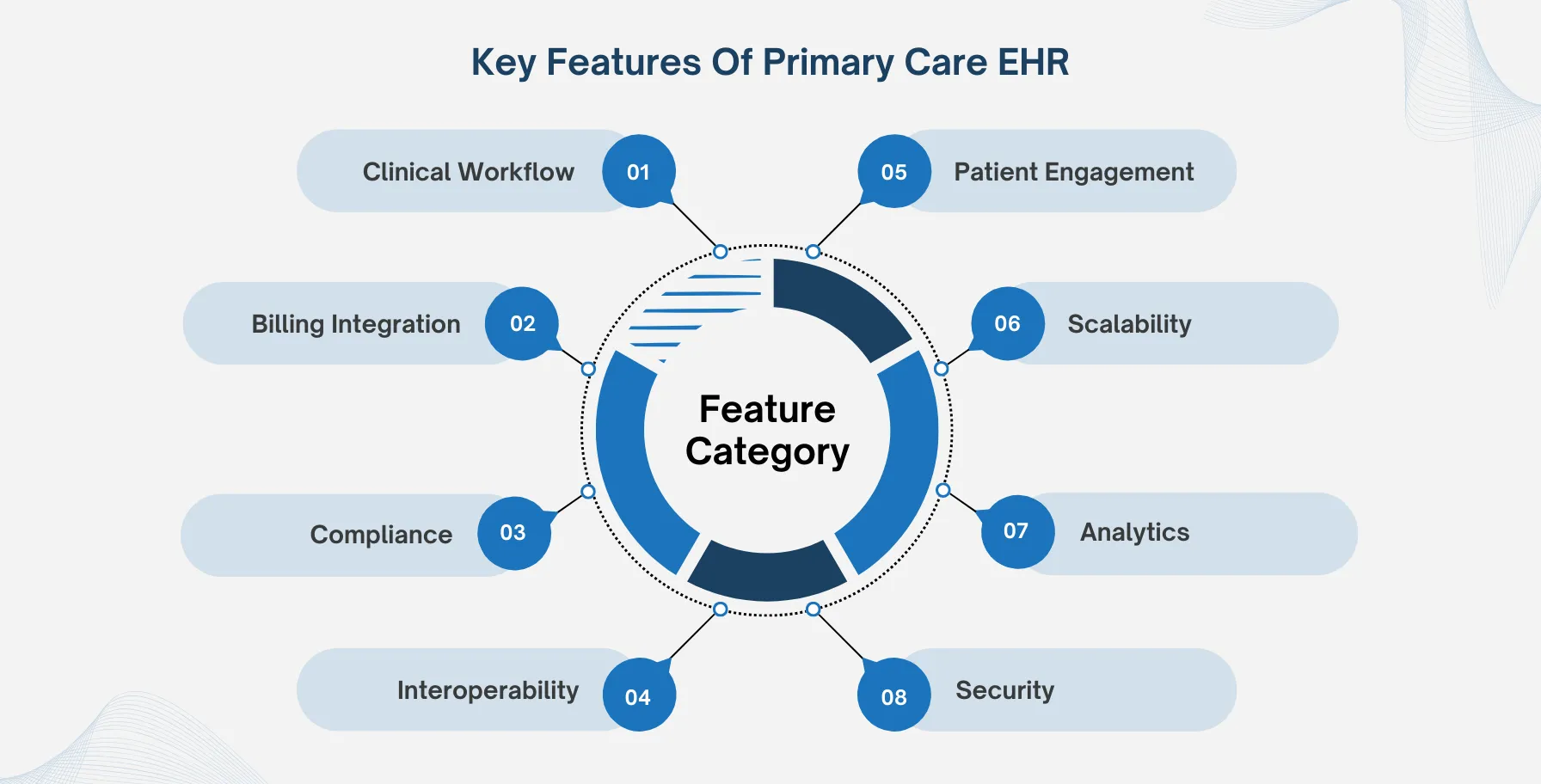
Key Features Of Primary Care EHR

Key Features Checklist for Primary Care EHR

Below is a consolidated overview of essential features to look for when evaluating EHR systems for primary care practices:
Feature Category What to Look For Why It Matters
Clinical Workflow
Custom templates, AI-assisted charting, quick navigation
Reduces provider burnout and increases efficiency
Billing Integration
Coding support, claim scrubbing, and eligibility checks
Improves revenue cycle performance
Compliance
HIPAA compliance, ONC certification, MIPS reporting
Protects practice from penalties
Interoperability
HIE integration, e-prescribing, and lab connectivity
Enhances care coordination
Patient Engagement
Portal, telehealth, reminders
Improves satisfaction and outcomes
Scalability
Multi-provider support, configurable dashboards
Supports long-term growth
Analytics
Financial and quality reporting tools
Enables data-driven decisions
Security
Encryption, role-based access, and audit trails
Protects sensitive patient data

Final Thoughts

Choosing the right primary care EHR is about more than checking off a feature list. It requires aligning technology with your clinical workflow, financial goals, regulatory obligations, and long-term growth strategy.
For U.S.-based healthcare providers and administrators, the ideal EHR should simplify documentation, strengthen revenue performance, ensure compliance, and enhance patient engagement, all without adding unnecessary complexity.

If you are evaluating options and looking for a solution built specifically for modern primary care practices, Maximus EHR is designed to meet those demands. With intelligent charting tools, integrated billing support, compliance-ready infrastructure, and scalable architecture, Maximus EHR empowers practices to operate efficiently while delivering exceptional patient care.

The right EHR does not just manage records; it drives the future of your practice.

Upgrade Your Primary Care EHR Today

See how Maximus EHR streamlines documentation, strengthens billing performance, and supports compliance. Schedule your free demo today.

FAQs

What is the most important feature to look for in a primary care EHR?
The most important feature in a primary care EHR is workflow efficiency. Primary care providers manage high patient volumes, so the system should offer customizable templates, fast charting tools, and seamless navigation. An ideal EHR reduces documentation time while maintaining accurate and compliant records.
How does an EHR improve revenue for primary care practices?
An EHR improves revenue by integrating billing and revenue cycle management tools. Features like coding support, real-time eligibility verification, and claim scrubbing help reduce denials and increase clean claim rates. When clinical documentation aligns with billing requirements, practices can accelerate reimbursements and minimize revenue leakage.
Is HIPAA compliance mandatory for primary care EHR systems in the United States?
Yes, HIPAA compliance is mandatory for all EHR systems used in the United States. A compliant EHR must include secure data encryption, role-based access controls, audit trails, and secure patient communication tools. Choosing a HIPAA-compliant and ONC-certified EHR protects both patient data and your practice from regulatory penalties.
How do I choose the best EHR for a small primary care practice?
To choose the best EHR for a small primary care practice, focus on usability, affordability, scalability, and integrated billing capabilities. The system should support your daily workflow without requiring extensive training. It should also be flexible enough to grow as your practice expands.
Can switching to a new EHR disrupt primary care operations?
Switching EHR systems can temporarily disrupt operations if not properly managed. However, choosing a vendor that offers structured onboarding, staff training, and secure data migration can minimize downtime. With the right implementation strategy, transitioning to a more efficient EHR can significantly improve long-term productivity and revenue performance.