Behavioral health practices face unique clinical, legal, and operational challenges that standard EHR systems often fail to address. From managing highly sensitive therapy notes to complying with strict privacy regulations, mental health providers require specialized electronic health record systems that support both patient care and regulatory compliance.
A well-designed behavioral health EHR not only simplifies documentation but also strengthens privacy protection and streamlines clinical workflows. For healthcare administrators and decision-makers, understanding the specific EHR requirements for behavioral health practices is essential when evaluating technology solutions that support long-term operational success.
This guide explores the key requirements behavioral health providers should look for in an EHR system, focusing on documentation standards, privacy compliance, and workflow optimization.
Unlike traditional healthcare settings, behavioral health practices handle patient information that is deeply personal and highly sensitive. Therapy sessions, psychiatric evaluations, and treatment plans often contain detailed psychological and emotional information that requires careful documentation and strict privacy safeguards.
Standard EHR systems designed for general medicine may lack the flexibility and compliance controls needed to manage behavioral health data effectively. Mental health providers require systems that support specialized documentation formats, therapy notes, long-term treatment planning, and confidential record management.
In addition, behavioral health providers must comply with regulatory requirements that go beyond standard healthcare privacy rules. Regulations such as HIPAA and 42 CFR Part 2 impose strict guidelines on how behavioral health records are accessed, shared, and protected.
Because of these unique needs, behavioral health practices benefit most from EHR platforms specifically designed to support their clinical workflows and compliance requirements.
Clinical documentation is a critical component of behavioral health care. Providers must maintain accurate and detailed records that support diagnosis, treatment planning, and ongoing patient monitoring.
Behavioral health documentation typically includes several types of records, including psychiatric evaluations, progress notes, treatment plans, therapy session summaries, and medication management records. These documents must be organized, structured, and easily accessible within the EHR system.
Unlike many other medical specialties, behavioral health providers often rely on narrative documentation that captures patient thoughts, behaviors, emotional patterns, and therapy outcomes. This means EHR systems must provide flexible documentation tools that enable clinicians to capture detailed patient interactions while maintaining structured clinical records.
Behavioral health EHR systems should also support customizable templates for different therapy approaches and clinical settings. For example, providers may require templates for cognitive behavioral therapy sessions, psychiatric assessments, or group therapy documentation.
Accurate documentation is not only important for clinical care but also essential for billing, audits, and regulatory compliance. Insurance providers often require detailed documentation to justify treatment services and reimbursement claims. Without structured documentation tools, behavioral health practices may face delays in claims processing or increased risk of claim denials.
An effective behavioral health EHR helps providers capture comprehensive patient information while reducing administrative burden and ensuring consistent documentation standards.
Privacy protection is one of the most important requirements for behavioral health EHR systems. Mental health records contain highly sensitive information, making security and compliance essential for protecting patient confidentiality.
Healthcare organizations must comply with the Health Insurance Portability and Accountability Act (HIPAA), which establishes national standards for safeguarding protected health information. HIPAA requires healthcare providers to implement technical safeguards that control access to patient data and protect it from unauthorized disclosure.
In behavioral health, an additional regulation called 42 CFR Part 2 applies to substance use disorder treatment records. This regulation imposes stricter rules regarding how patient information related to addiction treatment can be shared or disclosed. Providers must obtain explicit patient consent before releasing these records in many situations.
To meet these compliance requirements, behavioral health EHR systems should include several privacy-focused capabilities. These include role-based access controls that restrict access to specific patient records, audit trails that track every access or modification to patient data, and secure encryption that protects information both at rest and in transit.
Another critical feature is the ability to separate psychotherapy notes from general medical records. Psychotherapy notes often receive additional legal protections and must be stored securely within the EHR system.
By implementing strong privacy controls and compliance tools, behavioral health EHR systems help organizations protect patient trust while avoiding costly regulatory violations.
Beyond documentation and privacy, behavioral health EHR systems must support the day-to-day workflows of mental health providers.
Behavioral health care often involves longer appointment sessions, ongoing therapy plans, and regular patient follow-ups. Providers need efficient scheduling systems that allow them to manage extended sessions, recurring therapy appointments, and group therapy programs.
EHR platforms should also support care coordination among psychiatrists, therapists, social workers, and other members of the care team. Collaboration tools help ensure that all providers involved in a patient’s treatment have access to relevant information while still maintaining appropriate privacy restrictions.
Another important workflow component is treatment planning. Behavioral health providers often develop long-term treatment strategies that evolve. EHR systems should allow clinicians to create, update, and monitor treatment plans while tracking patient progress and outcomes.
Telehealth integration has also become an essential workflow feature for behavioral health practices. Many mental health providers offer virtual therapy sessions, making it important for EHR systems to support secure video consultations and remote documentation.
Efficient workflows not only improve provider productivity but also enhance the overall patient experience. When documentation, scheduling, and care coordination are streamlined, clinicians can focus more time on patient care rather than on administrative tasks.
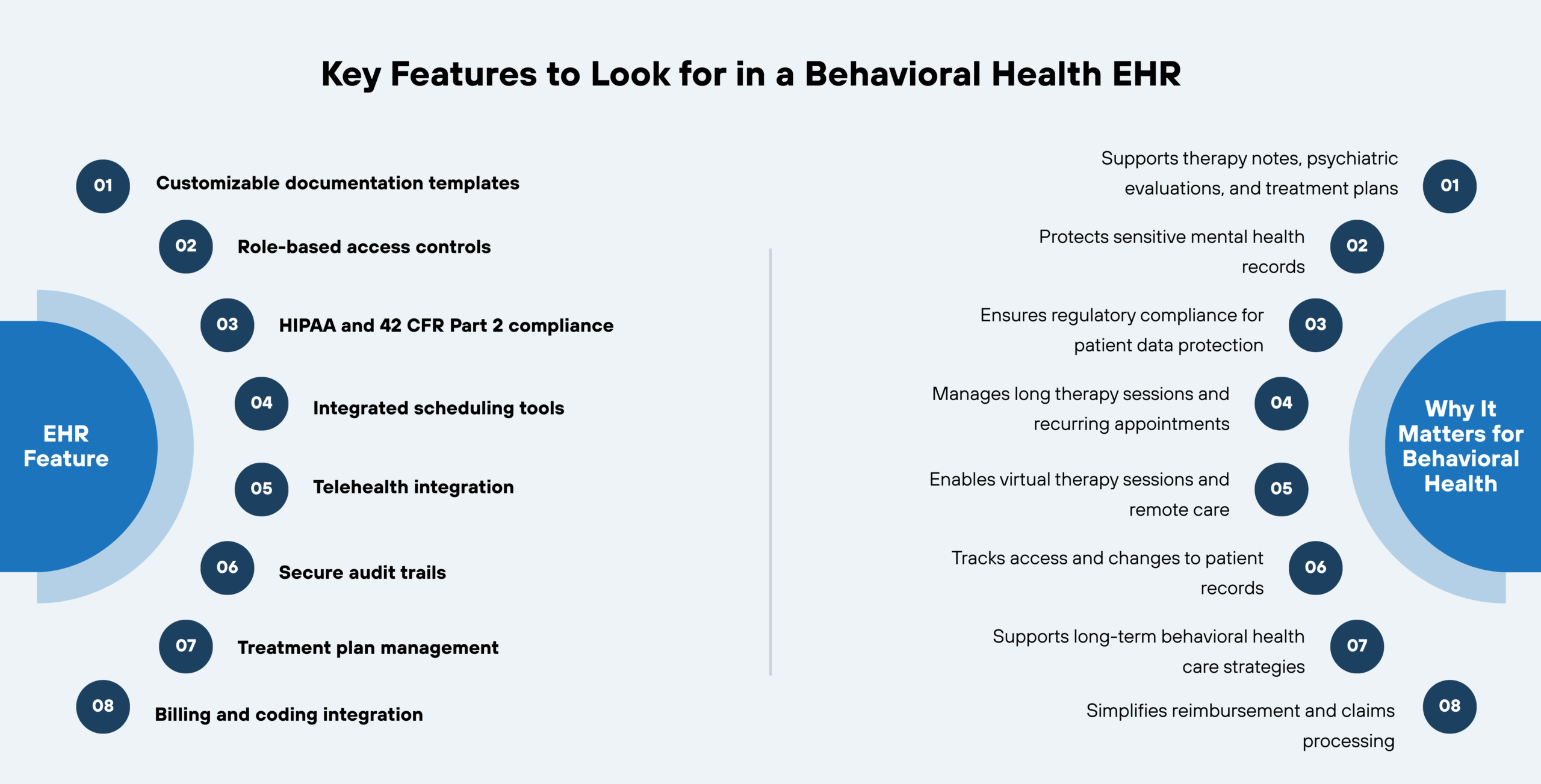
When selecting an EHR system for a behavioral health practice, healthcare administrators and decision-makers should evaluate whether the platform supports the specialized needs of mental health providers.
The following table highlights some of the most important capabilities that behavioral health organizations should consider when evaluating EHR solutions.
Choosing an EHR system that includes these capabilities can significantly improve operational efficiency while ensuring compliance with behavioral health regulations.
Behavioral health providers need technology solutions that balance clinical flexibility with strong compliance safeguards. A well-designed EHR platform can simplify documentation, protect sensitive patient data, and streamline clinical workflows.
With features that support structured documentation, privacy controls, and integrated workflows, Maximus EHR enables behavioral health practices to maintain accurate records while reducing administrative workload. Healthcare organizations can benefit from improved operational visibility, stronger data protection, and more efficient clinical processes.
By adopting an EHR platform built with behavioral health requirements in mind, providers can focus more on delivering quality care while ensuring compliance with evolving healthcare regulations.
Behavioral health practices operate within a complex clinical and regulatory environment that requires specialized technology solutions. Standard EHR systems may not provide the documentation flexibility, privacy protections, or workflow capabilities needed to support mental health providers effectively.
A behavioral health EHR must support detailed clinical documentation, comply with strict privacy regulations such as HIPAA and 42 CFR Part 2, and streamline the daily workflows of therapists, psychiatrists, and care teams.
For healthcare administrators and decision-makers, selecting the right EHR platform is a strategic decision that directly impacts patient care, operational efficiency, and regulatory compliance.
Maximus EHR helps mental health providers simplify documentation, ensure HIPAA and 42 CFR Part 2 compliance, and streamline clinical workflows. Start your 3-month free trial today.