Best EHR Features for Multi-Specialty Clinics

Best EHR Features for Multi-Specialty Clinics

Table of Contents

Multi-specialty clinics operate in a complex healthcare environment where multiple providers, specialties, and workflows intersect every day. From cardiology and orthopedics to primary care and behavioral health, these practices must manage diverse clinical needs while maintaining efficient operations and high standards of patient care.
In such settings, choosing the right Electronic Health Record (EHR) system becomes critical. A standard EHR may support basic documentation and scheduling, but multi-specialty clinics require more advanced capabilities that allow different departments to work seamlessly within one platform.
The best EHR systems for multi-specialty practices provide integrated workflows, customizable documentation tools, strong interoperability, and advanced reporting capabilities. In this blog, we explore the key EHR features that help multi-specialty clinics improve operational efficiency, enhance patient care, and support long-term growth.

Challenges Faced by Multi-Specialty Clinics

Multi-specialty clinics operate differently from single-specialty practices. Instead of managing one type of clinical workflow, they must support multiple specialties, each with unique documentation standards, treatment protocols, and billing requirements.
One major challenge is coordinating patient care across departments. A patient may visit a primary care physician, receive a referral to a cardiologist, and later undergo diagnostic testing in another department. Without an integrated EHR system, information sharing between providers can become fragmented, leading to delays and potential gaps in care.
Another challenge involves managing different documentation templates. Each specialty requires its own clinical forms, assessment tools, and treatment documentation. If an EHR system lacks customization options, clinicians may struggle to record accurate patient data efficiently.
Billing complexity also increases in multi-specialty settings. Different specialties often use different coding structures, reimbursement models, and insurance requirements. Without an integrated billing system within the EHR, administrative teams may experience delays in claims processing and revenue cycle management.
Because of these challenges, multi-specialty clinics require EHR platforms designed to handle diverse clinical workflows while maintaining a unified patient record.
EHR Features for Multi-Specialty

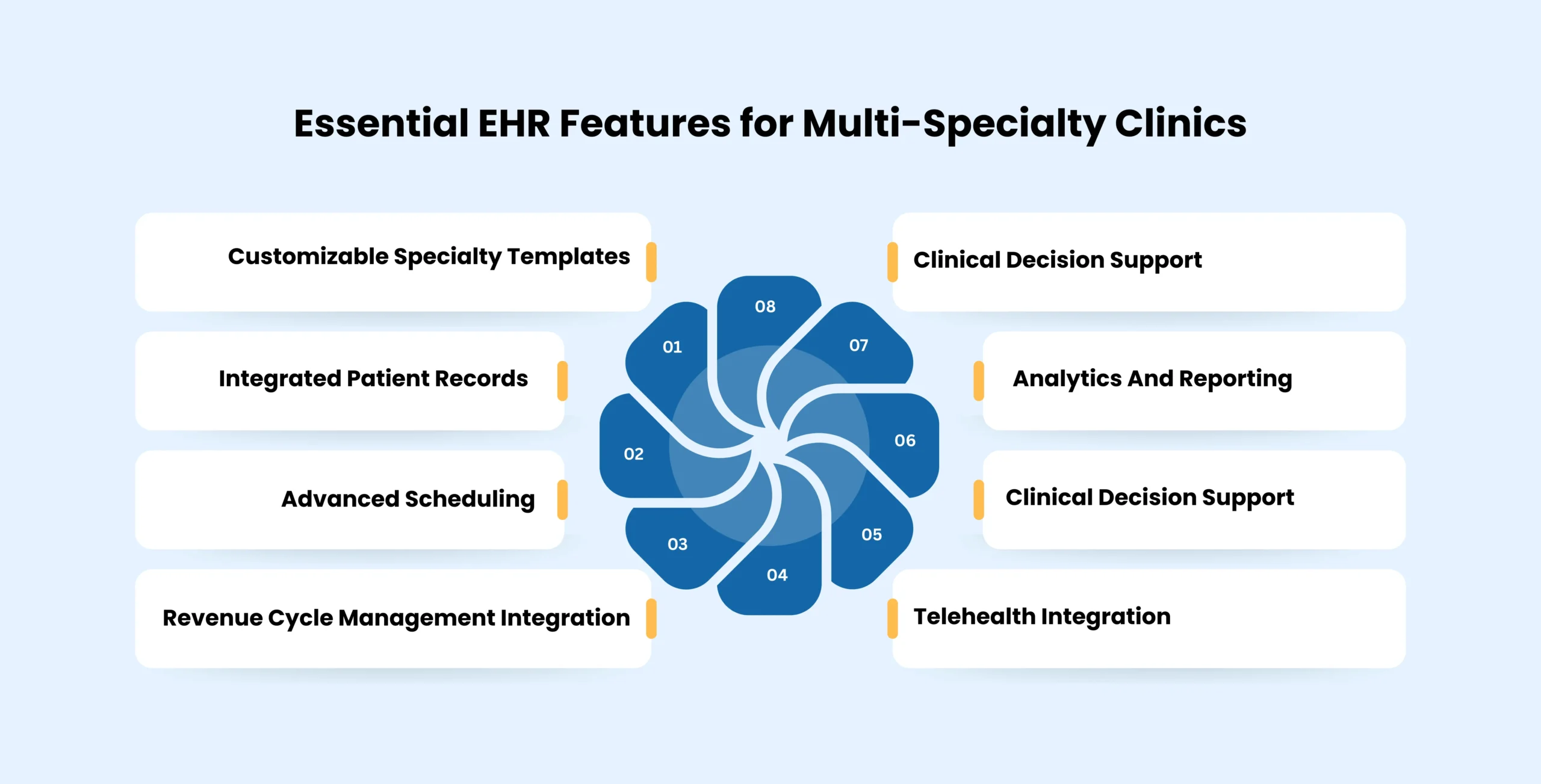
Essential EHR Features for Multi-Specialty Clinics

When evaluating EHR solutions, healthcare administrators and decision-makers should look for features that support both clinical and operational needs across departments. The right system should improve collaboration between providers while reducing administrative workload.
The table below highlights some of the most important EHR features that multi-specialty clinics should prioritize.
EHR Feature Why It Matters for Multi-Specialty Clinics
Customizable specialty templates
Allows each department to document patient encounters using specialty-specific forms
Integrated patient records
Provides a unified patient history accessible across all specialties
Interoperability
Enables secure data exchange with labs, pharmacies, and external providers
Advanced scheduling
Supports complex scheduling across multiple providers and departments
Revenue cycle management integration
Streamlines billing, coding, and claims submission
Clinical decision support
Helps providers make informed treatment decisions
Analytics and reporting
Provides insights into operational performance and patient outcomes
Telehealth integration
Supports remote consultations across specialties
These features help ensure that clinicians, administrators, and support staff can work within a single system while meeting the unique needs of different specialties.

How EHR Systems Improve Workflow and Collaboration

One of the biggest advantages of a modern EHR system is its ability to improve workflow efficiency and collaboration across departments.
In multi-specialty clinics, providers often rely on referrals and coordinated care. For example, a patient visiting a primary care physician may be referred to a specialist within the same clinic. With an integrated EHR system, the specialist can immediately access the patient’s medical history, diagnostic results, and previous treatment notes.
This seamless information sharing reduces duplicate tests, improves diagnostic accuracy, and enhances the overall patient experience.
Another important workflow improvement involves scheduling and patient management. Multi-specialty clinics typically handle high patient volumes, making efficient scheduling essential. EHR systems with advanced scheduling tools allow administrative staff to coordinate appointments across departments, manage provider availability, and reduce scheduling conflicts.
EHR platforms also support automated administrative tasks such as appointment reminders, prescription management, and follow-up care coordination. These capabilities reduce manual workload and allow clinical staff to focus more on patient care.
Collaboration tools within EHR systems further enhance communication between care teams. Secure messaging, shared care plans, and integrated documentation allow providers from different specialties to work together more effectively.
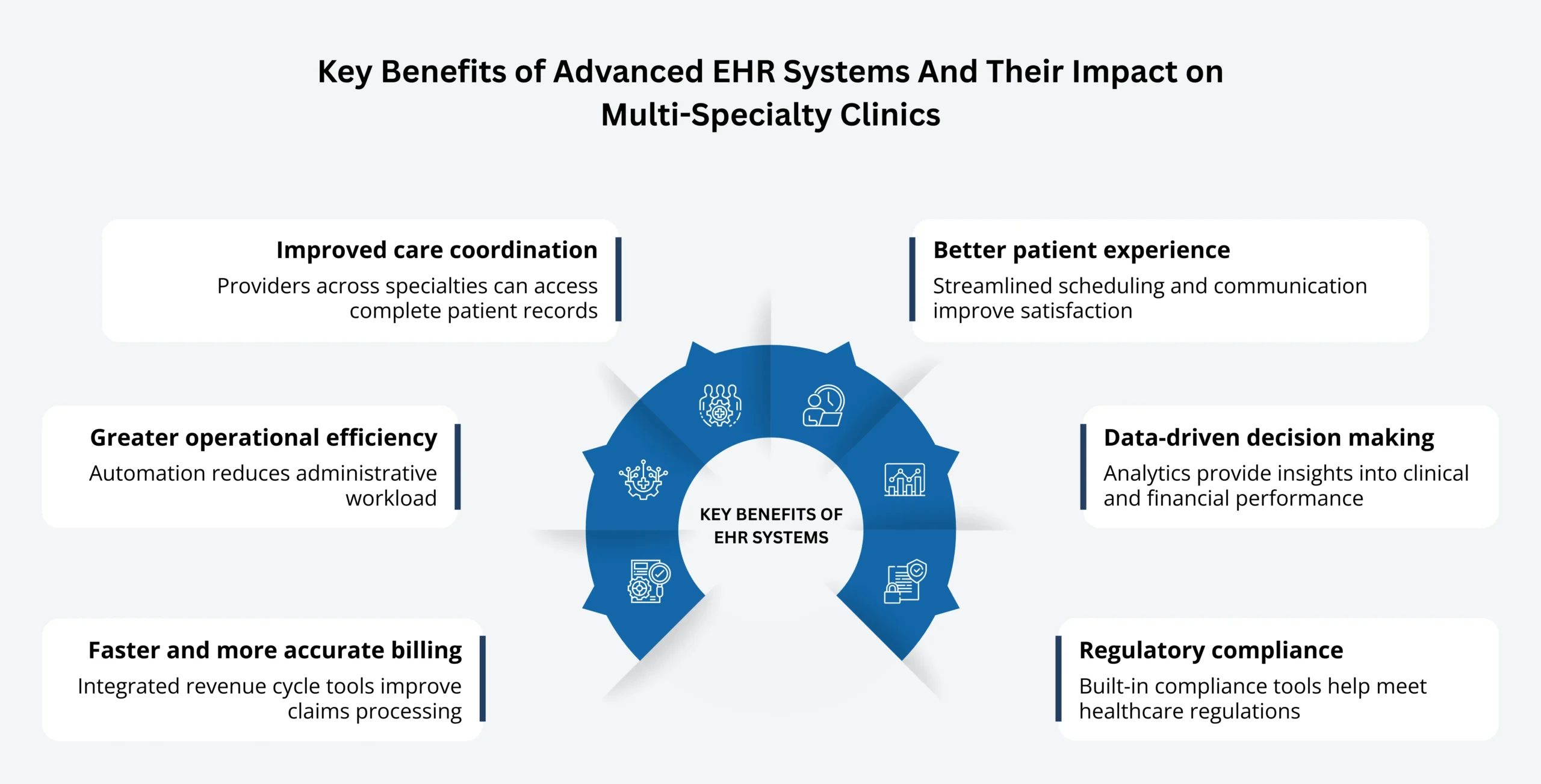
Key Benefits of Advanced EHR Systems

Key Benefits of Advanced EHR Systems

Implementing a robust EHR platform offers several benefits for multi-specialty clinics beyond documentation and workflow management.
The table below outlines some of the key advantages healthcare organizations can expect when using an advanced EHR system.
Benefit Impact on Multi-Specialty Clinics
Improved care coordination
Providers across specialties can access complete patient records
Greater operational efficiency
Automation reduces administrative workload
Faster and more accurate billing
Integrated revenue cycle tools improve claims processing
Better patient experience
Streamlined scheduling and communication improve satisfaction
Data-driven decision making
Analytics provide insights into clinical and financial performance
Regulatory compliance
Built-in compliance tools help meet healthcare regulations
These benefits highlight why many healthcare organizations are prioritizing modern EHR platforms as part of their digital transformation strategies.
When implemented effectively, EHR systems not only improve day-to-day operations but also support long-term growth and scalability for healthcare organizations.

How Maximus EHR Supports Multi-Specialty Clinics

For healthcare administrators and decision-makers evaluating EHR solutions, selecting a platform that supports diverse clinical environments is essential.

Maximus EHR is designed to address the complex needs of multi-specialty clinics by providing an integrated system that connects providers, departments, and administrative teams within a single platform. The system supports customizable documentation templates that allow each specialty to maintain its own clinical workflows while contributing to a unified patient record.

Maximus EHR also includes advanced scheduling capabilities that help clinics manage multiple providers and specialties efficiently. By centralizing scheduling, patient information, and clinical documentation, the platform enables healthcare teams to coordinate care more effectively.
Another key advantage of Maximus EHR is its integrated revenue cycle management functionality. Multi-specialty clinics often deal with complex billing requirements, and having billing tools built directly into the EHR can significantly improve claims accuracy and reimbursement timelines.
In addition, the platform supports interoperability with external healthcare systems, allowing providers to exchange data securely with laboratories, pharmacies, and other healthcare organizations.

With these capabilities, Maximus EHR helps multi-specialty clinics streamline operations, improve care coordination, and maintain compliance with healthcare regulations.

Conclusion

Multi-specialty clinics require technology solutions that can support diverse clinical workflows while maintaining operational efficiency. A well-designed EHR system serves as the central hub that connects providers, departments, and administrative teams within a unified healthcare environment.
From customizable documentation templates to advanced scheduling and integrated billing tools, the right EHR features can significantly improve both clinical and operational performance.
For healthcare providers and administrators evaluating EHR systems, it is important to prioritize platforms that offer flexibility, interoperability, and robust analytics capabilities.
Solutions like Maximus EHR are built to support the unique needs of multi-specialty clinics, helping healthcare organizations manage complex workflows while delivering high-quality patient care.
By investing in the right EHR technology, multi-specialty practices can improve collaboration, streamline operations, and position themselves for sustainable growth in an increasingly digital healthcare landscape.

Run Your Multi-Specialty Clinic on One Powerful EHR

Maximus EHR connects providers, specialties, and billing teams in one cloud platform. Improve coordination, streamline workflows, and deliver better patient care. Schedule your free demo today.

FAQs

What is a multi-specialty EHR system?
A multi-specialty EHR system is an electronic health record platform designed to support multiple medical specialties within a single practice. It allows providers from different departments to access unified patient records while using specialty-specific documentation templates, workflows, and billing processes.
What features should multi-specialty clinics look for in an EHR?
Multi-specialty clinics should prioritize features such as customizable specialty templates, integrated patient records, advanced scheduling tools, interoperability with external healthcare systems, revenue cycle management integration, and analytics reporting. These capabilities help providers manage diverse clinical workflows while maintaining efficient operations.
How does an EHR improve care coordination in multi-specialty clinics?
An EHR improves care coordination by giving providers across specialties access to a single, comprehensive patient record. This allows physicians to review previous diagnoses, test results, medications, and treatment plans, which reduces duplicate testing and helps ensure more informed clinical decisions.
Why is interoperability important for multi-specialty clinics?
Interoperability allows EHR systems to exchange patient data securely with external healthcare organizations such as hospitals, laboratories, pharmacies, and referral providers. For multi-specialty clinics, this ensures that patient information flows smoothly between different providers and care settings, improving both efficiency and patient outcomes.
How can the right EHR improve operational efficiency in multi-specialty practices?
The right EHR can streamline workflows by automating administrative tasks such as appointment scheduling, billing, documentation, and patient communication. Integrated revenue cycle management tools also help clinics reduce claim denials and improve reimbursement timelines, leading to better financial performance.