Accurate clinical documentation is essential for effective healthcare delivery. Every patient interaction, diagnosis, treatment decision, and follow-up plan depends on the quality and completeness of medical records. When documentation lacks detail or structure, it can lead to miscommunication, incorrect treatment plans, and compliance challenges.
Electronic Health Records (EHRs) were introduced to improve documentation efficiency and accessibility. However, many healthcare providers still struggle with generic templates that fail to capture the specific requirements of different medical specialties. These generalized documentation formats often create inefficiencies and increase the likelihood of incomplete or inaccurate records.
Specialty-specific templates address this challenge by aligning documentation workflows with the needs of individual medical disciplines. By guiding providers through structured, specialty-focused documentation, these templates help improve clinical accuracy while reducing administrative burden.
Modern healthcare technology solutions, such as Maximus EHR, support customizable documentation templates that enable providers to tailor workflows to their clinical specialties. This approach enables healthcare organizations to maintain accurate records while improving overall operational efficiency.
Specialty-specific templates are documentation frameworks within an EHR system designed to align with the workflows and clinical requirements of specific medical specialties. Rather than using a one-size-fits-all structure, these templates organize documentation fields, prompts, and data-entry sections according to how providers in a specific field conduct patient evaluations.
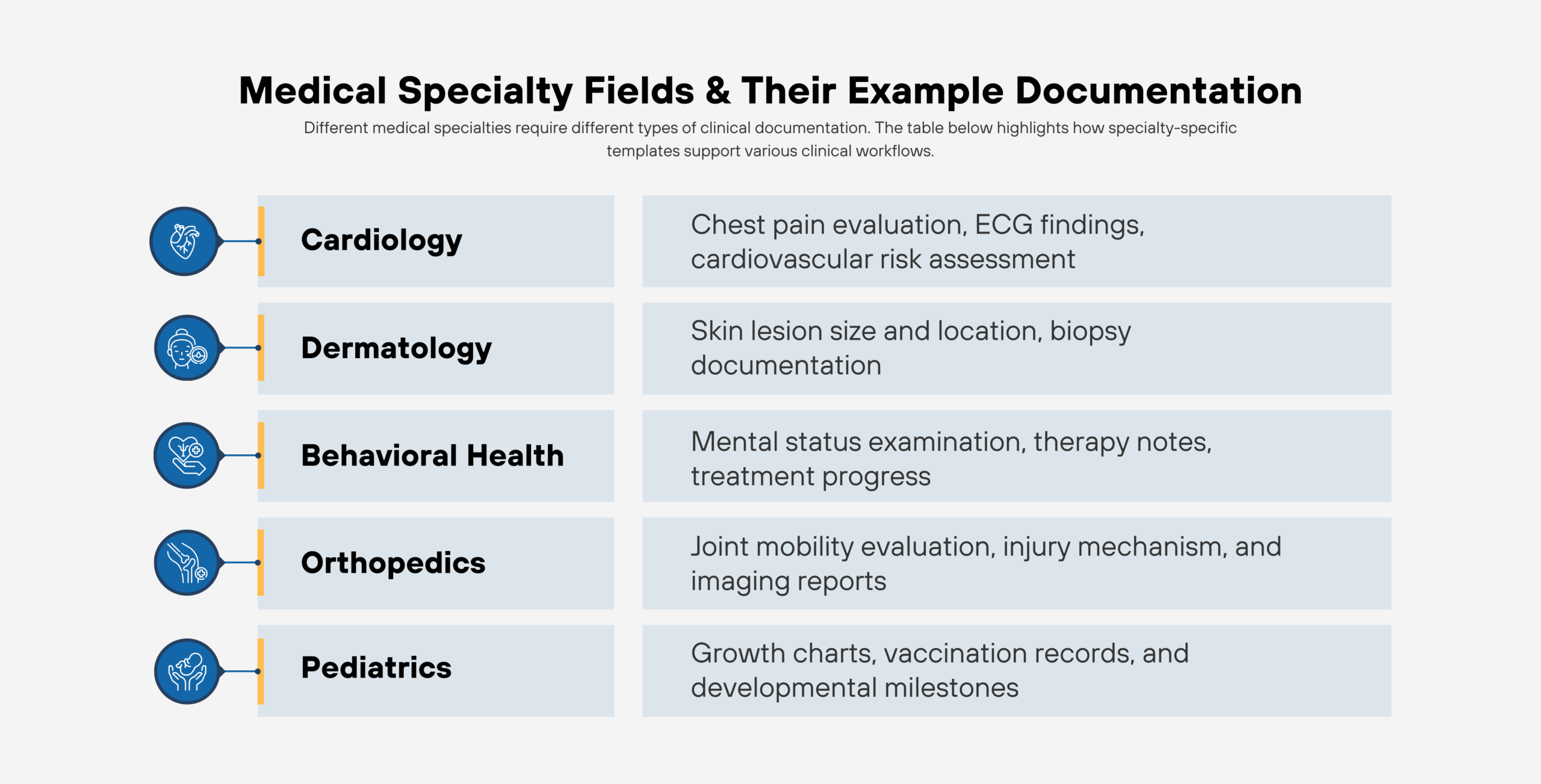
For example, a cardiologist documenting a patient visit will need to record details of cardiovascular symptoms, diagnostic test results (e.g., ECG), and cardiac risk factors. Meanwhile, a behavioral health provider may need structured sections for mental status evaluations, therapy notes, and treatment progress tracking. Specialty templates ensure that each provider has access to documentation tools that reflect the needs of their field.
By incorporating specialty-focused fields and prompts, these templates guide clinicians through patient documentation in a structured and consistent way. This reduces the chances of missing important clinical information and improves the overall quality of patient records.
Accurate documentation also plays a critical role in care coordination. In many healthcare environments, multiple providers may be involved in a patient’s care. If documentation is unclear or inconsistent, it becomes difficult for providers to understand the patient’s medical history and treatment plan fully.
In addition, regulatory compliance requirements make proper documentation essential. Healthcare organizations must adhere to strict documentation standards for auditing, reporting, and reimbursement processes. Specialty-focused templates help ensure that required data points are consistently captured.
Generic documentation templates are intended to serve all medical specialties using the same format. While this approach may seem efficient from a system design perspective, it often fails to meet the practical needs of healthcare providers.
When clinicians must adapt their documentation to fit a general template, several problems can arise. Important specialty-specific data fields may be missing, forcing providers to rely heavily on free-text notes. This reduces the consistency and structure of patient records, making it harder to extract meaningful clinical insights.
Another challenge is workflow inefficiency. Generic templates often contain irrelevant fields that do not apply to certain specialties. Providers must spend additional time navigating these fields, which slows down the documentation process and increases administrative workload.
Over time, these inefficiencies contribute to provider frustration and burnout. When documentation systems fail to align with clinical workflows, providers may view them as obstacles rather than helpful tools.
Specialty-specific templates are designed to reflect the real-world workflows of healthcare providers. By organizing documentation according to specialty-specific clinical processes, these templates help ensure that providers capture essential patient information during every encounter.
One of the key advantages of specialty templates is their ability to guide providers through structured documentation pathways. Instead of relying entirely on memory or manual note-taking, clinicians are prompted to record important clinical details relevant to their field. This structured guidance reduces the likelihood of missing important patient information.
Specialty templates also improve data consistency across healthcare organizations. When providers document patient encounters using standardized templates, it becomes easier to maintain uniform documentation practices. This consistency improves the reliability of patient records and supports better communication among healthcare teams.
Another important benefit is improved efficiency. When documentation templates are tailored to a provider’s specialty, clinicians can complete charting more quickly because they are only interacting with fields that are relevant to their practice. This streamlined approach reduces documentation time and enables providers to focus more on patient care.
Different medical specialties require different types of clinical documentation. The table below highlights how specialty-specific templates support various clinical workflows.
These examples demonstrate how specialty-focused templates ensure providers capture the most relevant clinical information during patient visits.
The use of specialty-specific templates provides significant advantages for both healthcare providers and healthcare organizations. When documentation processes align with clinical workflows, providers can work more efficiently while maintaining high documentation standards.
For healthcare organizations, structured specialty documentation improves the quality of clinical data available for analysis. This data can support quality improvement initiatives, clinical research, and population health management efforts.
Another important benefit is improved coding and billing accuracy. When patient encounters are documented using structured templates that capture essential clinical details, it becomes easier for billing teams to apply the appropriate medical codes and submit accurate insurance claims.
In addition, consistent documentation practices facilitate organizations’ compliance with requirements and preparation for regulatory audits.
Selecting an EHR system that supports specialty-specific documentation is essential for healthcare organizations seeking to improve clinical accuracy. Not all EHR platforms offer the same level of customization or flexibility.
Solutions like Maximus EHR enable healthcare organizations to design specialty-specific templates that support structured documentation, improve workflow efficiency, and enhance clinical data accuracy.
By implementing an EHR system that supports specialty workflows, healthcare organizations can reduce administrative burdens while improving the quality of patient records.
Clinical documentation is one of the most critical components of healthcare delivery. When patient records are accurate, structured, and comprehensive, providers can make better clinical decisions and deliver higher-quality care.
By guiding providers through structured documentation processes, these templates improve clinical accuracy, reduce documentation errors, and enhance efficiency across healthcare organizations.
Maximus EHR provides customizable specialty-specific templates that improve accuracy, streamline workflows, and reduce documentation time. Schedule a free demo today and see how smarter EHR tools support better patient care.