Electronic Health Records (EHRs) have become essential across the US healthcare system. From improving clinical workflows to strengthening patient outcomes, EHRs are meant to simplify the care experience. Yet for many hospitals and medical practices, the reality is different. Instead of boosting efficiency, outdated or poorly designed EHR systems often create friction. This slows clinicians down, increasing burnout and interrupting patient care.
But the challenges are not permanent. With the right strategies, healthcare organizations can overcome these obstacles and unlock the full value of their EHR.
Below are five of the most common EHR challenges US healthcare providers face today, and how to overcome them effectively.
A major pain point for healthcare providers is poor EHR usability. Many systems require too many clicks, have cluttered interfaces, or don’t align with the natural flow of clinical decision-making. This leads to:
In fast-paced environments like emergency departments, specialty clinics, and multi-location practices, these inefficiencies add up quickly.
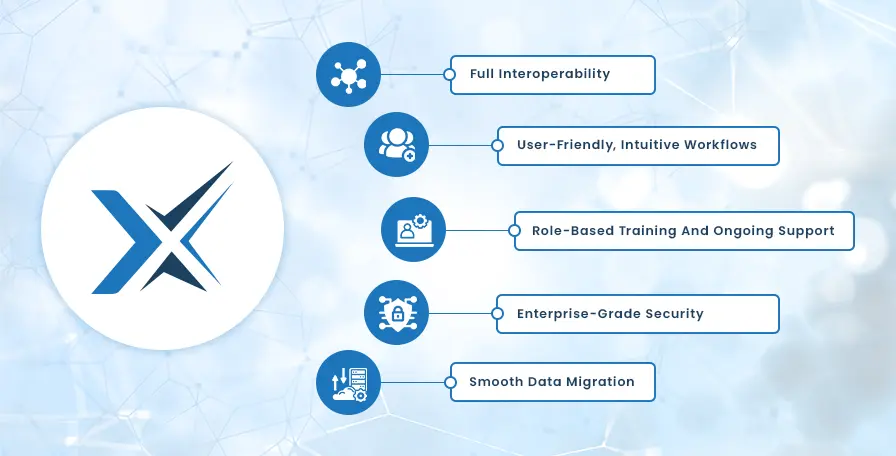
Choose an EHR built around clinical workflows, not the other way around. Healthcare organizations should prioritize systems that provide:
This ensures clinicians can document faster, spend more time with patients, and maintain productivity even during peak hours.
Interoperability remains one of the biggest hurdles in US healthcare. Many EHRs still fail to communicate effectively with:
As a result, providers waste valuable time manually importing data, chasing records, or dealing with incomplete patient histories, which can directly affect care quality.
Prioritize an EHR with strong interoperability and real-time integrations. Key features include:
Data migration is one of the most stressful steps when transitioning to a new EHR. Practices often struggle with:
For large hospitals or multi-specialty practices managing thousands of records, even minor errors can cause delays or compliance risks.
Work with an EHR partner that offers structured, guided data migration. The ideal approach includes:
The right system ensures a seamless transition, without losing critical patient data or interrupting appointments.
An EHR is only as powerful as its users. Many healthcare practices struggle because:
This leads to inconsistent documentation, billing errors, reduced productivity, and user frustration.
When users feel confident, the EHR becomes a powerful asset instead of a daily obstacle.
With cyberattacks on US healthcare providers rising each year, EHR security is more critical than ever. Common issues include:
A single breach can result in serious HIPAA violations, financial penalties, downtime, and reputational damage.
Strengthen your EHR infrastructure with modern security protocols, including:
US healthcare has evolved rapidly, and so have patient expectations. Providers need an EHR that:
The right EHR isn’t just a tool; it’s a long-term partner in improving quality of care, optimizing operations, and helping practices grow.
Whether you’re a single-provider practice, a multi-specialty group, or a large US hospital, Maximus EHR is built to scale with your needs, helping you deliver better care with less administrative stress.
It is important to understand that EHR challenges are common, but they’re also solvable. By choosing a modern, interoperable, secure system designed with clinicians in mind, healthcare organizations can eliminate inefficiencies, reduce burnout, and improve the overall patient experience.
If you’re tired of fighting your EHR, it might be time to explore a solution built for your workflow, not against it.
Experience an EHR that actually makes your work easier. Book a Free Demo of Maximus EHR Today Let’s streamline your workflows, strengthen compliance, and help your practice grow.