Automating Clinical Reminders Without Losing the Human Touch

Automating Clinical Reminders Without Losing the Human Touch

Table of Contents

Introduction

Healthcare today is evolving at a pace that requires efficiency and patient experience to go hand in hand. Clinics, hospitals, and private practices are constantly looking for ways to streamline operations without compromising the quality of care they provide. One of the most critical yet often overlooked areas in this equation is patient communication, specifically, clinical reminders.

Appointment reminders, follow-up notifications, and care alerts are essential for keeping patients engaged and on track with their treatment plans. However, managing these reminders manually can quickly become overwhelming, especially as patient volumes grow.

This is where automation steps in as a powerful solution. But with that comes an important question: can automation maintain the empathy and personal connection that patients expect from healthcare providers? The answer lies in finding the right balance.

Why Clinical Reminders Matter More Than Ever

Clinical reminders are no longer just operational tools; they directly influence patient outcomes, adherence, and overall experience.
They help ensure that patients stay informed, prepared, and connected throughout their care journey. When reminders are timely and clear, patients are more likely to follow through with appointments and treatment plans.
From a business perspective, reminders also stabilize workflows. Missed appointments create scheduling gaps, disrupt staff productivity, and impact revenue. A well-structured reminder system minimizes these inefficiencies and creates a more predictable operational flow.

The Problem with Traditional Reminder Systems

Traditional reminder methods often rely heavily on manual effort. While they may seem personal, they lack consistency and scalability.
Staff members are required to spend hours making calls or sending messages, which not only reduces efficiency but also introduces the risk of human error. Some patients may receive reminders late, while others may not receive them at all.
As practices grow, these inefficiencies compound, leading to workflow bottlenecks and increased administrative burden. Over time, this approach becomes unsustainable.

What Automation Brings to Healthcare

Automation changes the way healthcare providers approach communication. Instead of relying on manual processes, reminders can be scheduled and delivered automatically, ensuring consistency and reliability.
Automated systems allow providers to reach patients through multiple channels, including SMS, email, and app notifications. This flexibility increases engagement while catering to individual patient preferences.
Another major advantage is visibility. Providers can track which reminders are delivered, opened, and acted upon. This data provides valuable insights into patient behavior and helps refine communication strategies.

The Risk: Losing the Human Touch

Despite its advantages, automation raises an important concern: the loss of the personal connection that defines healthcare.
Patients want to feel seen and understood, not like they are part of a system. Generic, robotic messages can create distance and reduce engagement.

However, this risk is not caused by automation itself, but by how it is implemented. When designed thoughtfully, automation can actually enhance communication rather than diminish it.
How to Balance Automation with Personalization

How to Balance Automation with Personalization

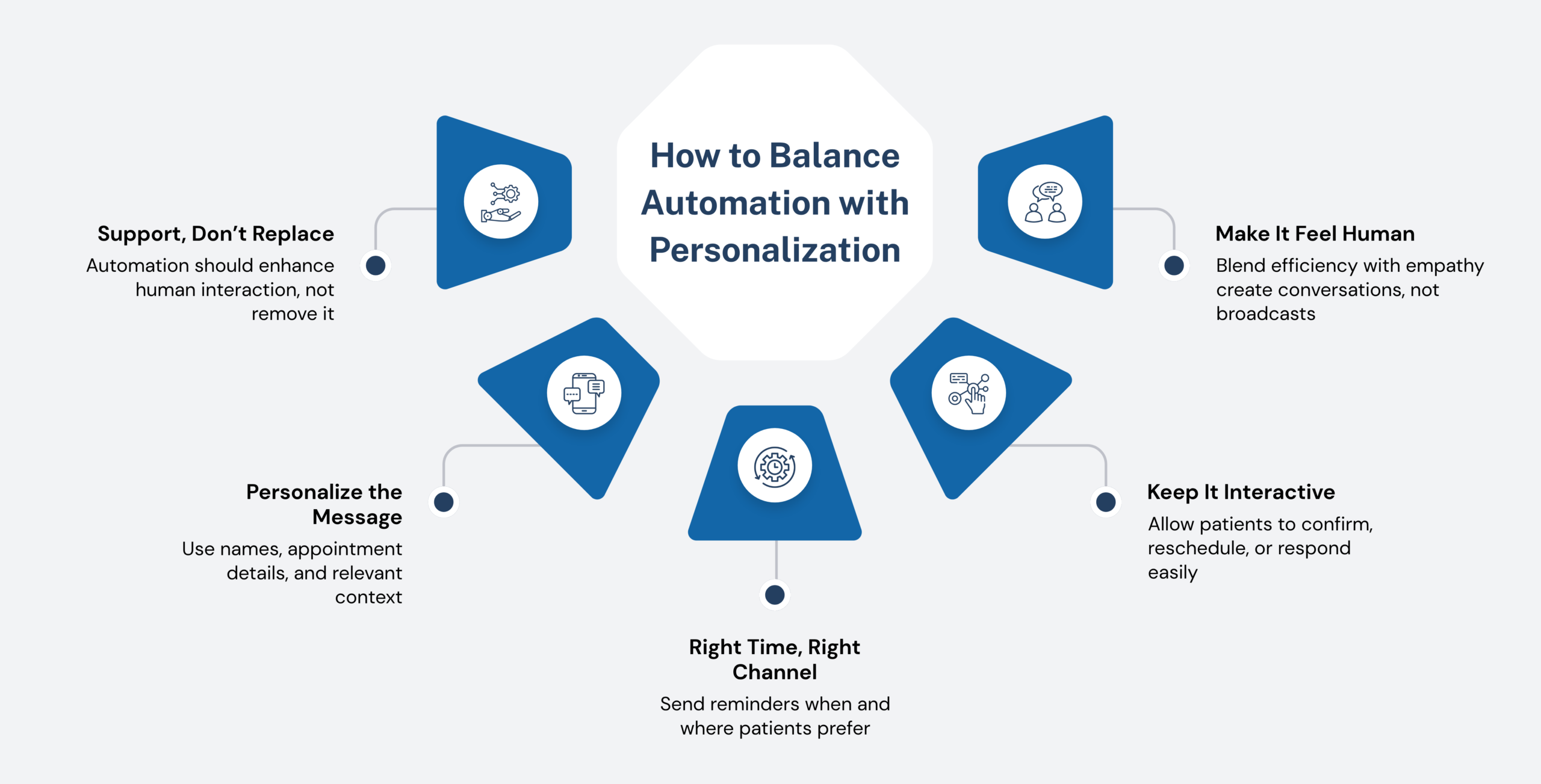
Balancing efficiency with empathy requires a strategic approach. Automation should not replace human interaction; it should support it.
Personalization plays a critical role here. By using patient data effectively, reminders can feel tailored and relevant rather than generic. Including patient names, appointment details, and context-specific instructions makes communication more meaningful.
Timing and delivery also matter. Sending reminders at appropriate times and through preferred channels increases the likelihood of engagement while showing respect for the patient’s routine.
Most importantly, communication should remain interactive. Patients should be able to confirm, reschedule, or respond easily, ensuring that automation feels like a conversation rather than a broadcast.

Key Features of an Effective Reminder System

To achieve this balance, healthcare providers need systems designed with both efficiency and patient experience in mind.
An effective reminder system should include:
These features ensure that automation enhances the care experience rather than making it feel impersonal.

Real Impact: Automation vs Manual Processes

The operational difference between manual and automated systems is significant:
Aspect Manual Reminders Automated Reminders
Time Required
High (hours daily)
Minimal
Accuracy
Prone to errors
Highly reliable
Scalability
Limited
Easily scalable
Patient Experience
Inconsistent
Consistent & personalized
Staff Workload
High
Significantly reduced
Tracking
Limited
Advanced analytics
Automation not only improves efficiency but also creates a more reliable and patient-friendly system.

Best Practices for Human-Centered Automation

To implement automation effectively, healthcare providers must focus on maintaining a patient-first approach. Technology should enhance communication, not replace the human element behind it.
Here’s how leading practices are doing it:
Best Practice Why It Matters
Personalize communication
Makes patients feel valued and understood
Avoid over-messaging
Prevents fatigue and improves engagement
Enable easy responses
Maintains a human, empathetic feel
Keep the tone conversational
Encourages interaction and convenience
Continuously optimize
Improves performance using real data
By following these practices, providers can ensure that automation strengthens patient relationships instead of weakening them.
The Future of Patient Communication

The Future of Patient Communication

Automation is reshaping healthcare communication, but its true value lies in how it is used. When implemented thoughtfully, it allows providers to deliver consistent, timely, and meaningful communication at scale.
Clinical reminders are no longer just operational tools; they are a key part of the patient experience. By combining automation with personalization, healthcare providers can create systems that are both efficient and empathetic.

Why Maximus EHR is the Right Choice

Achieving the right balance between automation and personalization requires the right technology.

Maximus EHR empowers healthcare providers to automate clinical reminders while maintaining a personalized, patient-first approach. Intelligent workflows, customizable messaging, and seamless integration help reduce no-shows, improve engagement, and streamline operations.

If you’re looking to modernize your patient communication without losing the human touch, Maximus EHR is built to help you do exactly that.

Automate Reminders Without Losing Patient Connection

Maximus EHR delivers smart, personalized reminders that reduce no-shows and keep patients engaged. Start your free trial today and transform patient communication.

FAQs

How do automated clinical reminders improve patient engagement?
Automated clinical reminders ensure that patients receive timely and consistent communication about their appointments, follow-ups, and care plans. This reduces the chances of missed appointments and helps patients stay more involved in their healthcare journey, ultimately improving engagement and adherence.
Can automated patient reminders still feel personal?
Yes, modern reminder systems allow for personalization using patient data such as names, appointment details, and treatment context. When combined with the right tone and timing, automated reminders can feel just as personal as manual communication, if not more consistent.
Are automated reminder systems HIPAA compliant?
Most advanced healthcare reminder systems, especially those integrated within EHR platforms, are designed to be HIPAA compliant. They include secure messaging protocols to protect patient data and ensure privacy in all communications.
How do automated reminders help reduce no-show rates?
Automated reminders notify patients in advance and often include follow-up alerts closer to the appointment time. This consistent communication significantly reduces forgetfulness, which is one of the leading causes of no-shows in healthcare practices.
What should healthcare providers look for in a reminder system?
Healthcare providers should look for features like customizable messaging, multi-channel communication (SMS, email, app), two-way interaction, EHR integration, and real-time analytics. These features ensure both efficiency and a better patient experience.