How Automation in EHRs Improves Accuracy Without Replacing Clinicians

How Automation in EHRs Improves Accuracy Without Replacing Clinicians

Introduction

When people hear the word “automation” in a clinical context, it’s easy to picture robots replacing doctors or algorithms making diagnoses. The reality is far less dramatic and far more useful. EHR automation is not about replacing clinicians. It’s about giving them the tools to do their jobs with fewer errors, less paperwork, and more time for actual patient care.

Physician burnout is at an all-time high, and documentation is a leading driver. According to 2025 research by Tebra, documentation is now the top cause of physician burnout. For every 15 minutes spent with a patient, clinicians spend an average of 9 minutes on charting. That math adds up to a lot of time away from care and a lot of room for human error in manual entry.
This is where smart EHR automation steps in, not to take over clinical thinking, but to handle the repetitive, error-prone administrative tasks that drain time and focus. Platforms like Maximus EHR are built with exactly this balance in mind.

What Is EHR Automation?

EHR automation refers to the use of artificial intelligence (AI), natural language processing (NLP), machine learning, and rule-based logic to handle tasks within an electronic health records system that would otherwise require manual input. These tasks include:
  • Auto-populating patient data fields from previous records
  • Flagging drug interactions and allergy conflicts in real time
  • Generating clinical notes from physician-patient conversations using ambient AI
  • Automating medical coding (ICD-10, CPT) from documentation
  • Sending appointment reminders, follow-up prompts, and care gap alerts
  • Organizing lab results and imaging findings for quick review
None of these tasks requires a clinical decision. What they do require is accuracy, consistency, and speed. Automation handles all three better than manual processes in most cases.
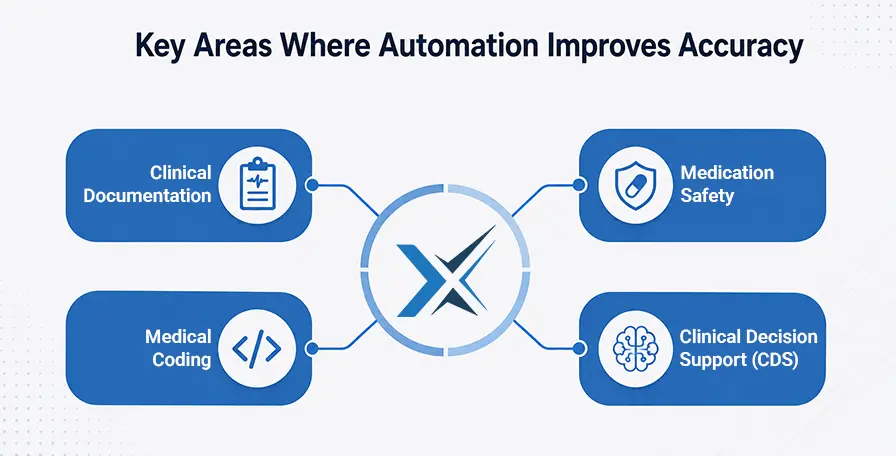
Key Areas Where Automation Improves Accuracy

Key Areas Where Automation Improves Accuracy

Clinical Documentation

Manual documentation is time-consuming and inconsistent. Ambient AI scribes listen to patient-clinician conversations and generate structured notes in real time, which the physician then reviews and approves. A 2025 University of Wisconsin study found that ambient AI documentation reduced clinician charting time by 30 minutes per day and improved billing accuracy for diagnosis notes. A separate trial using the Abridge AI tool showed documentation time per encounter dropped from 6.2 to 5.3 minutes.
The result is cleaner, more complete notes with fewer copy-paste errors, which is a well-documented source of documentation problems in EHRs.

Medical Coding

ICD-10 and CPT coding are one of the most error-prone parts of healthcare administration. Upcoding, undercoding, and unbundling are common issues that lead to claim denials, revenue loss, and compliance risk. NLP-driven coding tools within modern EHRs read physician notes and automatically assign accurate codes, catching what a manual coder might miss. This directly reduces denial rates and improves your clean claims rate.

Medication Safety

Automated drug interaction alerts and allergy checks within EHRs are one of the clearest examples of automation improving patient safety. According to the Merck Manual’s 2024-updated clinical guidance, automated dosing error detection and drug-drug interaction flags have measurable potential to reduce medication errors. These alerts don’t override the physician’s judgment. They surface critical information at the right moment so the clinician can make a better-informed decision.

Clinical Decision Support (CDS)

AI-powered clinical decision support tools analyze patient records to flag risk factors, suggest relevant screenings, and even predict disease progression based on historical data. These tools are designed to assist clinical thinking, not replace it. The physician still makes the call. The system just makes sure they have the right information in front of them when they do.
Automation Area Accuracy Benefit Time Saved
Ambient AI Documentation
Reduces copy-paste errors and incomplete notes
Up to 30 min/day per clinician
Automated Coding (ICD-10/CPT)
Fewer claim denials, better clean claims rate
Significant reduction in manual coding time
Drug Interaction Alerts
Real-time flagging reduces medication errors
Instant vs. manual cross-referencing
Clinical Decision Support
Risk flags and screening reminders surfaced at the point of care
Avoids missed diagnoses and redundant tests
Automated Lab Result Routing
Results reach the right provider faster
Eliminates manual sorting and routing delays

The Human Touch: What Automation Cannot Replace

Automation handles data. Clinicians handle people. No algorithm can replicate the empathy, contextual reasoning, and ethical judgment that a trained physician brings to a patient encounter. Here is what will always remain in human hands:
  • Diagnosing complex, ambiguous presentations where data is incomplete
  • Building trust and communicating difficult news to patients and families
  • Making nuanced treatment decisions where values and patient preferences matter
  • Advocating for patients when clinical guidelines don’t fit individual circumstances
  • Ethical decision-making in end-of-life care or high-risk interventions
AI and automation are tools. The clinician is still the expert who decides when to use them, how to interpret their outputs, and when to override them. That dynamic is not changing.

Automation vs. Manual Processes: A Quick Comparison

Task Manual Process With EHR Automation
Documentation
Clinician types or dictates after each visit
Ambient AI drafts notes in real time; clinician reviews
Medical Coding
Coder reviews notes, assigns codes manually
NLP reads notes and auto-assigns ICD-10/CPT codes
Drug Interaction Check
A pharmacist or a physician cross-references manually
EHR flags conflicts instantly at the point of prescribing
Lab Result Routing
Staff manually routes results to the correct provider
System auto-routes based on the ordering physician and priority
Appointment Reminders
Staff calls or emails patients individually
Automated reminders sent via patient portal or SMS
Denial Management
Biller reviews denied claims and resubmits manually
Automated denial tracking and resubmission workflows

How Maximus EHR Balances Automation and Clinical Judgment

Maximus EHR, developed by MaxRemind, is built on the philosophy that technology should work for clinicians, not against them. The platform integrates intelligent automation across documentation, coding, billing, and patient management, while keeping physicians firmly in control of every clinical decision.

Key features of Maximus EHR that support this balance include:

  • AI-assisted clinical documentation that drafts notes for physician review and approval
  • Automated coding tools that improve E/M code accuracy and reduce upcoding or unbundling risk
  • Real-time denial management and clean claims tracking to optimize revenue cycle performance
  • Integrated clinical decision support that surfaces relevant alerts without creating alert fatigue
  • A unified platform connecting EHR and RCM, so administrative automation never compromises clinical data integrity
The goal is simple – less time on paperwork and more time with patients results in better outcomes across the board.

Conclusion

Automation in EHRs is not a threat to clinicians. It is a long-overdue upgrade to the systems they work within every day. When implemented thoughtfully, it reduces documentation burden, catches errors before they become adverse events, improves coding accuracy, and gives providers more time to do what they went to medical school for.
The clinician is not being replaced. They are being supported in ways that were simply not possible before modern AI and NLP entered the picture. Platforms like Maximus EHR are proof that the right technology, built with clinicians in mind, makes better care possible.

Want to see how Maximus EHR can transform your practice?

See how Maximus EHR uses intelligent automation to reduce documentation burden, improve coding accuracy, support safer clinical decisions, and give providers more time for patient care.

FAQs

What is EHR automation in healthcare?
EHR automation uses technologies such as AI, natural language processing (NLP), and rule-based workflows to perform repetitive administrative tasks within an electronic health record system. These tasks include documentation, medical coding, appointment reminders, and medication safety checks, helping healthcare providers work more efficiently and accurately.
Can EHR automation replace doctors or other healthcare providers?
No. EHR automation is designed to support clinicians, not replace them. While automation can handle routine tasks and data processing, clinical judgment, diagnosis, patient communication, and treatment decisions remain the responsibility of healthcare professionals.
How does automation improve the accuracy of clinical documentation?
Automation tools such as ambient AI scribes can generate clinical notes in real time during patient encounters. This reduces manual data entry, minimizes copy-paste errors, improves documentation completeness, and allows providers to spend more time focusing on patient care.
How does automated medical coding reduce claim denials?
Automated coding systems analyze clinical documentation and suggest accurate ICD-10 and CPT codes. By reducing coding errors such as undercoding, upcoding, and missing documentation, these tools help improve clean claim rates and lower the risk of denials.
What are the benefits of using an automated EHR system like Maximus EHR?
Maximus EHR combines AI-assisted documentation, automated coding, clinical decision support, denial management, and patient engagement tools in a single platform. This helps healthcare organizations improve accuracy, reduce administrative workload, increase revenue cycle efficiency, and give clinicians more time to focus on patient care.

Table of Contents

Maximus | Electronic Health Record

Transform Your
Practice with
AI-Powered EHR

Reduce administrative burden, streamline workflows, accelerate revenue, and deliver exceptional patient care.