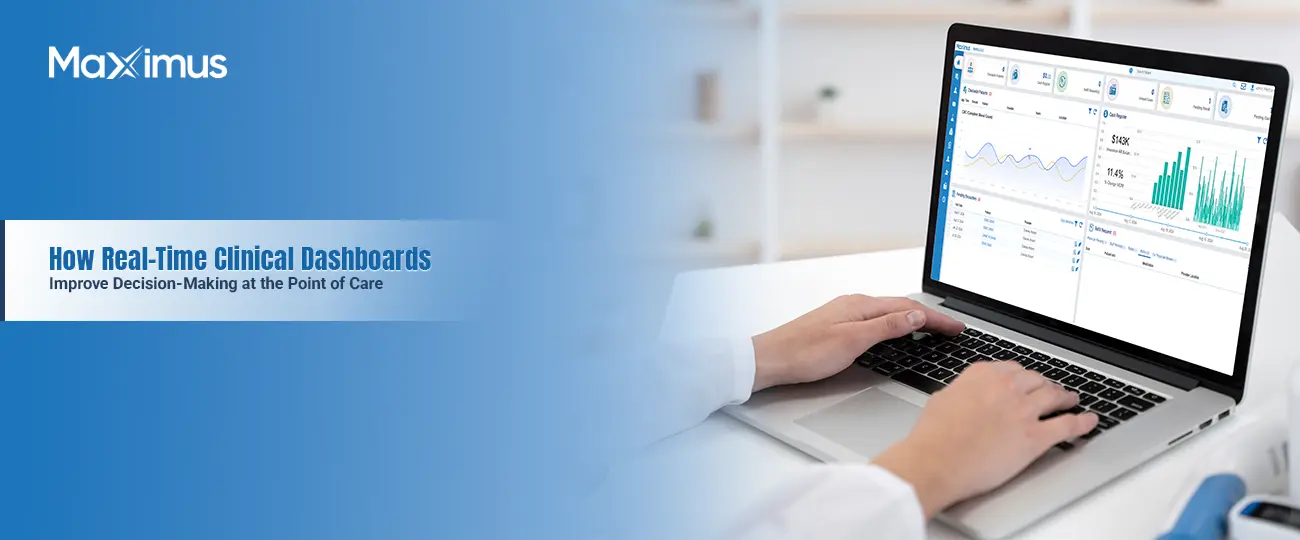
Healthcare decisions don’t happen in isolation; they happen in real time, often under pressure, and always with consequences. At the point of care, even small delays in accessing information can lead to inefficiencies, missed opportunities, or compromised patient outcomes.
Despite this, many healthcare organizations still operate in environments where data is fragmented, delayed, or difficult to interpret. Providers may need to switch between systems, wait for reports, or manually compile information before making decisions.
Real-time clinical dashboards address this gap by bringing clarity to complexity. They transform scattered data into a unified, live view, allowing providers and administrators to act with confidence, speed, and precision.
At their core, real-time clinical dashboards are designed to simplify decision-making. Instead of forcing users to dig through multiple systems, these dashboards present key clinical and operational data in one centralized interface.
What makes them particularly powerful is their ability to update continuously. As new information is entered, whether it’s patient vitals, lab results, or billing data, the dashboard reflects those changes instantly. This creates a dynamic environment where decisions are based on the most current information available.
Rather than being just a reporting tool, a well-designed dashboard becomes an extension of the clinical workflow, quietly supporting decisions without interrupting them.
In a clinical setting, timing is everything. A provider assessing a patient cannot afford to rely on outdated lab results or incomplete records. Similarly, administrators managing patient flow or staffing need immediate visibility to respond effectively.
Without real-time data, healthcare teams are often forced into a reactive mode. They address problems after they occur instead of preventing them. This not only affects patient care but also creates unnecessary strain on resources.
With real-time dashboards, the approach shifts entirely. Providers gain immediate access to patient insights, enabling faster diagnoses and timely interventions. Administrators can monitor operations in real time, identifying bottlenecks before they escalate.
This ability to act in the moment is what ultimately defines high-performing healthcare organizations.
The impact of real-time dashboards extends across both clinical and administrative functions, creating measurable improvements in how care is delivered.
One of the most significant advantages is the speed at which decisions can be made. When relevant data is readily available, providers spend less time searching for information and more time focusing on patient care. This leads to quicker diagnoses and more efficient treatment plans.
Another important benefit is improved patient outcomes. With continuous access to updated data, risks can be identified earlier and addressed proactively. This reduces complications and enhances the overall quality of care.
From an operational perspective, dashboards bring a level of transparency that is often missing in traditional systems. Teams can clearly see what is happening across departments, which improves coordination and reduces miscommunication.
To summarize, real-time dashboards support:
The effectiveness of a clinical dashboard depends largely on how well it aligns with real-world workflows. A dashboard that is overly complex or disconnected from daily tasks can quickly become more of a burden than a benefit.
An ideal dashboard is intuitive and adaptable. It allows users to focus on the information that matters most to their role, whether that’s patient-specific data for providers or performance metrics for administrators.
Equally important is seamless integration. When dashboards are connected to EHRs, billing systems, and lab reports, they eliminate the need for manual data collection and reduce the risk of errors.
Some of the most valuable features include:
When these features come together, the dashboard becomes a practical tool rather than just a visual layer.
The true value of real-time dashboards becomes evident in everyday use. They are not limited to high-level reporting but actively support frontline decision-making.
For example, during patient monitoring, providers can observe changes in vital signs as they happen, allowing them to respond immediately if a patient’s condition deteriorates. This reduces reliance on periodic checks and improves responsiveness.
In clinical decision support, dashboards provide instant access to patient history, ongoing treatments, and diagnostic data. This enables providers to make well-informed decisions without delays.
From an administrative standpoint, dashboards help manage patient flow by highlighting wait times, appointment schedules, and resource availability. This ensures that operations run smoothly and efficiently.
Even performance tracking becomes more meaningful, as leaders can evaluate metrics in real time rather than waiting for end-of-month reports.
While clinical improvements are often the primary focus, the financial impact of real-time dashboards is equally significant. By bridging the gap between clinical data and revenue cycle processes, dashboards help organizations operate more efficiently and profitably.
Instead of dealing with errors after claims are submitted, teams can identify and resolve issues at the source. This proactive approach reduces denials, shortens reimbursement cycles, and improves overall financial stability.
In essence, dashboards ensure that operational efficiency and revenue growth go hand in hand.
Organizations that rely on traditional systems often face a common set of challenges. Data is frequently scattered across multiple platforms, making it difficult to access and interpret. This leads to delays, inefficiencies, and a lack of clarity in decision-making.
Manual processes further complicate the situation. Staff may spend valuable time gathering and reconciling data instead of focusing on higher-value tasks. Over time, this not only reduces productivity but also increases the likelihood of errors.
Perhaps the most critical issue is the lack of visibility. Without a clear, real-time view of operations, leaders are forced to make decisions based on incomplete or outdated information.
These limitations highlight the growing need for integrated, real-time solutions in healthcare.
By embedding real-time clinical dashboards directly into its platform, Maximus EHR ensures that insights are always accessible within the workflow. Providers no longer need to switch between systems or wait for reports; they can make decisions based on live data, right at the point of care.
What sets Maximus EHR apart is its ability to connect clinical and financial data seamlessly. This unified approach allows organizations to not only improve patient care but also optimize their revenue cycle.
The platform is designed with flexibility in mind, offering customizable dashboards that cater to different roles within the organization. Whether it’s a provider reviewing patient data or an administrator tracking performance metrics, each user gets a tailored experience.
Ultimately, Maximus EHR transforms data into a strategic asset, helping healthcare teams operate with greater efficiency, accuracy, and confidence.
Real-time clinical dashboards are redefining how decisions are made in healthcare. By providing immediate access to actionable insights, they enable providers and administrators to move from reactive problem-solving to proactive care delivery.
The result is a more efficient, transparent, and patient-centered system, one where decisions are informed, timely, and aligned with both clinical and financial goals.
For healthcare organizations looking to stay competitive in an increasingly data-driven environment, adopting real-time dashboards is no longer optional; it is essential.
With solutions like Maximus EHR, healthcare teams can unlock the full potential of their data, improve outcomes, and build a more resilient and efficient future.
Maximus EHR delivers real-time clinical dashboards that empower your team with instant data, improving patient outcomes and operational efficiency. Start your free trial today.