In today’s fast-paced healthcare environment, operational efficiency is directly tied to how effectively teams can access and use information. From patient check-in to final billing, every step depends on seamless interaction with Electronic Health Records (EHRs). Yet, many healthcare organizations struggle with inefficiencies that stem not from the system itself, but from how access to that system is managed.
When staff members are given unrestricted access or, conversely, insufficient access, it disrupts workflows, slows down processes, and increases the likelihood of errors. This is where role-based access in EHR systems plays a critical role. By aligning system access with specific job responsibilities, healthcare organizations can ensure smoother operations, better coordination, and stronger data security.
Role-Based Access Control (RBAC) is a structured approach to managing who can view or edit specific data within an EHR system. Instead of granting uniform access to all users, permissions are assigned based on roles within the organization.
By narrowing the focus of each user’s interface, RBAC eliminates clutter and ensures that employees spend less time navigating the system and more time performing meaningful tasks.
Many healthcare organizations still rely on outdated access models that either grant excessive permissions or restrict access too tightly. Both extremes create inefficiencies that ripple across the entire workflow.
When users have access to too much information, it often leads to confusion and wasted time. Staff members must sift through irrelevant data, increasing cognitive load and slowing down decision-making. On the other hand, overly restrictive access forces employees to depend on others to retrieve information, causing delays and unnecessary communication loops.
These inefficiencies become particularly evident in high-volume practices, where even small delays can accumulate into significant operational bottlenecks. Additionally, poorly managed access increases the risk of errors, as users may interact with incorrect sections of the system or unintentionally modify data outside their scope.
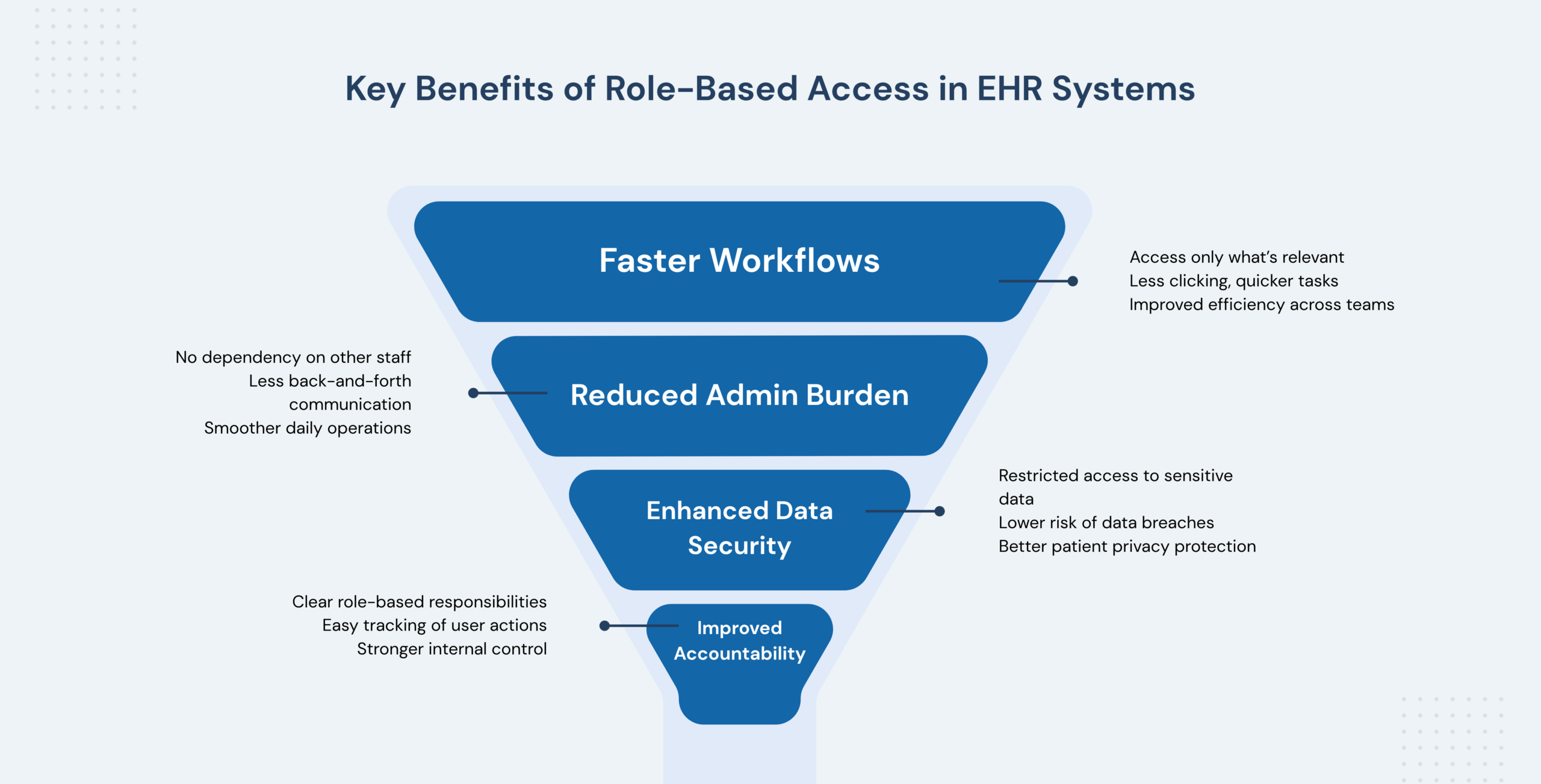
Implementing role-based access brings immediate and measurable improvements to healthcare workflows. One of the most significant advantages is speed. When users are presented with only the information relevant to their roles, navigation becomes intuitive, and tasks are completed more efficiently. Physicians can quickly access patient histories, administrative staff can handle scheduling without distractions, and billing teams can process claims without delays.
Another major benefit is the reduction of administrative burden. In traditional systems, staff often rely on one another to access or verify information. RBAC removes this dependency by giving each team member direct access to what they need, eliminating unnecessary back-and-forth communication.
Security is also greatly enhanced. By limiting access to sensitive patient data, organizations reduce the risk of unauthorized exposure. This controlled environment not only protects patient privacy but also safeguards the organization from legal and financial consequences.
Finally, role-based access improves accountability. Since each user operates within a defined role, it becomes easier to track actions and identify responsibility. This clarity strengthens internal processes and encourages more disciplined use of the system.
The impact of role-based access becomes clearer when comparing real-world workflows. In a typical healthcare setting without structured access, tasks often involve multiple steps, repeated navigation, and frequent interruptions. Staff members may need to request access or clarification, leading to delays that affect patient experience.
With role-based access in place, the workflow becomes more streamlined. A patient can be checked in quickly, the provider can access relevant clinical data without distraction, and billing can proceed without interruptions. The entire process becomes more coordinated, reducing stress on staff and improving overall efficiency.
For healthcare organizations in the United States, maintaining compliance with HIPAA regulations is a top priority. Role-based access directly supports compliance by ensuring that only authorized individuals can access Protected Health Information (PHI).
By restricting access based on job roles, organizations can demonstrate that they are following the principle of minimum necessary access, a key requirement under HIPAA. This reduces the likelihood of data breaches and ensures that sensitive information is handled appropriately.
Additionally, RBAC systems often include audit trails that track user activity. These logs are essential for identifying potential security issues and proving compliance during audits. In an environment where regulatory scrutiny is increasing, having a robust access control system is not just beneficial, it is essential.
Successfully implementing role-based access requires a strategic and well-planned approach. Organizations must first define clear roles within their teams and understand the specific data requirements for each position. Without this clarity, access controls can become either too restrictive or too lenient.
To ensure effective implementation, healthcare organizations should:
By following these practices, organizations can maximize the benefits of RBAC while minimizing potential challenges.
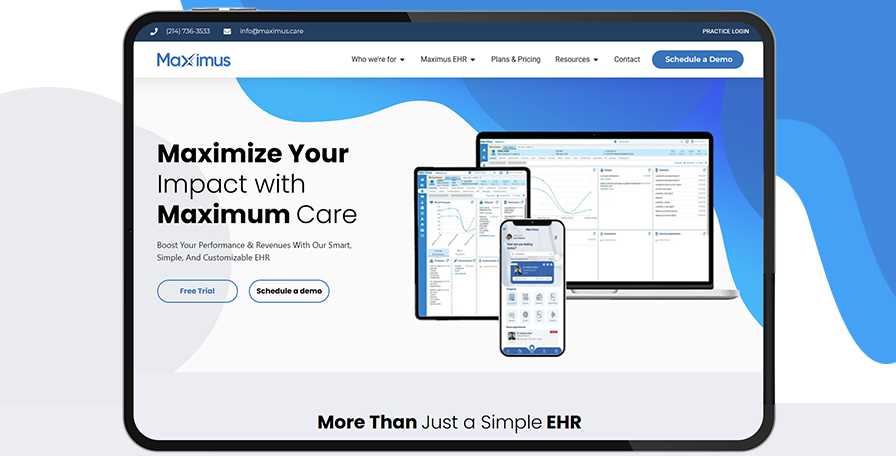
With Maximus EHR, healthcare teams can create a structured environment where each user interacts only with the information they need. This not only improves efficiency but also enhances the overall user experience. Staff members spend less time navigating the system and more time focusing on patient care and operational priorities.
The platform also strengthens data security by ensuring controlled access to sensitive information. Combined with detailed audit capabilities, it provides organizations with the tools needed to maintain compliance and accountability.
An advanced EHR like Maximus EHR allows you to assign precise user roles, ensuring every team member accesses only what they need – nothing more, nothing less.
As healthcare organizations continue to evolve, the need for efficient and secure systems becomes increasingly important. Role-based access in EHRs offers a practical solution to many of the challenges faced by modern healthcare teams.
By aligning access with responsibilities, organizations can eliminate inefficiencies, reduce errors, and create a more streamlined workflow. At the same time, they can strengthen data security and ensure compliance with regulatory standards.
For healthcare providers, administrators, and decision-makers, investing in a system that supports role-based access is a step toward long-term operational success.
With Maximus EHR, healthcare organizations can streamline workflows, improve team coordination, and maintain full compliance through intelligent role-based access.
Maximus EHR offers intelligent role-based access, customizable permissions, and audit trails to boost efficiency, reduce errors, and maintain HIPAA compliance. Book your free demo today.