
Maximus EHR Pricing: What Independent Practices Pay & Why

Maximus EHR Pricing for Independent Practices

Introduction

For independent healthcare practices, choosing the right Electronic Health Record (EHR) system is no longer just a technology decision; it is a financial and operational one. From monthly subscription costs to implementation fees and ongoing support expenses, EHR pricing can significantly impact a practice’s profitability and workflow efficiency.
Many providers enter long-term agreements without fully understanding what they are paying for. What initially looks affordable can quickly become expensive once hidden fees, integrations, onboarding charges, and billing add-ons are introduced.
That is why more independent practices across the United States are prioritizing transparent pricing, predictable monthly costs, and all-in-one platforms that eliminate the need for multiple disconnected tools.

Why EHR Pricing Matters for Independent Practices

Unlike large hospital systems, independent practices often operate with tighter budgets, leaner staff, and fewer administrative resources. Every operational expense directly affects profitability, staffing, and patient care.
A costly or inefficient EHR system can create challenges such as:
  • Increased administrative workload
  • Slower workflows
  • Higher claim denial rates
  • Expensive third-party integrations
  • Long-term contractual limitations
  • Reduced provider productivity
For smaller practices, affordability alone is not enough. Providers need an EHR solution that delivers:
  • Clinical efficiency
  • Revenue cycle optimization
  • Scalable growth
  • Integrated billing capabilities
  • Reliable support
  • Transparent pricing
The right system should simplify operations, not create additional complexity.
Why EHR Pricing Matters for Independent Practices

Understanding Common EHR Pricing Models

One of the biggest frustrations healthcare providers face is the lack of pricing transparency in the EHR industry. Different vendors use different pricing structures, making it difficult for practices to compare true costs.
Below are the most common EHR pricing models used in the healthcare industry today.
Pricing Model How It Works Potential Drawbacks
Per Provider Pricing
Monthly fee charged per provider
Costs increase as practice grows
Revenue-Based Pricing
Vendor takes a percentage of collections
Can become expensive over time
Tiered Subscription
Pricing based on features or users
Important tools may cost extra
One-Time License Fee
Large upfront software payment
Expensive maintenance and upgrades
All-in-One Subscription
Fixed monthly pricing with integrated tools
Requires choosing the right vendor
Many practices initially choose lower-cost systems, only to realize later that essential features such as billing, telehealth, reporting, scheduling, or support require additional fees.
This is why healthcare administrators and decision-makers are increasingly moving toward cloud-based EHR platforms with predictable monthly pricing.

What Independent Practices Typically Pay for EHR Software

EHR costs can vary significantly depending on:
  • Practice size
  • Specialty
  • Number of providers
  • Billing requirements
  • Deployment type
  • Customization needs
  • Support level
On average, independent practices in the United States may pay anywhere between a few hundred and several thousand dollars per month for EHR software and related services.
Typical EHR expenses may include:
  1. Monthly subscription fees
  2. Setup and implementation costs
  3. Data migration fees
  4. Training charges
  5. Billing software integrations
  6. Telehealth add-ons
  7. Clearinghouse fees
  8. Ongoing technical support
For growing practices, these expenses can quickly compound.
Practices that use separate systems for:
  • Scheduling
  • Billing
  • Patient communication
  • Telehealth
  • Reporting
  • Revenue cycle management
often end up paying significantly more than practices using a unified platform.
This is one reason many healthcare organizations are now searching for affordable EHR software for independent practices that combines clinical and financial operations under one system.
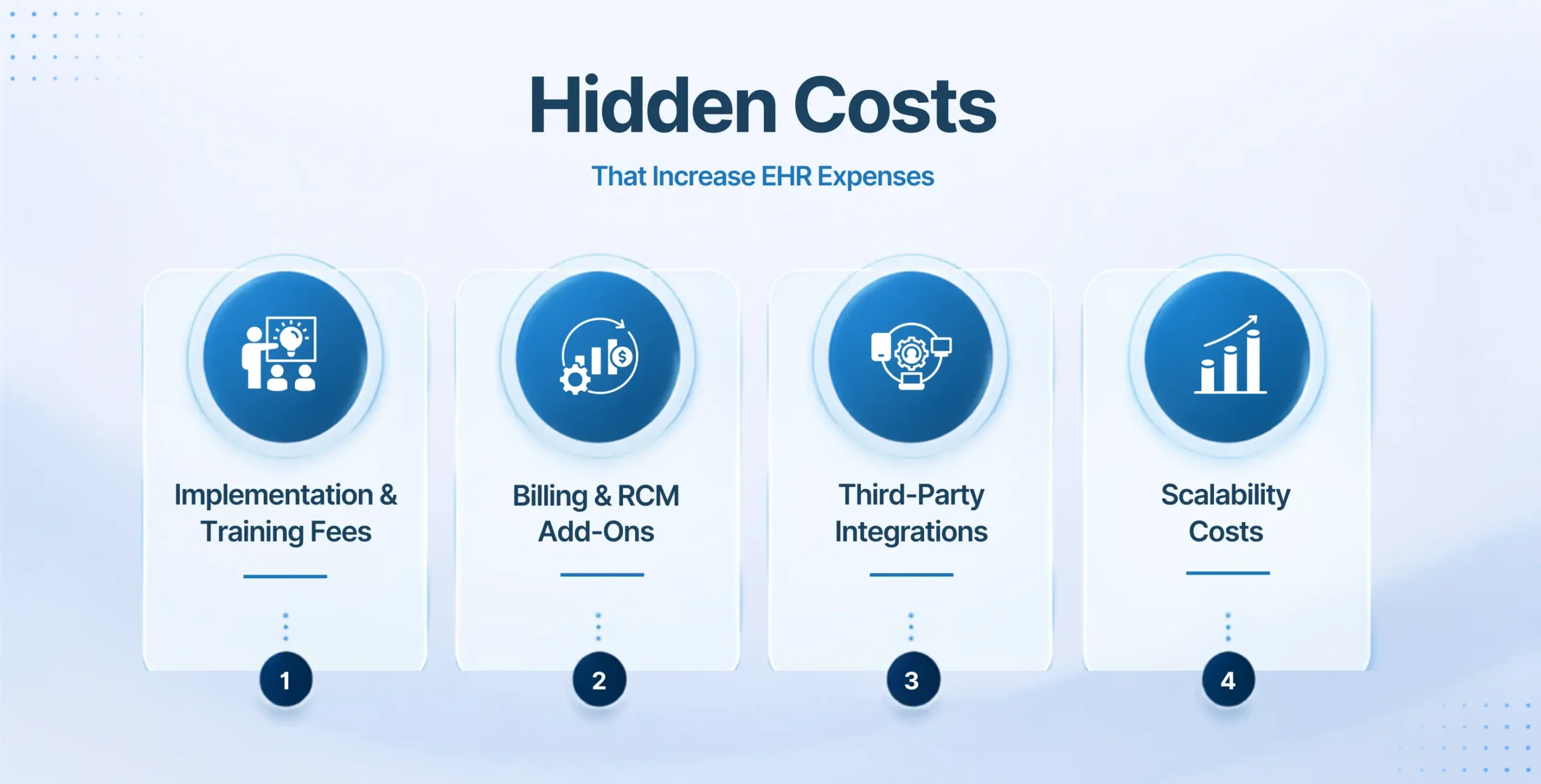
Hidden Costs That Increase EHR Expenses

Hidden Costs That Increase EHR Expenses

One of the biggest issues providers face when evaluating EHR software is hidden costs. Vendors may advertise low entry pricing, while additional charges appear later during implementation or expansion.
Here are some common hidden EHR expenses practices should watch for:
Implementation & Training Fees
Some vendors charge substantial onboarding fees for:
  • Staff training
  • Workflow setup
  • Configuration
  • Data migration
These costs can become especially challenging for smaller practices transitioning from legacy systems.

Billing & RCM Add-Ons

Many EHR platforms separate billing and Revenue Cycle Management (RCM) into premium packages.
This means practices may pay extra for:
  • Claim submission
  • Denial management
  • Eligibility verification
  • Payment posting
  • Revenue reporting

Third-Party Integrations

Disconnected software systems often require paid integrations for:
  • Labs
  • Pharmacies
  • Telehealth
  • Insurance verification
  • Payment processing
These integrations not only increase costs but also create workflow inefficiencies.
Scalability Costs
As practices grow and add providers, many EHR systems become increasingly expensive due to per-user pricing structures. What seems affordable for a single-provider clinic may become financially burdensome for multi-provider practices.

Why Practices Are Looking for Affordable, All-in-One EHR Solutions

Healthcare providers today are under increasing pressure to improve both patient outcomes and operational efficiency while controlling costs. As a result, independent practices are shifting toward EHR systems that provide:
  • Integrated billing and RCM
  • Cloud-based accessibility
  • Simplified workflows
  • Reduced administrative burden
  • Better financial visibility
  • Scalable pricing
Modern practices no longer want fragmented systems that require multiple vendors and complicated integrations. Instead, they are looking for:
  • One centralized platform
  • Predictable monthly costs
  • Faster reimbursements
  • Improved claim accuracy
  • Better user experience
This shift is especially important for practices aiming to increase profitability while maintaining quality patient care.

How Maximus EHR Delivers Better Value

Maximus EHR is designed specifically to help independent practices simplify operations, improve financial performance, and reduce unnecessary software costs. Rather than forcing providers to manage multiple disconnected systems, Maximus EHR offers an integrated platform that combines essential practice management tools into one solution.

Key Value Advantages of Maximus EHR

Integrated Billing & RCM

Maximus EHR helps eliminate the need for separate billing software by offering integrated Revenue Cycle Management capabilities. This helps practices:
  • Improve claim accuracy
  • Reduce denials
  • Accelerate reimbursements
  • Streamline financial workflows

Transparent Pricing Structure

Independent practices need predictable operational expenses. Maximus EHR focuses on transparent pricing without unnecessary complexity or excessive hidden fees.

Cloud-Based Accessibility

Providers and administrators can securely access the platform from anywhere, improving flexibility and operational continuity.

Workflow Efficiency

By centralizing clinical and administrative processes, Maximus EHR helps reduce repetitive tasks and improve staff productivity.

Scalability for Growing Practices

Whether a clinic is adding providers, expanding locations, or increasing patient volume, Maximus EHR is built to scale alongside practice growth.

Maximus EHR vs Traditional EHR Pricing Models

The table below highlights how Maximus EHR differs from many traditional EHR pricing structures.
Traditional EHR Systems Maximus EHR
Multiple add-on fees
Integrated platform approach
Separate billing software required
Built-in billing & RCM support
Complex pricing structures
Customized pricing
Expensive third-party integrations
Simplified workflow ecosystem
Limited scalability
Designed for growing practices
Administrative inefficiencies
Streamlined operations
For independent practices, the financial difference is not just about software costs; it is about long-term operational efficiency and revenue optimization.

Why Independent Practices Choose Maximus EHR

Healthcare providers are increasingly prioritizing technology solutions that support both patient care and business growth. Independent practices choose Maximus EHR because it helps address several major industry pain points:
  • Rising operational costs
  • Complex workflows
  • Revenue leakage
  • Administrative burnout
  • Disconnected systems
  • Lack of pricing transparency
More importantly, providers want technology that works with them, not against them.
Maximus EHR helps practices create:
  • More efficient workflows
  • Better financial outcomes
  • Improved staff productivity
  • Enhanced patient management
  • Sustainable long-term growth
For practices evaluating EHR software pricing, value matters just as much as cost.

Conclusion

Choosing an EHR system is one of the most important investments an independent practice can make. While pricing is a critical factor, the true cost of an EHR extends beyond monthly subscription fees.
Practices must evaluate:
  • Hidden costs
  • Billing capabilities
  • Workflow efficiency
  • Scalability
  • Support quality
  • Long-term ROI
The most effective EHR solutions are those that simplify operations, improve revenue cycle performance, and provide transparent pricing that practices can confidently plan around.
Maximus EHR is built to help independent practices achieve exactly that. If your practice is looking for an affordable, scalable, and all-in-one EHR solution designed for modern healthcare operations, now is the time to explore what Maximus EHR can offer.

Ready to Scale Up?

Explore how Maximus EHR can help your practice reduce operational complexity, improve efficiency, and support long-term growth.

FAQs

How much does EHR software typically cost for independent practices?
EHR pricing for independent practices can vary depending on the number of providers, features, billing requirements, and support services. Many practices pay monthly subscription fees along with additional costs for onboarding, billing integrations, training, and support.
What hidden costs should practices look for when choosing an EHR system?
Common hidden EHR costs may include implementation fees, data migration charges, training expenses, telehealth add-ons, billing software integrations, clearinghouse fees, and ongoing support costs. It is important to evaluate the total cost of ownership before selecting a platform.
Why do independent practices prefer cloud-based EHR systems?
Cloud-based EHR systems offer greater flexibility, remote accessibility, automatic updates, reduced IT infrastructure costs, and easier scalability. They also help practices streamline workflows and improve operational efficiency.
Does Maximus EHR include billing and revenue cycle management features?
Yes, Maximus EHR offers integrated billing and Revenue Cycle Management (RCM) capabilities designed to help practices improve claim accuracy, reduce denials, and simplify financial operations within a single platform.
How can Maximus EHR help growing healthcare practices?
Maximus EHR is designed to support growing practices by providing scalable workflows, transparent pricing, integrated tools, and operational efficiency. It helps practices manage increasing patient volumes while reducing administrative complexity.

Table of Contents

Maximus | Electronic Health Record

Transform Your
Practice with
AI-Powered EHR

Reduce administrative burden, streamline workflows, accelerate revenue, and deliver exceptional patient care.