
The ROI of Automated Pre-Visit Summaries Time Saved Per Provider, Per Day

The ROI of Automated Pre-Visit Summaries Time Saved Per Provider, Per Day

Introduction: The Hidden Financial Leak in Growing Clinics

Every expanding practice has a leak nobody puts on the P&L. It’s not rent. It’s not payroll. It’s the billable hours providers lose every day hunting through old records before they even say hello to the patient.
Multiply that by every provider, every patient, every single day, and you get a number that should alarm any office manager watching margins. This is where AI patient summary software stops being a nice-to-have and becomes a measurable line item on the recovery side of the ledger.
Automated pre-visit summaries aren’t an experimental luxury bolted onto your EHR. They’re a high-utility EHR efficiency tool built to deliver immediate, quantifiable cost recovery, starting on day one of implementation.
The Invisible Math of Manual Chart Prep

The Invisible Math of Manual Chart Prep

Here’s the math most practices never run. Take a standard 20-patient daily schedule. If a provider spends just 10 to 15 minutes manually prepping each chart, that’s:
  • 200–300 minutes per day lost to chart review alone.
  • 3.3 to 5 hours per provider, per day that could otherwise go to seeing patients.
  • 16.5 to 25 hours per week, or roughly two to three full working days, spent flipping through old notes instead of delivering care.
That drag doesn’t stay contained to the exam room. It:
  • Inflates administrative overhead as staff scramble to pull records ahead of visits.
  • Caps daily patient volume because providers physically cannot see more people.
  • Pushes appointments later in the day, increasing patient wait times and no-show risk
  • Fuels the burnout that drives clinical staff turnover.
Legacy chart review isn’t just slow. It’s a structural ceiling on how much revenue a practice can generate with the providers it already has.

Calculating the AI Pre-Visit Summary ROI

This is where the numbers flip. Modern automation doesn’t trim prep time. It collapses. Instead of 10 to 15 minutes per chart, an AI-generated pre-visit summary surfaces the relevant history, medications, labs, and flags in seconds, right at the point of care.
Run the same 20-patient day through this model:
  • Prep time drops from 3.3–5 hours to roughly 10 minutes total.
  • That reclaims 15 to 20+ hours per provider, per week.
  • Those hours convert directly into one of two outcomes: additional daily appointments, or eliminated overtime costs for staff who no longer need to manually assemble records after hours.
This is the core of the AI pre-visit summary ROI calculation. It’s not an abstract productivity language. It’s provider hours, converted back into either patient volume or payroll savings, both of which show up on next quarter’s financials.
For a mid-sized practice, reclaiming even 15 hours per provider per week is the equivalent of adding a part-time provider’s worth of capacity, without the cost of hiring one.

Enhancing Clinical Revenue via Gap-in-Care Detection

Time savings are only half the equation. The other half is revenue you’re currently leaving on the table.
Intelligent AI engines don’t just summarize; they analyze. At the point of care, they automatically flag:
  • Missing preventative screenings (mammograms, colonoscopies, wellness visits) that impact quality scores.
  • Chronic condition metrics that are overdue for tracking, such as A1c or blood pressure readings.
  • HCC risk adjustment variables that go undocumented in manual workflows, directly affecting reimbursement under value-based care models.
Every unflagged gap is a missed reimbursement opportunity or a compliance risk waiting to surface in an audit. When this detection happens automatically instead of relying on provider memory during a rushed visit, practices see a direct lift in both coding accuracy and value-based care yields.
This is where reducing visit prep time stops being a productivity phrase and starts functioning as a revenue strategy.
Evaluating the Total Cost of Ownership

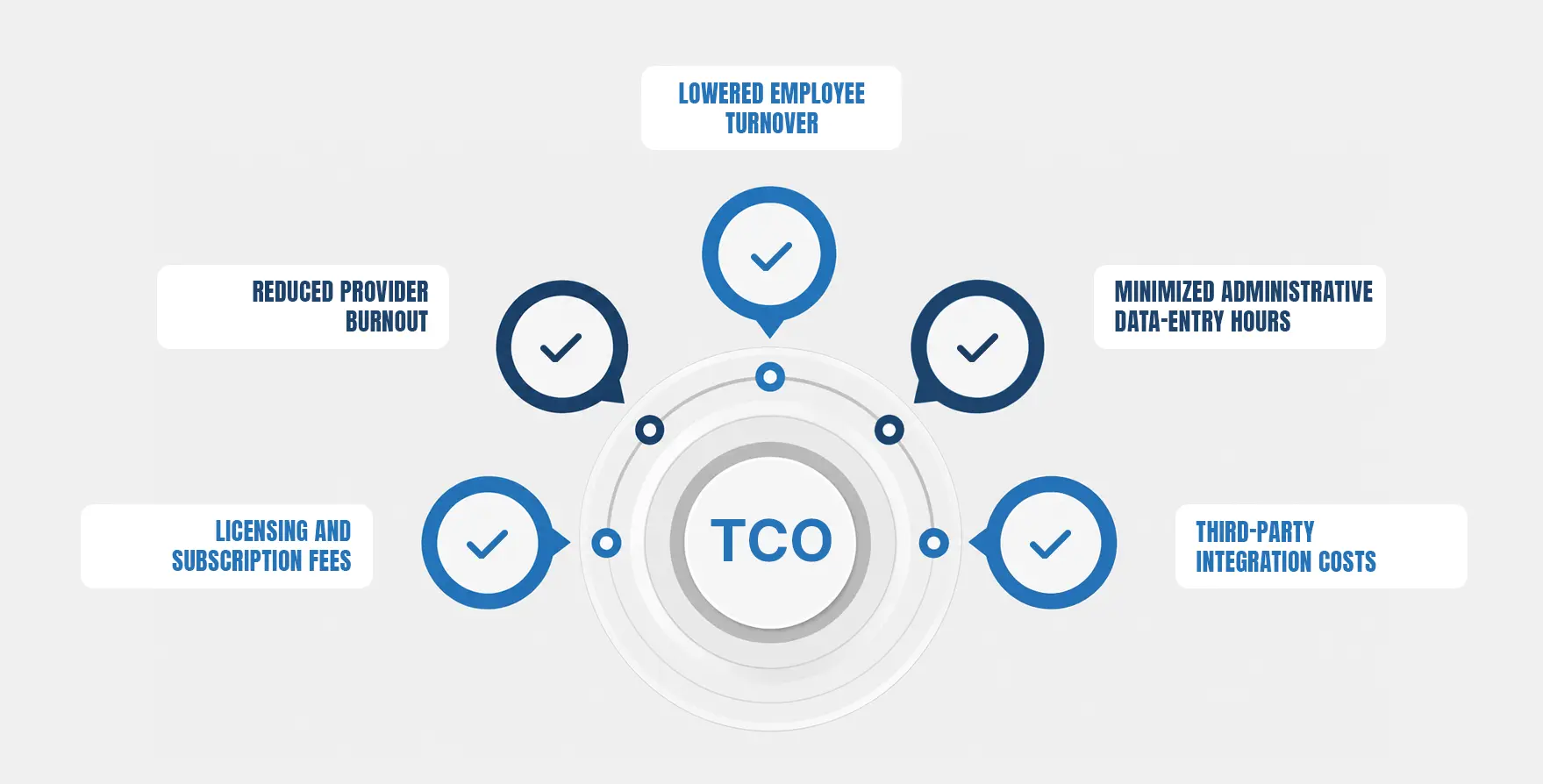
Evaluating the Total Cost of Ownership (TCO)

Office managers evaluating any EHR efficiency tools need to look past the license fee. Use this checklist to weigh true cost against true savings:
  • Licensing and subscription fees:
    The visible cost, easy to compare across vendors
  • Reduced provider burnout:
    A real but often unbudgeted saving, since burned-out providers cost more in turnover than any software line item
  • Lowered employee turnover:
    Recruiting and onboarding clinical staff is expensive; retention pays that cost down over time
  • Minimized administrative data-entry hours:
    Every hour staff spend hunting for records is an hour not spent on billing, scheduling, or patient experience
  • Third-party integration costs:
    Standalone AI summary tools often require separate contracts, data-sharing agreements, and IT overhead to bolt onto your existing EHR
The lowest sticker price rarely wins this comparison. The tool that’s natively integrated into your EHR, with no separate subscription or IT lift, almost always wins on TCO.

The Efficiency Equation: Manual Reviews vs. Automated AI Summaries

Metric Manual Chart Review Automated AI Summary
Daily Prep Time Per Provider
10–15 min/patient (3.3–5 hrs/day for 20 patients)
Under 30 seconds/patient (~10 min/day for 20 patients)
Information Synthesis Speed
Manual scroll through years of notes, labs, referrals
Instant AI-generated summary at chart open
Risk/Gap-in-Care Identification
Inconsistent, dependent on provider memory
Automated flagging of screenings, HCC gaps, chronic care metrics
Direct Administrative Overhead
High: staff hours spent pulling and organizing records
Near-zero: summary generates natively in workflow
Weekly Reclaimed Clinical Hours
0 (baseline)
15–20+ hours per provider

The Maximus EHR Scale Advantage

Maximus EHR was built to close the exact gap this article has been walking through.
Automated pre-visit summaries are engineered directly into Maximus EHR’s native clinical framework, not bolted on as a third-party add-on. That means:
  • No separate software subscription to manage or renegotiate.
  • No integration risk from stitching an outside AI tool into your existing system.
  • Summaries and gap-in-care flags generated inside the same workflow your providers already use.
As practices scale, this native architecture becomes the difference between an efficiency tool that grows with you and one that becomes another vendor to manage. Maximus EHR is built as the definitive, future-proof platform for practices that want to maximize operational ROI without multiplying their tech stack.

Book Your Live Workflow Demo

Documentation fatigue isn’t a staffing problem. It’s a systems problem, and it has a fix. Maximus EHR removes every financial barrier standing between your practice and that fix:
  • A completely free 1-month trial, so you see the time savings before you commit a dollar.
  • 100% free data migration from your legacy system, with zero disruption cost to your practice.
Every day you wait is another day of lost provider hours and uncaptured reimbursement. Secure your margins and claim your true ROI.

Reclaim Provider Hours with AI

Explore how automated pre-visit summaries help reduce prep time, improve clinical readiness, and uncover revenue opportunities before each visit.

FAQs

How long does it take to see ROI from an AI pre-visit summary tool?

Most practices see measurable time savings within the first week of go-live. Because prep time drops from minutes to seconds per chart almost immediately, the financial ROI (reclaimed provider hours, reduced overtime) typically shows up in the first billing cycle, not after months of adoption.

Does automated chart prep replace the provider's clinical judgment?
No. The AI summary organizes and surfaces existing patient data (history, labs, medications, flagged gaps) so the provider can review it faster. Every clinical decision, diagnosis, and treatment plan still rests entirely with the provider.
Will switching to an EHR with automated summaries disrupt our current workflow?

It shouldn’t, if the tool is natively built into your EHR rather than layered on as a third-party add-on. Native integration (like Maximus EHR’s) means no separate login, no duplicate data entry, and no extra system for staff to learn.

How does gap-in-care detection affect reimbursement specifically?
By flagging missed screenings, overdue chronic condition metrics, and undocumented HCC risk adjustment variables at the point of care, the system helps close coding gaps that would otherwise go unbilled or under-billed, directly supporting value-based care reimbursement.
What does migrating to Maximus EHR from our current system involve?
Maximus EHR offers 100% free data migration from legacy systems, plus a free 1-month trial so your team can validate the time savings before committing. Most practices complete migration without disrupting active patient scheduling.

Table of Contents

Maximus | Electronic Health Record

Transform Your
Practice with
AI-Powered EHR

Reduce administrative burden, streamline workflows, accelerate revenue, and deliver exceptional patient care.