Healthcare organizations today are surrounded by data. Every patient interaction, diagnosis, prescription, and billing activity generates valuable information. However, despite having access to this vast amount of clinical data, many organizations still struggle to use it effectively.
The real challenge is not collecting data, it’s making sense of it. Without proper analysis and reporting, clinical data remains static and underutilized. This is where EHR reporting plays a critical role. It enables healthcare providers and decision-makers to turn raw data into meaningful insights that support better care, improved efficiency, and smarter financial decisions.
Over the past decade, the healthcare industry has shifted toward a more data-driven approach. With the rise of value-based care models, providers are now expected to deliver measurable outcomes while maintaining operational efficiency.
Clinical data plays a central role in helping organizations understand patient populations, identify care gaps, and evaluate treatment effectiveness. It also supports long-term planning by revealing trends that would otherwise go unnoticed. However, as the volume of data continues to grow, the need for structured reporting becomes even more critical.
Simply having access to data does not guarantee better outcomes. In many healthcare settings, data is scattered across multiple systems, making it difficult to access and analyze promptly.
This often results in delayed decision-making and inefficiencies that impact both patient care and operational performance. Raw data, without context or structure, does not provide clear direction. It lacks the ability to highlight trends, identify risks, or guide action.
To truly unlock its value, healthcare data must be transformed into insights, and that transformation begins with effective reporting.
EHR reporting is the process of extracting and analyzing data from electronic health records to present it in a structured and meaningful way. Instead of viewing isolated data points, users gain access to dashboards, summaries, and reports that provide a clear picture of performance.
These reports can be customized for different roles within a healthcare organization. Clinicians may focus on patient outcomes and treatment history, while administrators may prioritize operational efficiency and financial metrics.
Ultimately, EHR reporting bridges the gap between data collection and decision-making, allowing organizations to act with clarity and confidence.
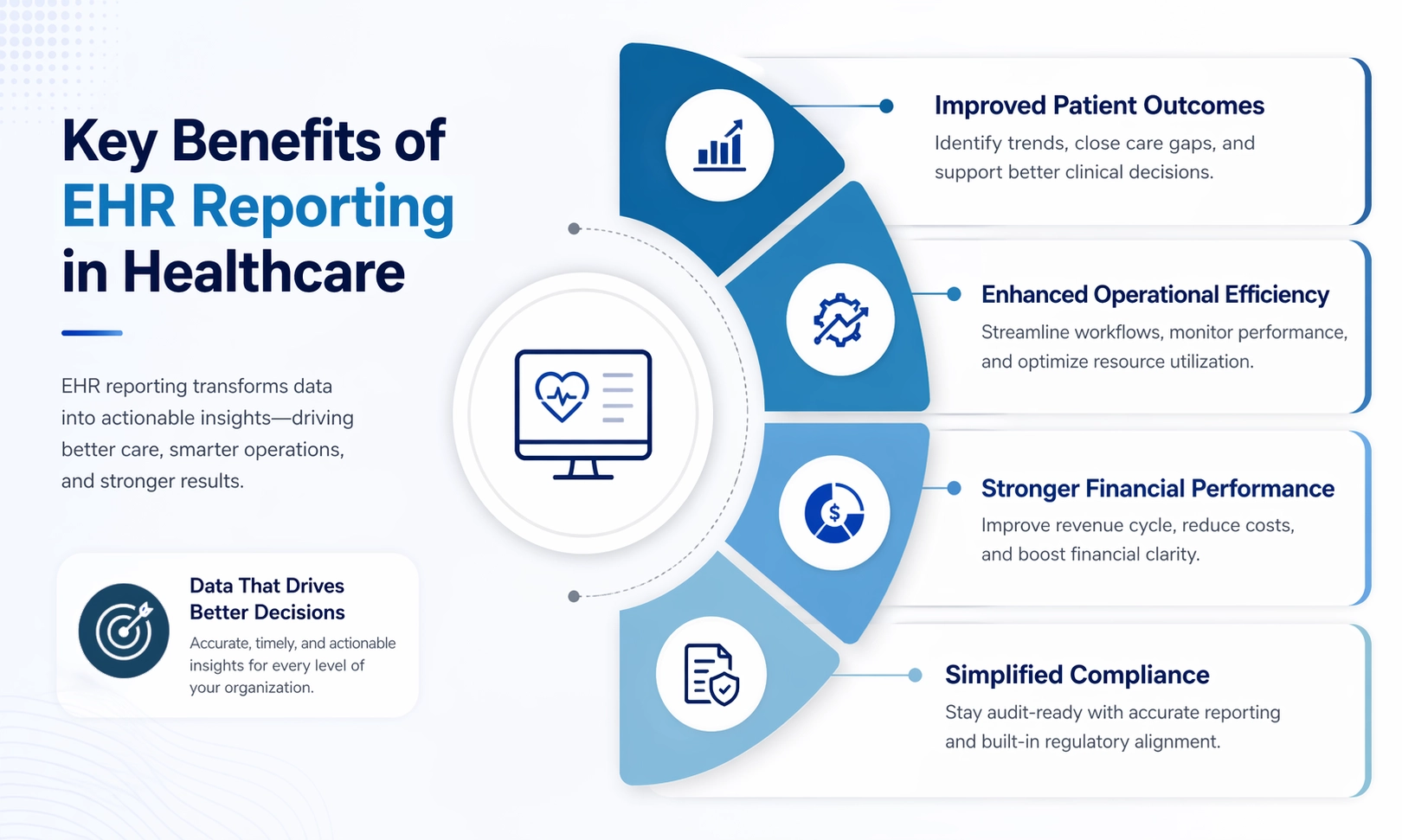
EHR reporting brings measurable improvements across clinical, operational, and financial areas. Rather than relying on assumptions, healthcare organizations can make decisions backed by real data.
Some of the most impactful benefits include:
These benefits collectively help organizations deliver higher-quality care while maintaining efficiency and profitability.
Different types of EHR reports provide different perspectives on performance, and together they create a complete picture of healthcare operations.
By combining insights from these reports, organizations can align clinical performance with operational and financial goals.
In a fast-paced healthcare environment, timely and accurate decisions are essential. EHR reporting provides real-time access to critical information, enabling stakeholders at every level to act with confidence.
For providers, this means having immediate access to patient histories and treatment progress, allowing for more precise clinical decisions. Administrators gain visibility into workflows and performance metrics, helping them optimize operations and resource allocation.
At the executive level, reporting supports strategic planning by offering insights into trends, growth opportunities, and overall performance. Instead of relying on intuition, leaders can make informed decisions based on concrete data.
Despite its advantages, many organizations struggle to leverage their EHR data fully. One of the main issues is data fragmentation, where information is stored across multiple systems that do not communicate effectively.
Another challenge is the lack of flexibility in reporting tools. Standard reports often fail to meet the specific needs of different users, limiting their usefulness. Additionally, manual reporting processes can slow down operations and introduce errors.
Limited data visibility further complicates decision-making. When insights are not available in real time, organizations are forced to act on outdated information, which can negatively impact both care delivery and operational outcomes.
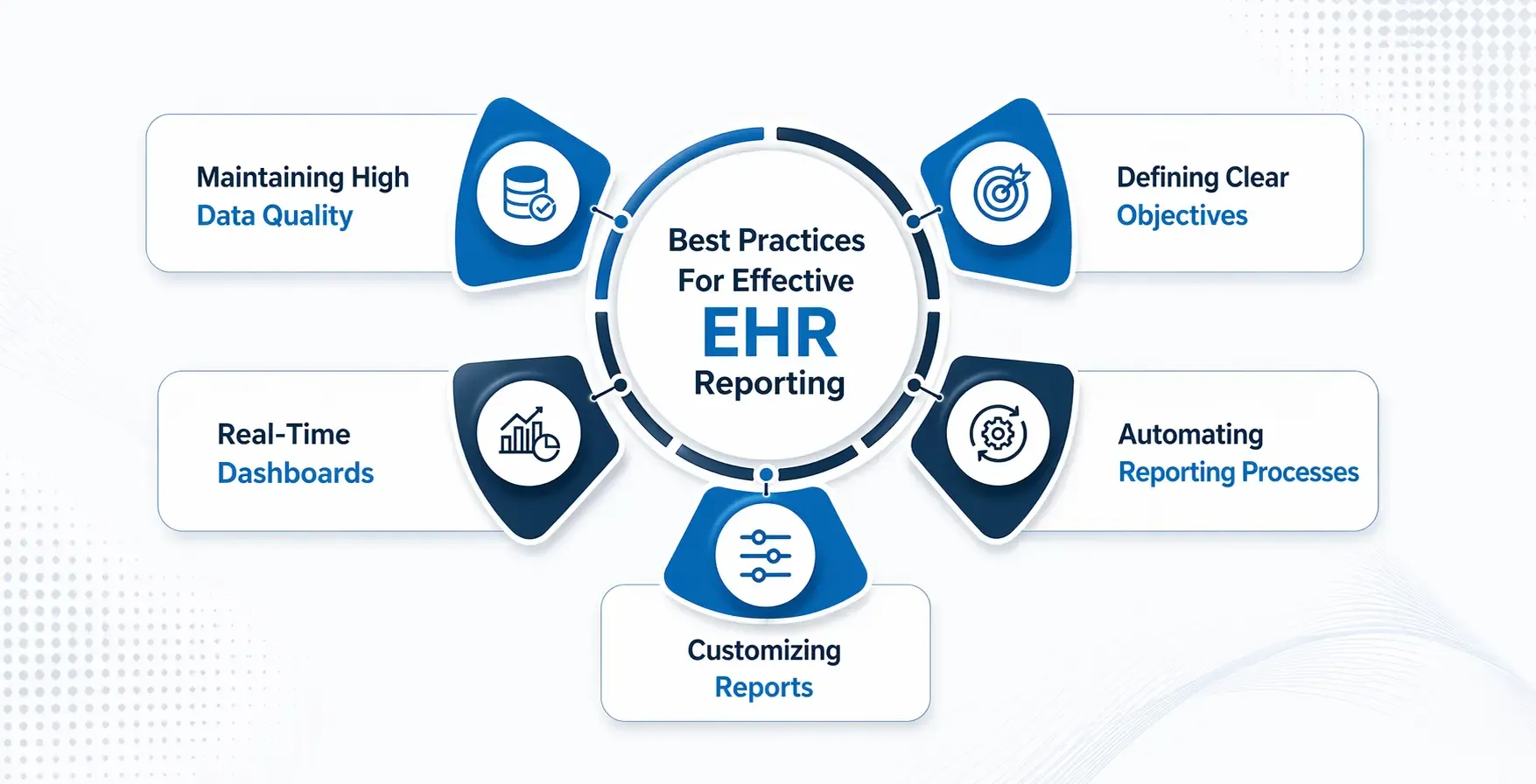
To maximize the value of EHR reporting, healthcare organizations must take a strategic and structured approach.
Key best practices include:
When these practices are implemented effectively, EHR reporting becomes a powerful tool for continuous improvement.
An effective reporting system should not only provide data but also make it easy to interpret and act on.
These features ensure that healthcare organizations can access meaningful insights without unnecessary complexity.
Maximus EHR is designed to help healthcare organizations go beyond basic data storage and fully utilize their clinical information.
With advanced reporting capabilities, the platform transforms complex datasets into clear, actionable insights. Real-time dashboards provide instant visibility into performance, while customizable reports allow organizations to focus on the metrics that matter most.
By integrating clinical, operational, and financial data into a single system, Maximus EHR eliminates silos and improves overall efficiency. Automated reporting further reduces administrative burden, enabling teams to focus more on patient care.
Most importantly, Maximus EHR empowers decision-makers to act proactively. Instead of reacting to issues after they arise, organizations can identify trends early, address gaps, and continuously improve outcomes.
A lack of data no longer limits the healthcare industry; it is defined by how effectively that data is used. Organizations that can turn clinical data into actionable insights are better positioned to deliver high-quality care, improve efficiency, and achieve sustainable growth.
EHR reporting plays a central role in this transformation. It converts raw information into meaningful insights that support better decision-making at every level.
For healthcare providers, administrators, and decision-makers, the path forward is clear: adopt solutions that not only collect data but also make it actionable.
Maximus EHR helps you turn insight into impact. Because in healthcare, better data doesn’t just inform decisions, it improves lives.
Maximus EHR delivers real-time reporting and actionable insights to improve care, efficiency, and revenue. Start your free trial today.