Ambient AI Scribe vs. Manual Dictation: Which Saves More Time in Your EHR Workflow?

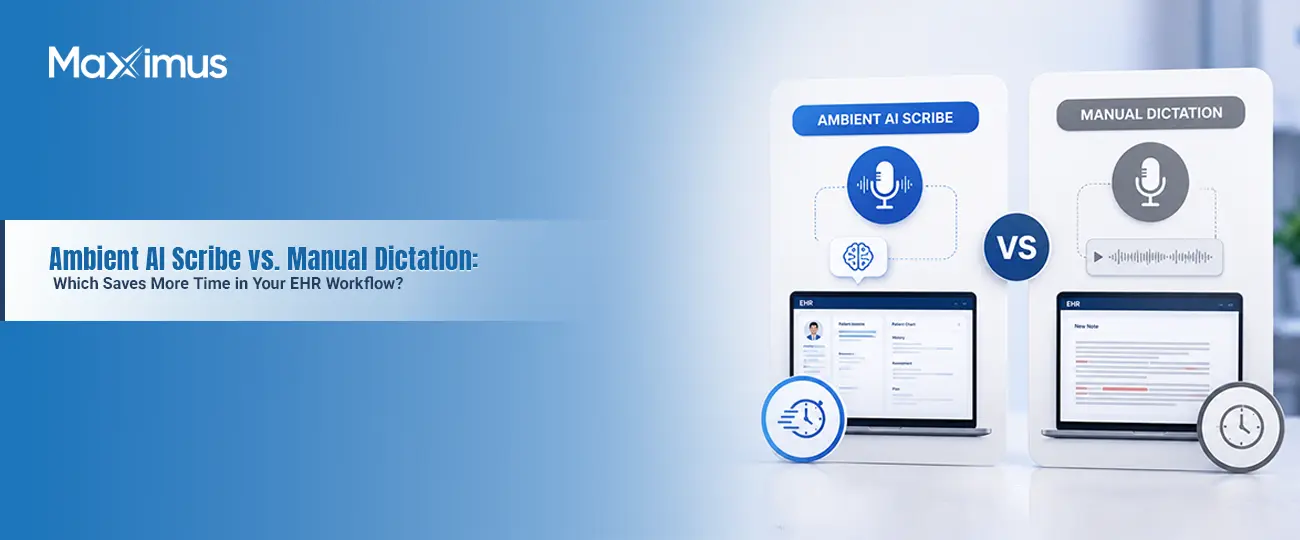
Ambient AI Scribe vs. Manual Dictation: Which Saves More Time in Your EHR Workflow?

Introduction

Pajama time is not a myth. It is the block of hours after clinic closes when physicians sit at home finishing notes instead of living their lives. Studies on EHR burden consistently point to documentation as the single biggest driver of physician burnout.
When practices compare an ambient AI scribe vs dictation, the real question is not which tool sounds more advanced. It is which one actually removes the bottleneck between seeing a patient and closing the chart. Dictation, even in its modern voice-to-text form, still puts the burden of structuring and correcting notes on the physician. Ambient AI removes that burden almost entirely.
This comparison breaks down exactly where each approach saves time, where it costs time, and what administrators should demand before signing a contract for either.

The Mechanics of Manual Dictation and Voice Recognition

Legacy voice recognition vs AI scribe technology looks similar on the surface. Both involve talking instead of typing. The workflow underneath is very different.

With traditional dictation and speech-to-text tools, physicians must:
  • Speak punctuation out loud, including “period,” “comma,” and “new paragraph”
  • Dictate each SOAP section manually and in order
  • Pause conversation with the patient to record findings, or dictate afterward from memory
  • Review the entire transcript line by line for misheard terms, especially drug names and dosages
  • Manually move dictated text into the correct EHR fields if the tool is not natively integrated
None of this is passive. The physician is still doing the cognitive work of structuring the note. Voice recognition just changes the input method from keyboard to microphone. The editing overhead remains high because speech engines still misfire on accents, background noise, and medical terminology.

How an Ambient AI Scribe Transcribes the Real Encounter

Ambient AI scribes work on a completely different principle. Instead of dictating a summary after the fact, the software listens to the actual conversation between doctor and patient in real time.
Here is what happens during the visit:
  • The microphone picks up natural conversation, no prompts or commands needed.
  • The AI filters out small talk, chit chat, and irrelevant tangents.
  • Clinical language models identify symptoms, history, and exam findings as they are spoken.
  • The system maps that information directly into structured fields: HPI, ROS, physical exam, assessment, and plan.
  • A draft note is ready for review within moments of the visit ending.
The physician never stops to dictate. They talk to the patient like a human being, and the chart builds itself in the background. This is the core distinction in any ambient AI scribe vs dictation comparison. One requires a second, separate task. The other happens invisibly during the first task.
The Definitive AI Scribe Comparison Time Saved Per Day

The Definitive AI Scribe Comparison: Time Saved Per Day

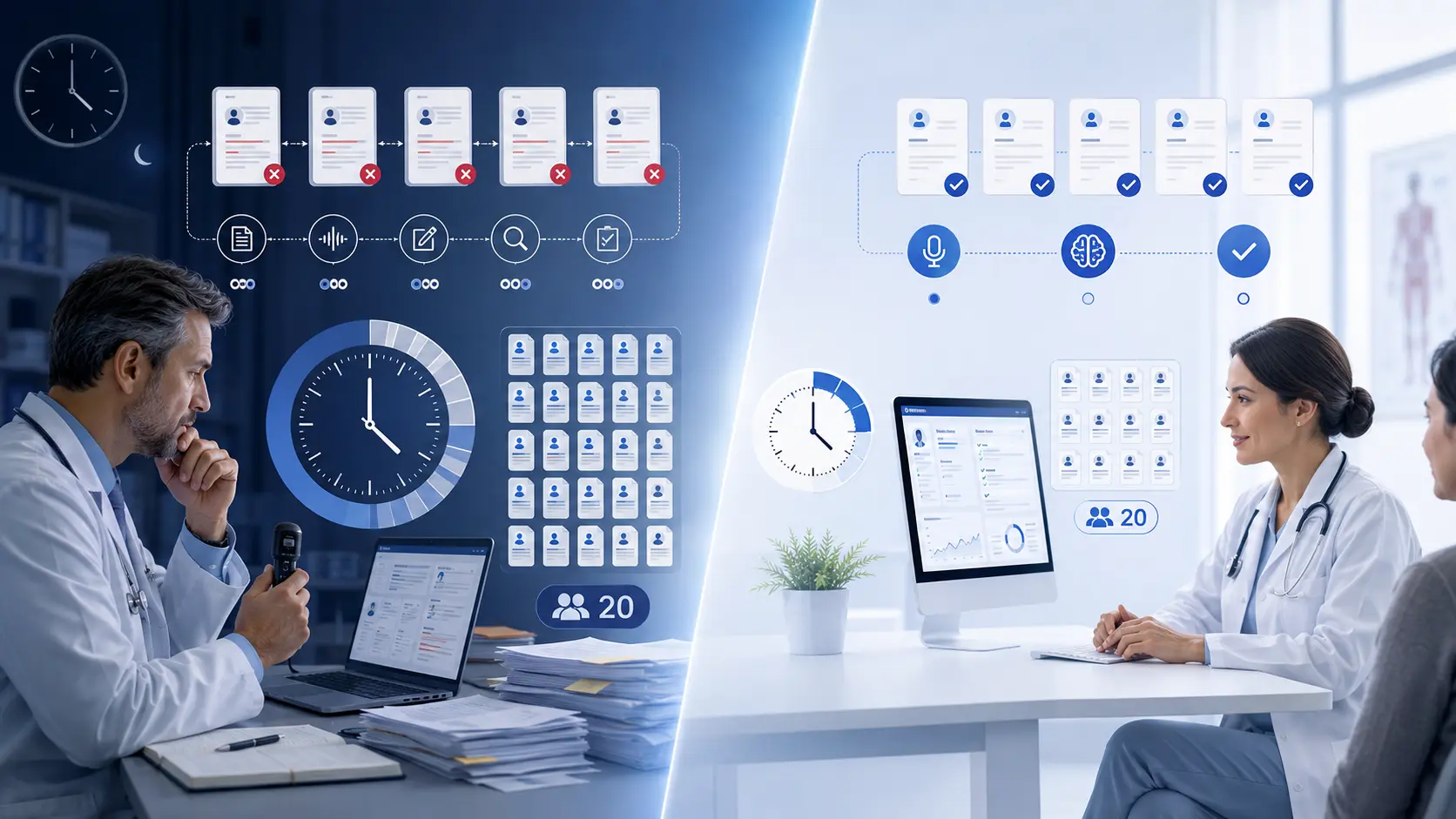
Numbers make the case clearer than adjectives. Consider a physician seeing 20 patients a day.

With manual dictation:

  • 8 to 12 minutes of dictation and review per chart
  • 20 patients x 10 minutes average = over 3 hours of documentation work
  • Most of that work happens after hours, fueling pajama time

With an ambient AI scribe:

  • 1 to 3 minutes of quick review and edit per chart
  • 20 patients x 2 minutes average = roughly 40 minutes of documentation work
  • Most charts close before the patient leaves the room
That gap, often two or more hours a day, is not a marginal improvement. It is the difference between a physician who drives home on time and one who opens a laptop at 9 PM. In any serious AI scribe comparison, this time delta is the deciding factor for practice administrators evaluating ROI.

The Charting Showdown: Manual Dictation vs. Ambient AI Scribe

Metric Manual Dictation / Voice Recognition Ambient AI Scribe
Doctor-Patient Interaction
Interrupted. Doctor pauses to dictate or types between exchanges
Uninterrupted. Doctor stays present, technology listens in the background
Data Structuring Method
Manual. Physician dictates section by section, speaks punctuation
Automatic. AI maps conversation into HPI, ROS, exam fields
Administrative Time Per Encounter
8 to 12 minutes of dictation plus review
1 to 3 minutes of review and edit
Editing Overhead
High. Physician proofreads for misheard words and grammar
Low. Clinical language model produces near-final notes
Integration with EHR Workflows
Often bolted on. Requires separate dictation software or device
Native or plug-in ambient listening tied directly to chart fields
Key Criteria for Selecting the Best AI Scribe for EHR

Key Criteria for Selecting the Best AI Scribe for EHR

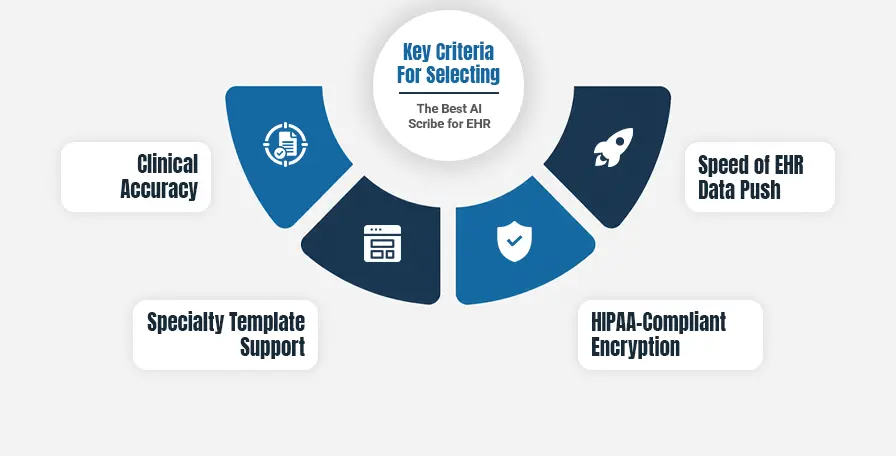
Not every ambient tool delivers on its promise. Administrators evaluating vendors should build a checklist around these criteria:

Clinical Accuracy

  • Does the AI correctly capture medical terminology, not just conversational English?
  • Can it distinguish between patient-reported symptoms and physician assessment?

Specialty Template Support

  • Does it support specialty-specific note formats, not a generic SOAP template?
  • Can templates be customized per provider or department?

HIPAA-Compliant Encryption

  • Is audio processed and stored under HIPAA-compliant security standards?
  • Where does the audio data live, and how long is it retained?

Speed of EHR Data Push

  • Does the structured note populate EHR fields automatically, or does someone still copy and paste?
  • How many clicks separate the finished conversation from a signed note?
The best AI scribe for EHR is not the one with the flashiest transcript. It is the one that plugs directly into clinical workflow without adding new steps.

The Maximus EHR Advantage: Native Ambient Integration

Most practices bolt a third-party ambient scribe onto their existing EHR. That means separate logins, separate subscriptions, and a constant risk of sync errors between the scribe tool and the chart.

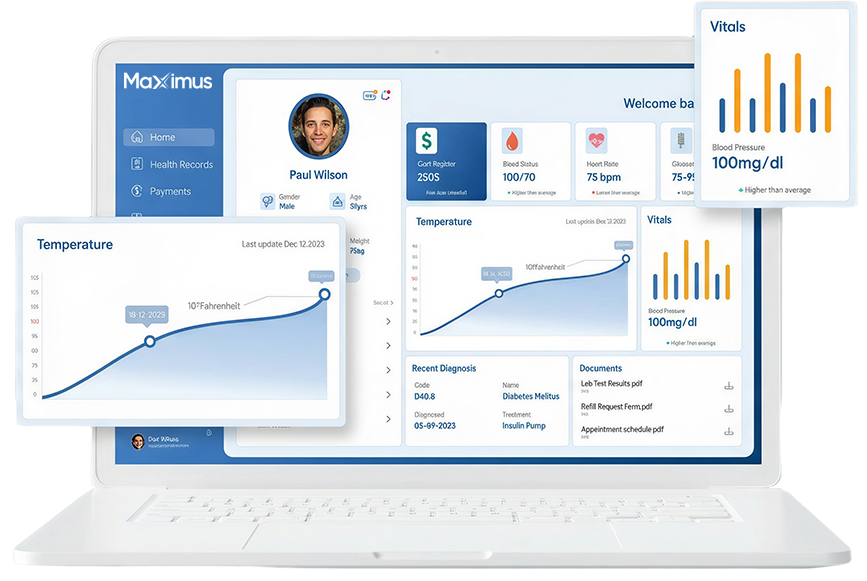
Maximus eliminates that entire layer of complexity. Ambient listening is built into the platform itself, not bolted on as an afterthought.

  • One screen, one login, zero app switching
  • Conversation-to-chart mapping happens natively inside the Maximus record
  • No separate vendor contract, no separate support line, no separate invoice
  • Structured notes populate directly into Maximus fields the moment the visit ends
  • AI-assisted documentation is paired with Maximus’s billing-native architecture, so accurate notes translate into cleaner claims downstream
This is the difference between an EHR with an AI feature and an EHR built around AI as the default charting method. Maximus was designed from the ground up as a billing-native platform, and ambient documentation extends that same philosophy: less friction, fewer disconnected tools, more time back in the physician’s day.

Stop Dictating. Start Practicing Medicine.

Every minute spent dictating, correcting, and copy-pasting is a minute stolen from patients or from your own life outside the clinic. The evidence is clear: ambient AI scribe technology closes the documentation gap that manual dictation and legacy voice recognition simply cannot.
Maximus is ready to show you exactly how much time your practice could reclaim.
  • 100% free, zero-cost data migration. Moving your existing records costs you nothing.
  • A completely free 1-month trial. Experience native ambient charting before you commit to anything.
  • A personalized, live workflow demo. See your own specialty’s documentation transformed in real time.
Book your Maximus demo today and find out what pajama time-free evenings actually feel like.

See Ambient AI Scribe in Action

Watch how Maximus EHR turns real patient conversations into structured notes without extra apps, copy-paste work, or separate dictation tools.

FAQs

Is an ambient AI scribe more accurate than voice recognition dictation?
Yes, in most real-world use. Voice recognition just transcribes words. An ambient AI scribe understands clinical context, so it knows the difference between a symptom the patient mentions and a diagnosis the physician states. That contextual layer is what cuts editing time down to minutes instead of hours.
Does an ambient AI scribe replace the need for an EHR?
No. An ambient AI scribe generates the note. The EHR stores it, structures the chart, and connects it to billing and scheduling. Maximus EHR combines both functions natively, so there is no separate scribe tool to manage on top of the record system.
How long does it take to see time savings after switching from dictation to ambient AI?
Most practices notice a difference within the first week. Physicians spend less time reviewing transcripts and more time closing charts before the patient leaves the room. Full efficiency gains typically show up once the AI adapts to a provider’s specialty and documentation style, usually within the first few weeks of regular use.
Is ambient AI scribe technology HIPAA compliant?
It should be, but not every vendor meets the same standard. Before choosing a solution, confirm how audio is encrypted, where it is stored, and how long it is retained. Maximus EHR handles ambient listening under the same HIPAA-compliant security framework that protects the rest of the patient record.
Can an ambient AI scribe handle specialty-specific documentation, like cardiology or podiatry notes?
Yes, if the platform supports specialty templates. A generic AI scribe built only for primary care will struggle with specialty terminology and exam formats. Look for a solution, like Maximus EHR, that lets templates adapt to the provider’s specialty rather than forcing every note into the same SOAP structure.

Table of Contents

Maximus | Electronic Health Record

Transform Your
Practice with
AI-Powered EHR

Reduce administrative burden, streamline workflows, accelerate revenue, and deliver exceptional patient care.